Chair Plans, Patterns, and Builds · the thousand-year build · design, 2 October 2026
1000 Year Chair
Reclaimed white oak in one thickness, square cuts and pegs, and two bolted-on upholstered panels that are meant to be renewed every generation.
Free to build, copy, change and sell. The drawings and plans are licensed Creative Commons Attribution 4.0 (CC BY 4.0): credit Karl T. Ulrich, hundredyearchair.com.
Not yet built. These are plans of the design as it stands on 2 October 2026; the plywood mock-up has been sat in daily since late September, and the seat cushion is built in its final form. The cover material, the peg species, the panel bolt positions and the ship's bell are open.
The chair
Between the fourteenth and the twenty-ninth of September the thousand-year chair changed type three times: a lounge chair on the Keel Truss, then an upholstered lounge with head support, then an armchair you sit up in. None of the changes came from an argument. All three came from sitting in something. A reclining chair needs a mechanism, and a thousand-year chair should not contain one.
The chair is built of boards in Rietveld's vocabulary: one thickness, square cuts only, every fastener exposed. What boards buy at this term is the absence of a glue line. The replaceable part is the upholstery, which really does fail on a fifteen to thirty year cycle and has a living trade to renew it. The panels also do the structure: bolted at two points into each side frame with their faces bearing on it, either one stops the chair racking.
The oak stops 50 mm short of the cushion at every free end, so the corner that meets a doorframe is the consumable. Apply that rule and the overhang rule in order and the front leg position is not a choice: the pad is placed by ergonomics, the seat board is held back from the pad, the front pin sits one stick width back from the board end, and the pin is centred on the leg.
Drawings
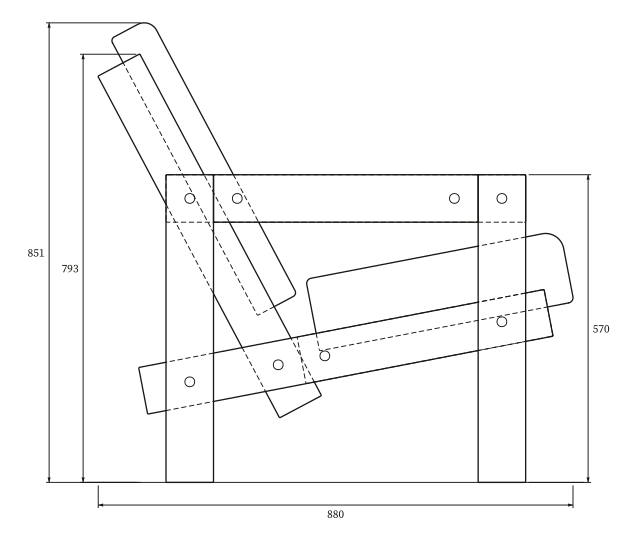
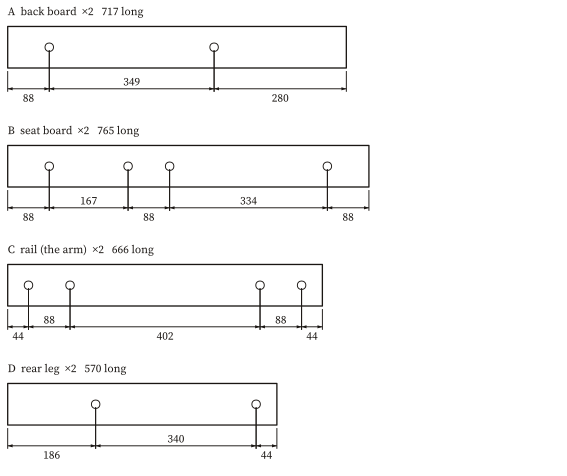
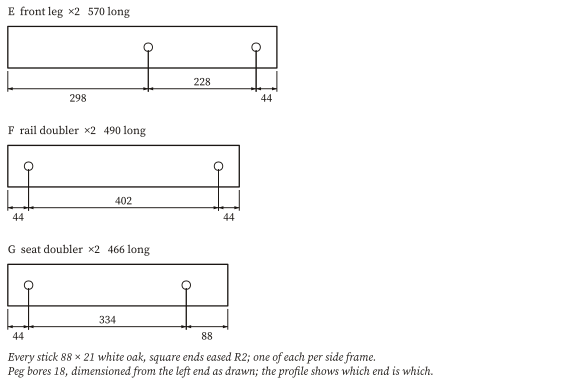
Cut list
| Part | Name | Qty | Length | Width | Thick | Note |
|---|---|---|---|---|---|---|
| A | back board | 2 | 717 | 88 | 21 | inboard layer; 2 peg bores |
| B | seat board | 2 | 765 | 88 | 21 | middle layer; 4 peg bores |
| C | rail (the arm) | 2 | 666 | 88 | 21 | middle layer; 4 peg bores |
| D | rear leg | 2 | 570 | 88 | 21 | outboard layer; 2 peg bores |
| E | front leg | 2 | 570 | 88 | 21 | outboard layer; 2 peg bores |
| F | rail doubler | 2 | 490 | 88 | 21 | outboard layer; 2 peg bores |
| G | seat doubler | 2 | 466 | 88 | 21 | inboard layer; 2 peg bores |
| seat pad | 1 | 480 | 550 | 135 | sprung, on an 18 mm plywood frame | |
| back pad | 1 | 580 | 550 | 83 | flat panel, no springs | |
| peg | 16 | 18 | riven hickory or black locust, 15 to 18, whittled to the bore |
Stock. About 12 kg of oak for the pair of side frames (5.9 kg each), in 88 × 21 mm sticks; one good beam yields the whole chair at a 30 percent yield of clear heartwood. Plywood for the two panel frames.
The inch plan. The oak section is 88 × 21 mm, given as 3 7/16 × 13/16 in; the inch plan converts every length to the nearest sixteenth.
Hardware. Sixteen pegs, 15 to 18 mm, riven hickory or black locust. Eight panel bolts, about 6 mm, partly threaded bronze machine screws, in bronze bushings through the oak and threaded inserts in the plywood.
Building it
- Select the oak. The plan calls for white oak, rift or quarter sawn heartwood, and this build uses reclaimed timber from a hand-hewn cabin. Confirm the species on a fresh crosscut with a drop of sodium nitrite before cutting anything, and select boards by weighing them, since very slow-grown ring-porous oak is lighter and weaker, not denser.
- Mill every stick to one section, 88 × 21, and cut it square to length. There are no mitres, compound angles or shaped ends. Ease the corners to about R2 with a sanding block.
- Lay out each side frame full size from the profile. Three layers: the back board and seat doubler inboard, the seat board and rail in the middle, the two legs and the rail doubler outboard. Only the angled members hang off: the seat board and back board run one full stick width past every joint they cross, while the rail and legs are squared flush with each other.
- Bore the peg holes, 18, eight to a side frame: five at the junctions and three at the doublers, with the one at the front leg serving the leg, the seat board and its doubler together. Specify the hole, not the peg; a driven peg is whittled to fit, so the bore is the number that has to survive.
- Drive the pegs: riven, not turned, in hickory or black locust, because the timber-framing standard wants peg stock no less dense than the timber it joins, and white oak on white oak is marginal.
- Bore four plain holes per panel through the oak for the panel bolts, about 6 mm, and fit each with a bronze bushing. The oak carries holes and no threads, so no thread standard can strand it; a custodian with no bolts can drive pegs through the bores instead.
- Build the seat panel on an 18 mm plywood frame: four sinuous springs crowned about 25 mm, two rows of tie wire, a non-woven insulator, 100 mm of firm foam with the corners chamfered 25 at 45 degrees, two plies of 10 mm dacron. Build the back as a flat panel with 75 mm of a softer foam and no springs. Set the threaded inserts in the plywood, so everything threaded lives in the consumable part.
- Bolt the panels on with partly threaded bronze machine screws through the bushings into the inserts, matching the metals at the insert. Either panel alone stops the chair racking; the second lets one be re-covered at a time.
- Put the document inside the upholstery, where every re-covering will find it. Each upholsterer reads what is there and adds a page.
- Finish the oak with wax, as the September specification set it; the finish has not been revisited for the armchair.
Open and estimated
- The cover: vegetable-tanned cowhide is the baseline; pieced kangaroo is under consideration.
- The peg species, and the four panel-bolt positions in each side frame, which are set with the panels.
- The ship's bell, the durable inscribed object that carries the numbers in a form that survives fire and flood. Undecided.
- Whether the oak bought is white oak at all, pending the sodium nitrite test.
Further: A Thousand-Year Brief · Old Wood, New Chair, the build so far · Appendix: The Thousand-Year Build.
Designed by Karl T. Ulrich. The drawings are generated from tools/thousand_v3_geom.py, the same parameters that will cut the parts; the chapter Old Wood, New Chair tells how they were reached. Plan of 2 October 2026. Every drawing on this page is generated from the same parameters as the PDFs and the cut list, by tools/make_plans.py. Drawings and plans by Karl T. Ulrich, hundredyearchair.com, licensed CC BY 4.0: free to copy, adapt, build and sell, with attribution.