The Hundred-Year Chair · a chapter
A Thousand-Year Chair?
A few nights a year I sleep on the ground in southern Utah, on the San Rafael Swell. It is not a mountain. It is a great blister of rock the size of a county, pushed up out of the desert and then sawn to pieces by water that mostly is not there any more. I go to look at rock art. In the family taxonomy I am a rock rat, which means I will drive a long way on a bad road to lie in a sleeping bag on sandstone and wake up stiff, and I consider this a reasonable trade.
There are big famous sites out that way. Nine Mile Canyon gets called the world's longest art gallery. It earns the name. But the panels I like are the ones with no name and no sign and no register to put your initials in. Finding them is a game I play against people who have been dead for a thousand years. I try to think like one of them. If I lived here, if I were walking this country for water and game and stone and trying, like everyone who has ever carried anything uphill, to spend as little effort as possible, which way would I go? Where is the route that costs the least? And then, somewhere along it, where is the outlook or the obvious landmark, the boulder you would gather at, the overhang you would wait out a storm under? More often than not, when I have guessed the route right, I walk up to a sheltered face of Navajo sandstone and there it is. A petroglyph, pecked into the dark rock varnish so the pale stone shows through. Sometimes a pictograph, painted on and somehow still there. A sheep, a spiral, a broad-shouldered figure with too few fingers, watching the same valley I am watching.
I do not know how old most of them are. They are older than the Fremont people who farmed this country later, and the oldest were made before anyone in that landscape planted a seed. Past that the specialists themselves keep moving: every time the dating technique improves, the oldest styles get revised younger by whole millennia. One figure out there does matter to me. To the sandstone, a thousand years is nothing. It is yesterday. I came up to this chapter, the thousand-year one, carrying an engineer's question, and the rock made me put it down and pick up a better one.

The engineer's question was: can I build a chair that lasts a thousand years? Lying on the ground under a panel that has outlived its makers, their whole people, and their entire language, I found I could not take my own question seriously in that form. The rock asked two prior questions first, and until I had bet on those, the engineering was premature. Will there be anyone at all to sit in a thousand years? And if there is, will they sit the way I do?
Two bets
Here is the first bet, and I will put real money on it while admitting it could lose. I think humans will still be here in the year 3026. Not certainly. We have invented several ways to end ourselves that the Fremont had not, and any of them could cash out. But extinction inside a single millennium seems to me the long shot, and I will take the field against it.
What I will not bet on is that I would recognize them. Look at what two hundred years did. In 1826 the fastest a message or a person could travel was the speed of a horse, most of humanity farmed, and the germ theory of disease did not exist. A thousand years is five of those intervals stacked end to end. I do not expect to recognize the language of 3026, or its gods, or its work, or the things it does for fun, any more than a Fremont forager would recognize a podcast. The culture is the disposable part. It always has been. It is the part the rock does not preserve.
And yet here is the second bet, and I will put the grocery money on this one. They will still sit. And when they do, the angle between the seat and their back will be somewhere around a hundred and five degrees, opening further the more they are resting and the less they are working. Not because of fashion, which is the most disposable thing of all, but because of the spine, which is not going anywhere. Andersson and Nachemson put pressure gauges inside the discs of the lower back in 1974 and watched the load fall as the backrest opened from a right angle toward about a hundred and ten, which is still where the review literature puts the optimum. My own lower back has voted the same ticket at the end of every long day. The Fremont sat on rock to rest, and I would bet they leaned their backs against a boulder at very close to that angle, because a tired body has been looking for that angle for as long as there have been tired bodies. A chair is a machine for holding a body at the angle it wants when it is tired. That want is older than the Fremont, and it will outlast whatever replaces us.
So the durable thing is the sitting, and the disposable thing is everything the chair means to the people around it now. That flips the whole problem. A thousand-year chair is not, at bottom, an engineering problem. It is the problem of riding a piece of furniture across a cultural gulf so wide that nothing the chair says today will still be legible on the far side, and only the body, folded at its stubborn angle, will be there to receive it.
What has actually done it
Still, the engineer in me wants to know the ceiling, so set the sitting aside and ask the narrow question. Strip away survival by burial, which teaches custody but not design, and ask what wooden things have lasted a thousand years in service, standing up, doing their jobs. The list is short and specific.
The record holder is a temple complex. The Buddhist monuments of the Horyu-ji area near Nara include several wooden structures from the late seventh and early eighth centuries, the oldest surviving wooden buildings in the world, some thirteen hundred years in continuous religious use. The wood is hinoki cypress, chosen by carpenters who understood their material's chemistry long before anyone could name it. Europe's answer is oak. A door in Westminster Abbey, dendro-dated in 2005 to timber felled after 1032 and built in the 1050s, is still in place at close to a thousand years. It has been cut down since, and now leads into a small room rather than swinging on a cathedral. The oak roof of St Mary's at Kempley, felled between 1114 and 1141, is the earliest and most complete Norman timber roof in Britain and is still over its nave at close to nine hundred. Norway's stave churches hold pine about as long; part of Urnes is built from timber of 1069 and 1070. The throne of Charlemagne has stood in its gallery at Aachen for more than twelve hundred years, marble slabs over an oak core, and served for the coronations of German kings across six centuries. And the Coronation Chair in Westminster Abbey, better than seven hundred years old and counting, is what the Abbey calls the oldest piece of furniture in the United Kingdom still used for its original purpose. Canterbury's Chair of St Augustine is a century older and also still enthrones archbishops, which the Abbey's claim survives by being stone rather than furniture. The longest-serving chair I can document is therefore about 725 years old. I have looked for one that has done a thousand years in service and cannot find it. The question mark in this chapter's title is there on purpose.
North America keeps its wood a third way, neither maintained like Horyu-ji nor used like the Coronation Chair, but abandoned into dryness. In the sheltered alcoves of the Colorado Plateau, the same desert I sleep in, Ancestral Puebloan roof beams and latillas have held their places for seven and eight centuries; ninety percent of what you see at Spruce Tree House is original material. Further south, at Tonto, the vigas in the Lower Dwelling carry tree-ring dates from 931 to 1109, which is worked wood in place past a thousand years. The dry Basketmaker caves add the perishables, woven sandals and aprons and bags that should have rotted a dozen times over and did not, because the rain never reached them and the sun never cleared the overhang. Those beams turned out to carry a bonus. Tree-ring dating was built here, in the Southwest, largely by reading them, so the wood that outlasted a thousand years also proved to be a legible record of every year it grew. I hold onto that, because a chair that carries its own cut list is trying to be the same thing, a record you can read straight off the object. This is about the only country on earth where a chair, kept dry and left alone, could plausibly reach a thousand years untouched, a temptation I will come back to once the real chair is on the table.
Two details from this census bear on the design. First, species. The survivors cluster in woods whose heartwood chemistry fights decay, the tannin-rich, tylose-plugged oaks and the phenol-rich cypresses. Species does not buy immortality; it buys tolerance of a custody lapse, the damp decade, the insect year. Second, metal. The same tannins that defend oak against rot attack iron, swelling the fastener with rust and staining the wood black around it, while copper alloys hold up far better. The Bronze Age is, among other things, a four-thousand-year materials trial that bronze passed: the little lost-wax Dancing Girl of Mohenjo-daro, four inches of tin-bronze cast around 2500 BCE, is still in the National Museum in Delhi. Oak and bronze is a pairing the sea proved a long time ago. Oak and iron is a slow chemical argument the iron always loses, and the wood loses along with it.
The Pantheon and the shrine
There are two known ways to make a wooden thing last a thousand years, and Japan shows both within a day's travel of each other.
Horyu-ji is the first way. Build from materials that endure, then maintain the single artifact forever. Many of the original atoms are simply still there, thirteen centuries on. Ise Jingu, the great Shinto shrine, is the other way entirely. Its principal buildings are torn down and rebuilt on an adjacent plot every twenty years, a practice conventionally traced to the 690s and kept up ever since, apart from one lapse during the civil wars that ran nearly two centuries; the nuns of Keikoin rebuilt the outer shrine in 1563, a hundred and twenty-nine years after its last reconstruction, and got both shrines rebuilt in 1585. No plank of Ise is old. The design is thirteen centuries old, carried not in wood but in information and ritual: the drawings, the joinery, the carpenters trained in each cycle to train the next. Ise keeps its identity in what it knows and treats the wood as a consumable.
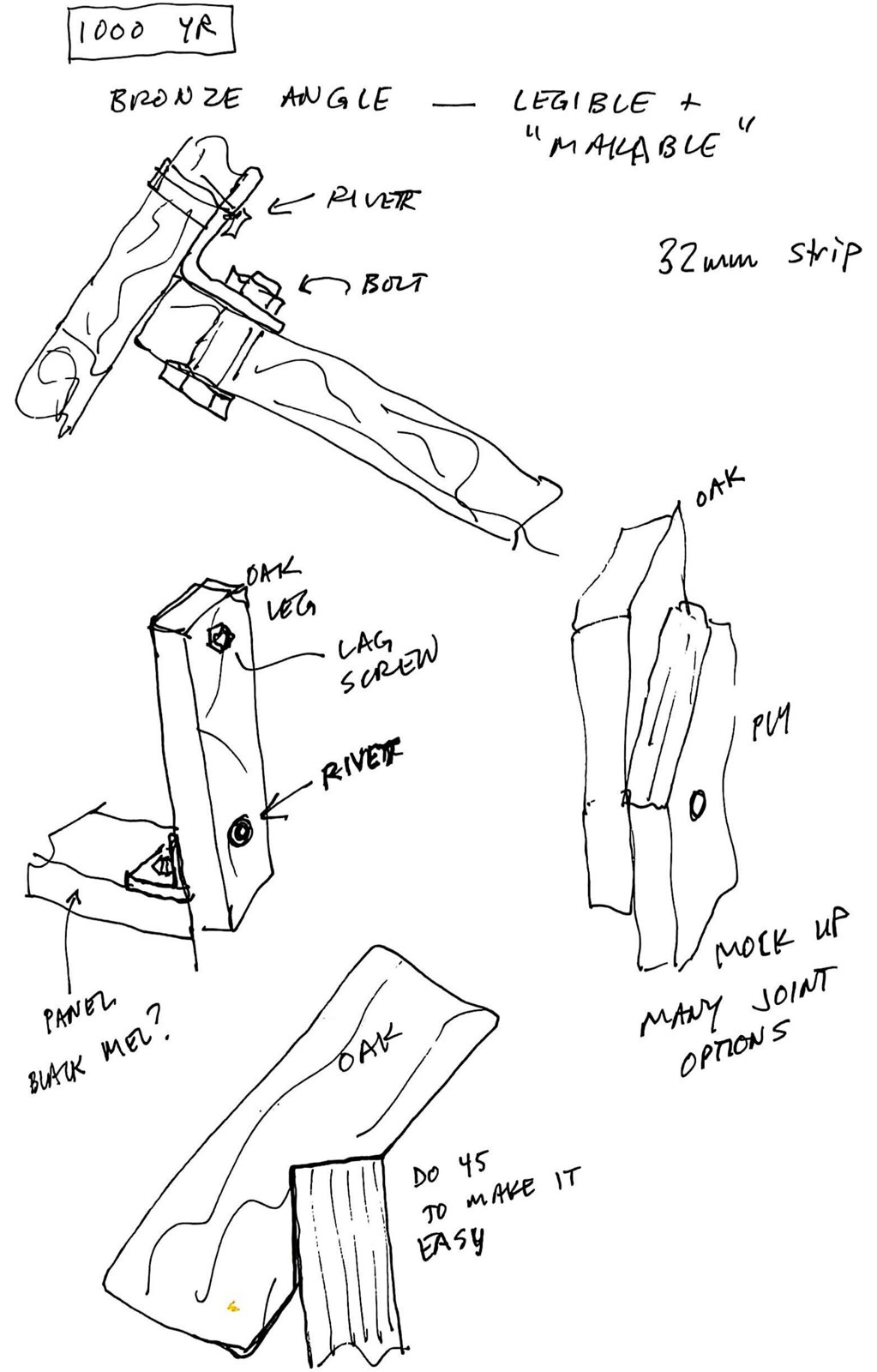
The millennium version of the chair turns out not to be some exotic special edition at all. It is the same keel chair, respecified in the woods and metals off the survivor list. The keel is white oak, quarter-sawn and solid, the Pantheon member, meant to last outright the way the Dancing Girl has. The panels are white oak as well, cross-laminated and frankly consumable, the Ise members, unbolted and replaced from any competent stock as they wear while the chair stays itself. The fasteners are bronze, never iron. And at the working joint where the two triangles meet the keel sits a single cast bronze bracket. I have come to call it the chair's ship's bell: the durable, inscribed piece that rings the object's identity forward across the centuries. The keel can also be read as both the enduring atoms and the surviving information at once, which is the coda's argument and not mine to make here.
The clock in the mountain
The deepest sustained thinking anyone has done about millennial objects is the Long Now Foundation's 10,000 Year Clock, Danny Hillis's mechanical clock now being built into a mountain in west Texas. The Long Now was co-founded by Stewart Brand, whose account of how buildings and institutions endure I come back to in the coda; the clock is that same lifelong question aimed ten thousand years out. Its published design principles read like a checklist written for this chapter. It should keep good time for ten thousand years. It should be maintainable with Bronze-Age technology. Its workings should be discoverable by close inspection. It should be improvable over time. And the same design should scale from a tabletop to a monument.
Two of these the chair had already backed into on its own. A bronze bolt with a slotted head, a bronze wood screw any ground blade can drive, and plain cylindrical holes that outlast every thread standard are precisely "maintainable with Bronze-Age technology." And a truss whose statics you can read in its silhouette, whose joints show their bolts, whose one bronze bracket carries the chair's own dimensions cast into it, is the clock's transparency: repairable by inspection, with no surviving company or manual assumed.
But the clock also carries a warning the chair cannot dodge. Hillis put it in one sentence in 1995: "The only way to survive over the long run is to be made of materials large and worthless, like Stonehenge and the Pyramids, or to become lost." The clock accordingly shuns precious materials and hides in a mountain besides. Bronze fails this test on purpose. Bronze has scrap value, and scrap value is a custody hazard. Nazi Germany confiscated more than 175,000 church bells between 1939 and 1945 and destroyed over 150,000 of them, and a chair carrying a bronze bracket and a fistful of bronze screws is, in a desperate year, a small pour of metal waiting to happen. The clock's survival strategy is to be unreachable. A chair cannot take that strategy, because a chair that is hidden has stopped being a chair. So the chair has to run the opposite play. It has to be re-wanted, generation after generation, loved expensively enough that melting it never occurs to anyone. The tomb hides, the mountain hides, the institution guards, the market prices, and the chair charms. Custody is not one strategy but a portfolio, and the chair is holding the riskiest and most human asset in it.
Even "worthless" is not a stable defense, as the Silk Road caves show. The Mogao grottoes at Dunhuang were dug and painted across roughly a thousand years and then took some of their worst damage in a few modern decades: soldiers billeted in them in 1921, and in 1924 a set of frescoes that Langdon Warner lifted off the walls with a chemical solution and carried back to the Fogg. To a garrison the shrine was shelter; to a collector the paint was a career; to the market the sealed library cave was money. Nothing is worthless to a desperate year. The lesson the chair actually needs is sharper than the clock's: an object survives only while its highest-value use is to go on being itself. The defense is not worthlessness, which cannot be engineered anyway, but meaning dense enough that no other use of the thing ever wins the auction.
What a thousand years requires
The census, the shrine and the clock compress into four requirements. I have ordered them from the outside in, from the social to the metallurgical. That is the order in which they kill.
1. Custody, engineered, forty times consecutively. Everything else is conditional on someone deciding the chair is worth keeping dry. At a hundred years that is three or four handovers and a family can carry it. At a thousand it is roughly forty in a row, and forty consecutive coin flips is a different kind of problem: the chair has to recruit its own custodians on sight, from strangers, in centuries whose language it will not speak. Beauty is not decoration here. It is the mechanism.
2. Repairable with any century's tools. Assume no company, no catalog, no matching driver bit. Every wear surface lives in a replaceable part; the fastener is a bronze bolt or wood screw a smith could forge; the drive is a slot any blade fits; a wallowed hole is bushed and drilled again. The dependency chain has to end at a person with a file.
3. Robust to standards drift. Betting that a metric M6 thread still exists in 3026 is a fair bet, and the design does not lean on it. The plain hole predates and will outlast every thread standard. A bronze bolt can be recut to whatever thread survives, or dropped for a wood screw or a driven peg. The spec is cast into the bronze bracket, so the standard travels with the object. Redundancy of information rather than optimism about standards.
4. Failure in the right order. The chair should fail fastener before panel, panel before keel, and nothing before the geometry. What the thousand-year term adds to that ordering is the honesty of saying which parts are meant to die. The bronze screws are consumables. The white oak panels are Ise, meant to be renewed on a cycle. The keel and its bronze bell are Horyu-ji, meant to last outright. Retightening once a generation is not maintenance overhead; it is the small ritual that keeps a custodian's hand on the object, the shrine rebuilt in miniature.
Species and metal the census already settled: white oak and hinoki off the survivor list, bronze and never iron anywhere it touches tannic wood, no glue in the permanent members, no pivots, end grain sealed.
The millennium bill of materials
Which yields a chair I can specify without hand-waving, and a plainer one than the census might lead you to expect. A single white oak keel, quarter-sawn, carrying the whole geometry in its fish-mouth cuts. White oak cross-laminated panels for the seat and back, sized to be unbolted and replaced from ordinary stock when they wear, which across a thousand years they certainly will. Bronze wood screws, or bronze bolts in plain holes, in place of the steel the hundred-year chair gets away with. And one cast bronze bracket at the keel's working joint, the chair's ship's bell, carrying the load and, cast into its face, the numbers needed to build the next of everything around it. No iron anywhere it touches the oak, no pivots, and no glue outside the panels that are meant to be replaced. One screwdriver to build it, one per century to keep it. A bracket and a handful of screws is well under a kilogram of bronze, small enough to be a poor theft and personal enough to be a fine inheritance.
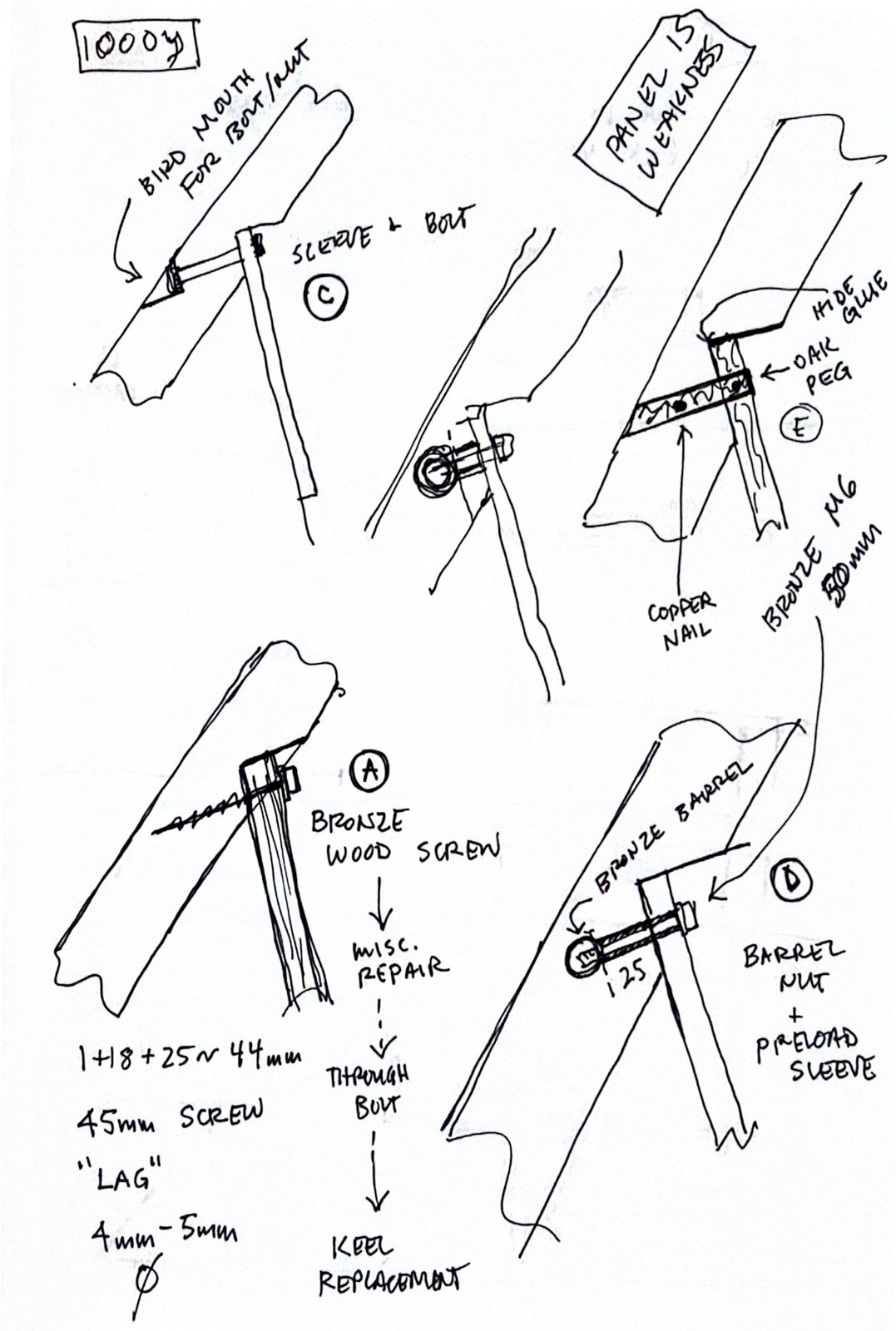
And the same geometry, cut instead from a salvaged panel and pinned with hardware-store barrel bolts, is the same chair one strategy over. The information is identical; only the custody bet is different. At a hundred years the chair is atoms with a warranty. At a thousand years the chair is information wearing whatever atoms the century can spare.
The desert would keep it
There is a shortcut hidden in that census, and I have stood in the alcoves that offer it. Build the chair as well as I know how, carry it out to a dry overhang on Cedar Mesa or some unnamed shelf like it, set it back where the rain has not reached in a thousand years and the sun never clears the lip, protect it from the one predator that matters now, which is us, and walk away. The physics would very likely deliver. Ten centuries on, someone lifts a cover and there it is, unfaded, every panel original, the joints still tight, a chair in perfect condition because it was never once asked to be a chair.
And by the whole argument of this book, that is a failure dressed as a triumph. A chair that may not be sat in has already quit being a chair; it buys its thousand years by dying first, the way a pinned butterfly buys permanence by giving up flight. The longevity I care about is not the survival of a sealed object in a dry room. It is delivery on the triad, lovable and legible and maintainable, out in a world full of the very people the time capsule was built to hide from. And a chair that lasts that way, in the weather of use, will almost certainly not be the same chair at the end. It will be a ship of Theseus, its panels renewed a dozen times and its keel carried on, loved forward rather than sealed away. The desert can keep a relic without any help from me. Only people can keep a chair, and only by using it up and remaking it. That is the harder trick.
Back to the rock
Which returns me to the sandstone, and to the thing I actually envy out there. The petroglyph carries no instructions at all. It has no cut list, no dimensions, no clue to its own making. It outlived its maker, its maker's whole people, and its maker's language, and it did the whole thousand years on nothing but meaning, on the fact that whoever came after found it worth not destroying. My chair makes the opposite bet. It ships its own cut list cast in bronze, it buys its own repair with slots and files, it engineers everything the rock left to luck. And in exchange it takes on the one liability the rock does not carry, because meaning is the single thing you cannot cast into a bracket. The chair has to earn its meaning again in every generation, or it goes to the furnace no matter how cleverly its bell is cast.
The Fremont left a mark and no chair. I am trying to leave a chair and, cast into its one bronze bell, a mark. Whether anyone in 3026 sits in that particular chair, I have no idea, and the rock has cured me of pretending otherwise. But that they will sit, and that they will sit at about a hundred and five degrees against something built or found to hold them there, I will still bet the grocery money. And if one of them ever stands over a sheltered rock and tries to think like me, reading my route, minimizing my effort, guessing where I would have stopped to rest, I would like the chair to be there at the obvious landmark, still doing the one thing that never went out of style, holding a tired body at the angle a tired body has always wanted.
Every claim in this chapter was checked against institutional or primary sources on 6 September 2026 and eleven were found to overreach; all eleven are corrected above. Fremont culture roughly 300 to 1300 CE (Natural History Museum of Utah). Barrier Canyon Style, long attributed to the Desert Archaic, has been dated dramatically younger, to roughly 0 to 1100 CE by luminescence (Pederson and Simms, PNAS, 2014), so the chapter claims only "older than the Fremont." The disc-pressure work is Andersson, Ortengren, Nachemson and Elfstrom, "Lumbar disc pressure and myoelectric back muscle activity during sitting. I. Studies on an experimental chair," Scandinavian Journal of Rehabilitation Medicine 6(3), 1974, 104 to 114; the modern review putting the optimum at 110 to 130 degrees with 110 preferable is Harrison and colleagues, Journal of Manipulative and Physiological Therapeutics 22(9), 1999, 594 to 609. No numeric pressure values are quoted here, because the 1974 paper's figures could not be obtained in the original [pull it before print if any number is wanted].
Horyu-ji: the ICOMOS evaluation for World Heritage site 660 states the eleven pre-eighth- century buildings "may justifiably be claimed to be the oldest surviving wooden buildings in the world"; the UNESCO list entry itself hedges to "some of the oldest." Hinoki rests on the temple carpenter Tsunekazu Nishioka, quoted by Kyoto University, rather than on the Agency for Cultural Affairs [thinly sourced]. Westminster Abbey door: dendro-dated in 2005, timber felled after 1032, built in the 1050s, since cut down; the Abbey says nothing about it still swinging, which the chapter no longer claims. St Mary at Kempley: oak felled 1114 to 1141, the earliest and most complete Norman timber roof in Britain (English Heritage; Morley and Miles, Antiquaries Journal 80, 2000). Urnes: part of the church built from timber of 1069 and 1070 (NTNU dendrochronology). Coronation Chair: the Abbey claims oldest piece of furniture in the United Kingdom still used for its original purpose, not in the world, and the chapter now says so; Canterbury's Chair of St Augustine, c. 1201 to 1204, is older and also still in use, and is stone. Spruce Tree House at ninety percent original material and Tonto's Lower Dwelling vigas at tree-ring dates 931 to 1109 are the National Park Service. Dendrochronology and A. E. Douglass: University of Arizona Laboratory of Tree-Ring Research. Dancing Girl: tin-bronze, lost wax, about four inches, c. 2500 BCE, National Museum Delhi (Smarthistory); no source states it is undamaged, so the chapter no longer says so. Ise Jingu: the twenty-year cycle and the adjacent kodenchi are the shrine own account; the 690 date is conventional rather than institutional, hence "the 690s"; the interruption and the Keikoin nuns rebuilding of 1563 and 1585 are Andrei, Religions 13(7), 2022, 585. Long Now: founded 1996 by Brand, Hillis and Eno; the five design principles are quoted from longnow.org/clock/principles. The Hillis sentence is verbatim from "The Millennium Clock," Long Now, 16 February 1995. Church bells: more than 175,000 confiscated and over 150,000 destroyed by Nazi Germany between 1939 and 1945 (National Bell Festival); the First World War requisitions are real but the chapter no longer claims them, pending a citation. Mogao: soldiers billeted 1921 (Wikipedia only); Langdon Warner 1924 removal and the Fogg destination are Harvard Art Museums, and the method is given as a chemical solution rather than the unsourced "chemical cloth."
A chapter of The Hundred-Year Chair, drafted and refined in public. The same text lives in the book; the interactive tools and the fully-sourced technical notes live here. home · the book · the technical notes · hundredyearchair.com