The Hundred-Year Chair · a chapter
Old Wood, New Chair
By late September I was sitting every day in a plywood mock-up of the thousand-year chair. The oak was still to come. Plywood let me change the chair while I was deciding what kind of chair I wanted.
I had started toward a lounge chair, then added upholstery, head support, and an ottoman. My favorite recliner was the reference. A tall back on the mock-up supported my head, but I found it comfortable in only one position. To lean farther back and sleep, I wanted the movement of the recliner itself. I did not want to build that mechanism into this chair. I settled on an armchair for conversation and work, with a lower back and level arms that could carry a board for a laptop.
The back height needed sitting to resolve too. I had calculated it from shoulder height, then found that my upper back stopped touching the flat support below that point. I was measuring a body dimension when I needed to know where my body met the chair. For the back angle I used pieces of eighteen-millimeter plywood as shims. After fussing with the mock-up, I wanted the back brought forward by about four degrees. The drawing could record the angle after I chose it.
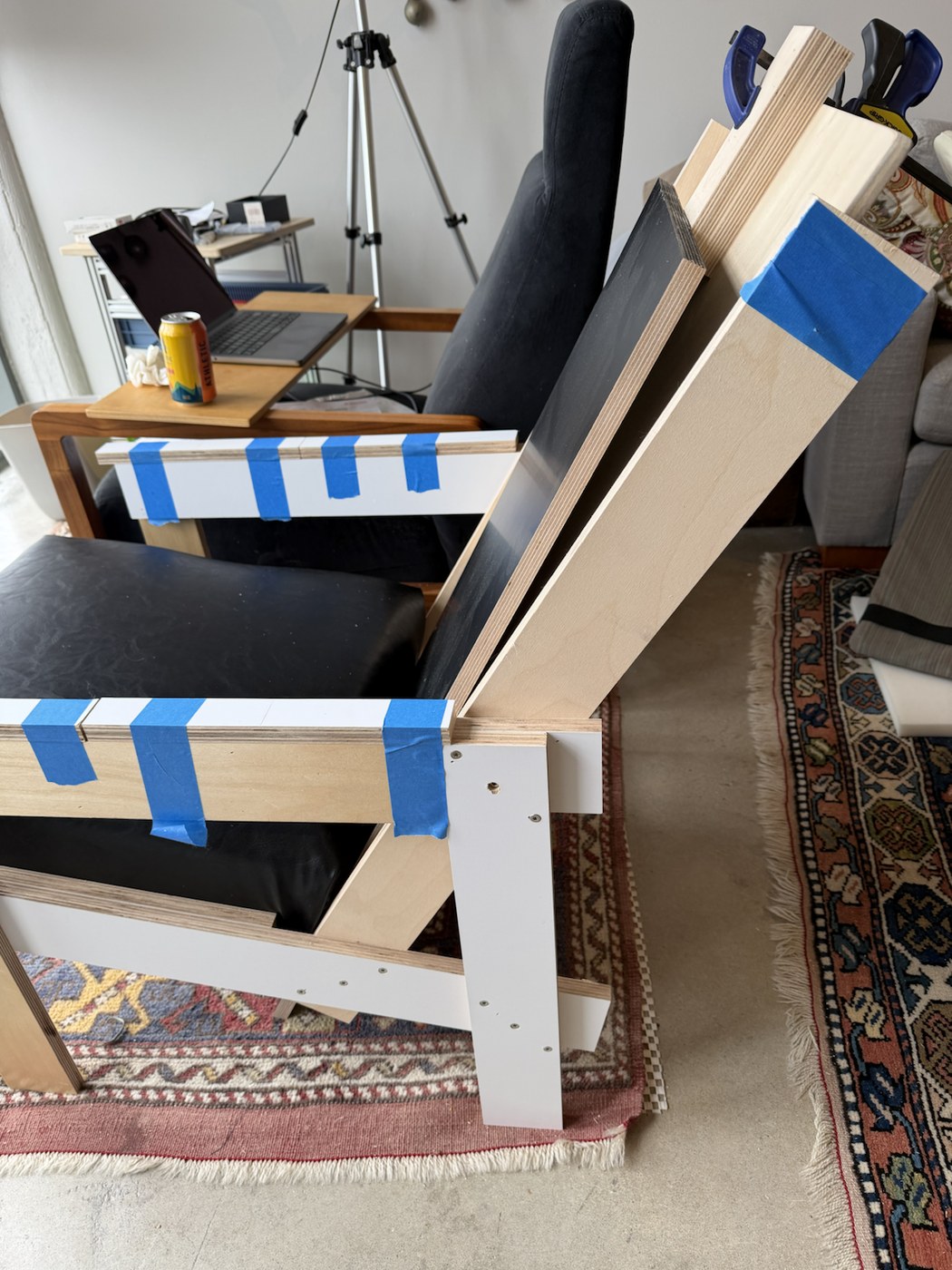
The cushion made those dimensions harder to keep straight. The top of the seat with me sitting on it was not the face of the panel beneath it, nor the surface of the unoccupied cushion. The drawing needed to distinguish all three. Otherwise I could specify the right angle for the wrong surface and discover the error only after making the frame.
The cushion could also change shape under me. If it compressed more beneath my pelvis than beneath my thighs, a level pad would become a wedge, changing the effective seat angle as well as its height. Its thickness in a catalog would not tell me that shape. The foam's firmness, the distribution of my weight, and the support beneath it would all matter. A back cushion would move me forward relative to the arms too. I needed to judge the frame and cushions together, with me sitting in them.
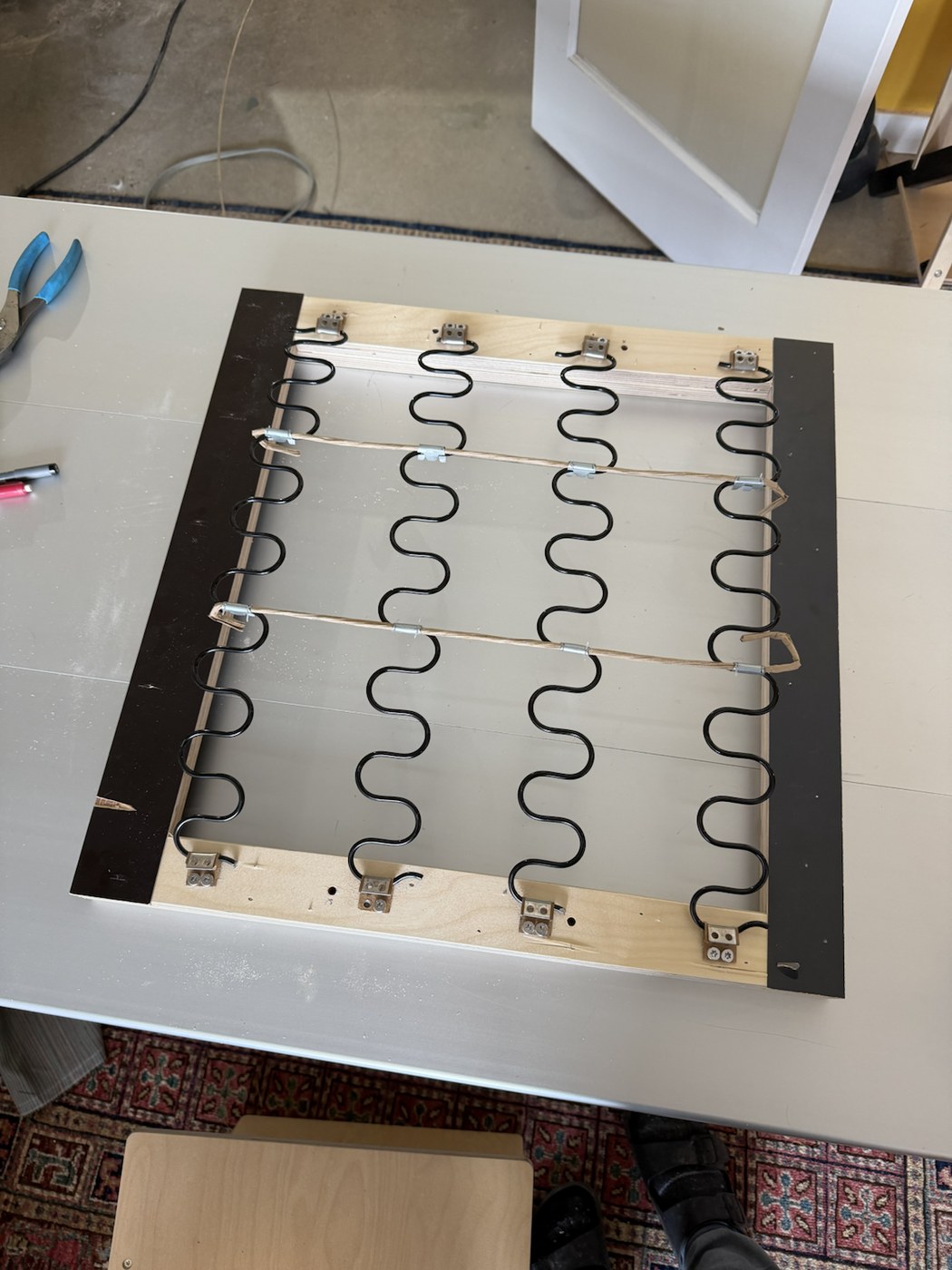
I built the seat on a plywood frame with four sinuous springs, the familiar zigzag wires, connected by two rows of ties. Over them went an insulating layer, firm foam, and batting. This was something I could sit on while the oak frame remained a drawing. The back would have foam without springs. I was still choosing the final covering.
The proposed oak frame had become a refinement of Kratstoel: flat boards, square ends, and visible connections. The current drawing uses boards 88 millimeters wide and 21 thick, overlapping in three layers at each side. The angled boards project beyond their crossings. I could keep the square cuts without trying to make every end finish flush against a sloping neighbor. The cushions extend beyond the oak at the front of the seat and the top of the back.
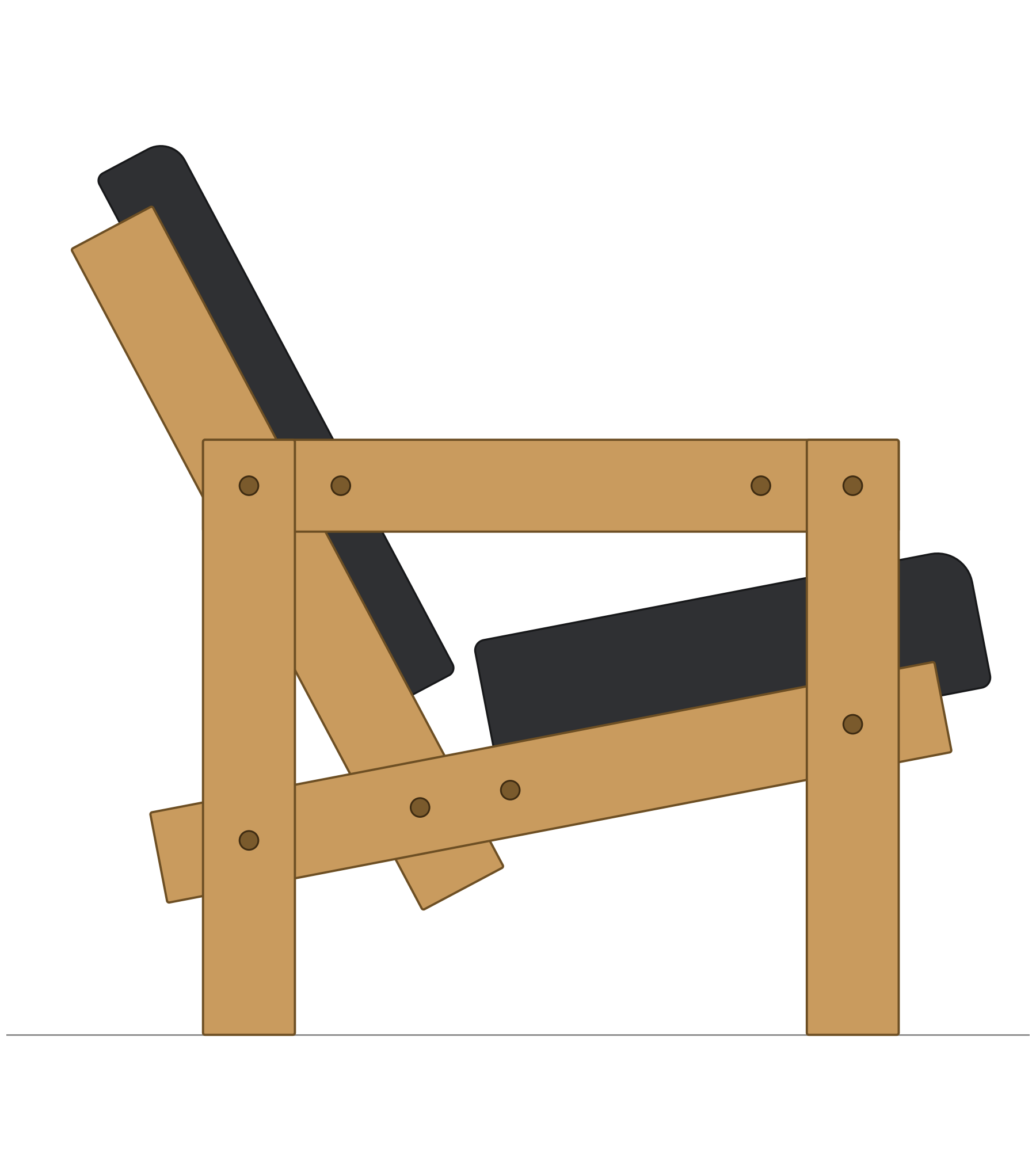
I had considered closing the frame joints with copper rivets. What bothered me was the repair: someone would need to recognize the fastening, obtain the pieces, and know how to close a new rivet. I preferred wooden pegs for this frame. The drawing shows eight per side, including those holding the extra pieces that thicken the arm and seat rails. The peg material and fit still needed to be settled in wood.
The cushion attachments would be different. My plan called for four bolts per module, passing through the oak into threaded fittings in the replaceable seat or back. I wanted the threads in the part likely to be renewed, leaving plain holes in the frame. Bronze sleeves in those holes were part of the proposal. I still needed to make the connections, check how the panels braced the two sides, and take them apart again.
For the frame I had ordered a hundred board feet of reclaimed timber, sold as white oak. This shipment was from Ohio, not Minnesota. The history supplied with it describes the John Walling log house, built in the 1830s, dismantled in 1972, and rebuilt in Highland County, Ohio. A separate shipment was coming from Minnesota. I had initially confused the two and would need to keep their histories, and the boards I used from each, separate.
I thought the Ohio lot might yield enough wood for three or four chairs. That depended on what remained after preparing it. I still needed to inspect the timber, confirm the wood identification, and see which parts of the hewn logs could become sound chair members. A hundred board feet of old building was not yet a stack of boards I could cut to the drawing.
I estimated that the trees might have been a hundred to two hundred years old when felled. If they were cut for the cabin in the 1830s, some of the wood might reach back three or four centuries. I wanted to investigate the rings, partly because I found the prospect fascinating. The house history could tell me about a building; it could not date each ring or show what had been lost when a log was hewn. I would like to mill some of the oak and keep a record of where the boards came from.
For now, the chair I used was still plywood. The seat assembly was built, and I had revised the drawing after the sitting trials. The oak, the pegs, and the removable panels still had to work together. There was also the question of what information I could leave with them, and where to put it.
Notes
- "sitting every day": Author's supplied draft, "The Thousand-Year Build," dated October 2, 2026, summarizing the September 14 to October 2 design sessions. Its closing status identifies a plywood mock-up used daily since late September and a built seat assembly. This is an interim account, not evidence that the oak chair has been built.
- "My favorite recliner": Author's supplied October 2 build draft, sections "A chair you sit up in" and "The parameters," describing the changing purpose, tall-back trial, shoulder-height calculation, observed back contact, and shimming. The four-degree change is rounded from the reported 36-millimeter adjustment over 510 millimeters. [VERIFY] Match the trial chronology and dimensional record to the dated notebook or session before publication. No general claim about anatomy or a prescribed posture is made.
- "The plywood mock-up during": Project photograph IMG_3999.HEIC from the author's photo inbox, visually inspected October 2, 2026. The caption describes the visible temporary assembly without assigning a precise capture date or claiming it matches every feature of the current drawing. [VERIFY] Confirm capture date and photographer credit before publication. The reading edition uses a resized derivative with embedded metadata removed.
- "distinguish all three": Author's October 2 build draft and thousand-year-armchair-v3-layout.py, which distinguishes loaded contact surfaces, free upholstery surfaces, and panel faces. These are model inputs and derived geometry, not independently measured compression data for all occupants.
- "a level pad would become a wedge": Author's conditional geometric reasoning, relocated from So Similar, Yet So Different on October 4, not a measured compression profile. Polyurethane Foam Association, "Foam Performance," https://pfa.org/foam-performance/, describes firmness and compression-load testing. Eun-ji Go and Sang-Heon Lee, "Effects on sitting pressure distribution during the application of different cushions and anterior height wedges," Journal of Physical Therapy Science 29(3), 2017, pp. 390–393, https://doi.org/10.1589/jpts.29.390, measures pressure distribution, not cushion deflection. [VERIFY] Record the actual cushion's shape under a sitter; neither source establishes a universal compression percentage or the effective angle of this seat. References are carried forward from the earlier chapter's note, not independently rechecked in this relocation pass.
- "four sinuous springs": Author's October 2 build account and project photograph IMG_3991.HEIC, visually inspected October 2. Four springs and two transverse tie rows are visible. The draft describes the insulation, foam, and batting added above them and distinguishes the spring seat from the proposed foam-only back. [VERIFY] Confirm the completed seat's layer specification, trial record, photograph date, and credit; no quantified spring capacity is claimed here. The reproduced photograph has embedded metadata removed.
- "88 millimeters wide and 21 thick": Current project geometry in thousand-year-armchair-v3-sticks.py, which sets W_REF to 88 and THICK to 21 and assigns overlapping layers; thousand-year-armchair-v3-profile.py draws the eight peg positions per side. The source draft's unqualified eight-peg total is clarified here as a per-side count. [VERIFY] Reconcile the final cut list, joint layout, clearances, and dimensions against the physical build before issuing construction instructions.
- "proposed armchair in profile": Project drawing thousand-year-armchair-v3-profile.png, supplied with the October 2 build draft and visually inspected against the caption. It depicts the proposed oak version, not the plywood mock-up or a completed oak chair. The source scripts retain older comments and should not be treated as a finalized manufacturing packet.
- "closing the frame joints": Author's October 2 build draft describes considering copper rivets and preferring wooden pegs for perceived future repairability. The September 29 scratch pad names oak pegs, whereas the new draft considers other species. [VERIFY] Record the final species, diameter, grain, fit, retention method, repair procedure, and physical joint checks. The passage does not certify a joint strength or a service life.
- "four bolts per module": Proposed cushion interface in the supplied October 2 build draft. [VERIFY] Establish the final hardware, sleeves, threaded fittings, access, panel-to-frame bearing, lateral restraint, and removal sequence in the actual build. Proposed plain bores and renewable fittings do not establish compatibility with every future replacement or adequate rigidity without testing.
- "a hundred board feet": Author's September 29, 2026 shipment report and geographic correction. The 100-board-foot lot is Ohio; a separate Minnesota shipment has been reported. The new build draft conflates the material narrative and introduces an unsupported Minnesota cabin date. That date and its species-specific age calculation are not adopted here. Neither shipment's arrival is confirmed by this account.
- "John Walling log house": Supplied "John Walling History_0005.jpg," headed "The John Walling Log House," re-inspected October 2, 2026. It dates construction to the 1830s and describes dismantling, relocation to Highland County, Ohio, and rebuilding in 1972. [VERIFY] Establish the account's author, publication, date, and pages, and retain the supplier record linking the purchased lot to the house. This source does not describe the Minnesota material.
- "three or four chairs": Author's estimated yield, not a result of milling. The source draft also says the purchased oak's species remains unconfirmed. [VERIFY] Record the actual species identification, condition, preparation losses, and usable yield by lot; the seller's white-oak description is not an independent identification.
- "a hundred to two hundred": Author's estimate of tree age at felling. The three-to-four-century interval is conditional on that estimate and on felling for the cabin in the 1830s, not a dendrochronological finding or the age of every fiber. Ring dating and milling remain planned; the account does not imply that an old log makes a newly built chair old.
A chapter of The Hundred-Year Chair, drafted and refined in public. The same text lives in the book; the interactive tools and the fully-sourced technical notes live here. home · the book · the technical notes · hundredyearchair.com