The Hundred-Year Chair · a chapter
Ten Thousand Years of Sitting
I can hold a resting squat, flat-footed, for about a hundred and twenty seconds. I know the number because I have timed it. My wife can hold one for as long as a conversation lasts. Wendy was raised in mainland China. She folds down onto her heels to weed the garden, to sort the mail, to wait for a suitcase at baggage claim, and stands back up without a thought, the way you or I stand up from a chair. For her it is rest. For me it is a yoga pose. I can get most of the way there with a cheat, a running shoe with enough heel to tip my toes down, or a spot of ground that slopes away so my ankles do not have to bend as far, and on a good day I can almost get my heels flat. At two minutes my calves give out. Looking around Terminal E at the Philadelphia airport, I would guess I am in the top one percent of sixty-something American men at this particular skill.
I could not stop wondering, watching Wendy, whether this was in her somehow, a thing written in the blood. Was there some mutation in the Han line ten thousand years ago that kept the hips and ankles open, that let a whole civilization rest on its heels while mine forgot how? The idea is wrong. The evidence is my own body. I did the 23andMe test. I do not carry a drop of Asian ancestry; I am seven-eighths British Isles and one-eighth German, entirely northwestern European, the population that arguably invented the dining chair and then sat in it until it could not squat any more. And yet, with a running shoe and a month of stubbornness, I trained my own heels nearly flat. If a pure product of the chair-sitting nations can claw the squat back in his sixties, the squat is not something a person needs the right ancestry for. It is a practice. Wendy kept hers by never stopping. I lost most of mine to a lifetime of chairs. Before I could ask how to build a chair that lasts a hundred years, I had to ask a question I had never once thought to ask: why are there chairs at all?
I had assumed the chair was simply obvious, a thing that has always been there, like the spoon. The spoon nearly qualifies. Its Latin name, cochlear, is the word for a snail shell, and bone spoons carved in the Near East are older than farming: a found object that people eventually learned to make. The chair is younger. I am a designer, not a historian or an anthropologist, but after digging a bit I came to believe the chair is not obvious. I mark the places where I am guessing.
Sitting up is very old, and nearly everywhere
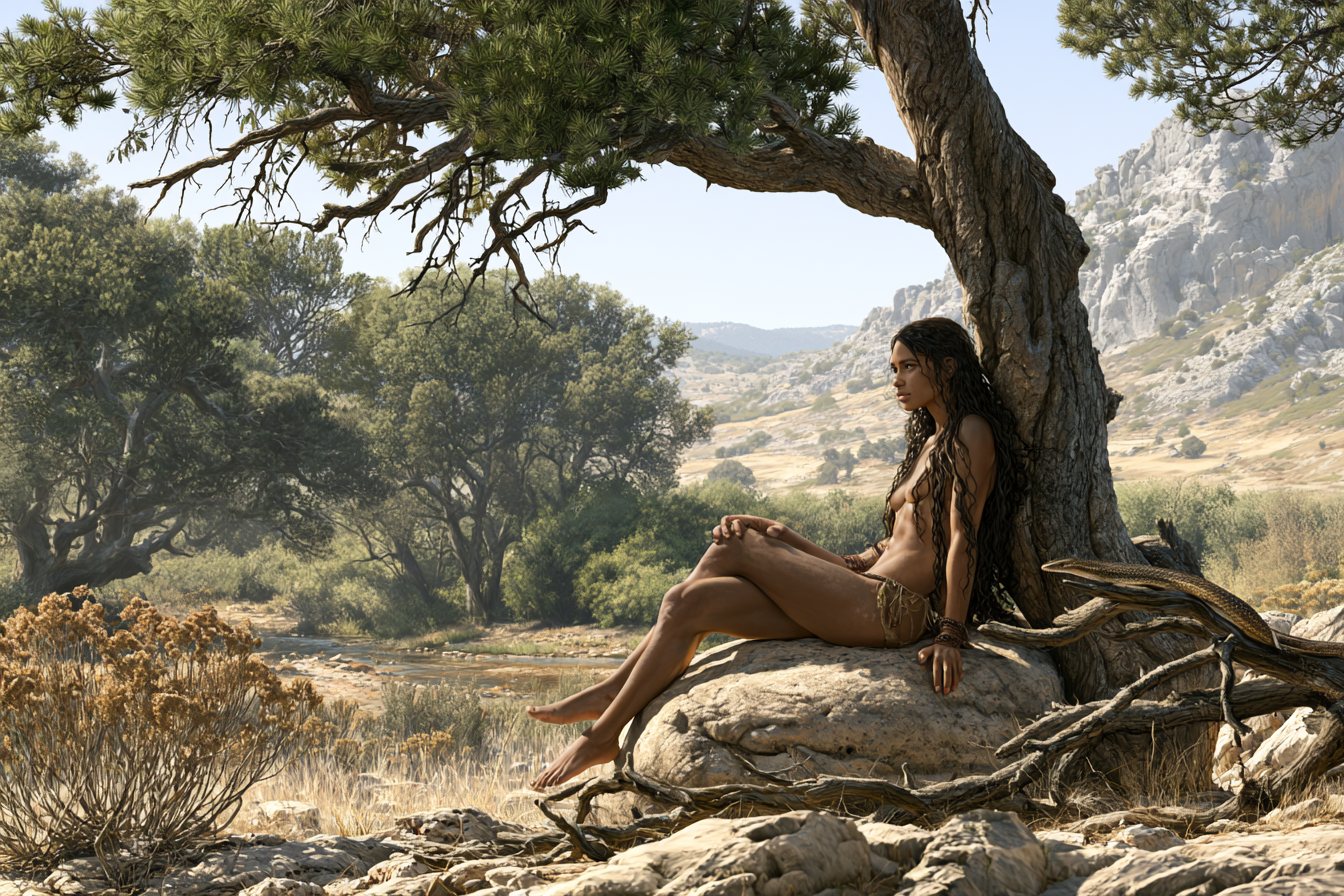
Start with the body. A human being cannot comfortably stand all day, and lying down is for sleeping, so for the long middle of the day we fold ourselves into some intermediate posture. The ways to do that are few. You can sit on the ground. You can squat, as Wendy does. Or you can get your seat up off the ground onto something: a rock, a log, a stump, a step, a raised surface built for the purpose. That last move, raising the body to sit, is what a chair is. I am fairly confident it is not the invention of any one culture or century. It is a thing bodies discover wherever there is a boulder at the right height. Some ancestor of ours lowered herself onto a convenient rock in the Pleistocene and felt the relief you feel dropping into a chair after standing too long. The chair is that rock, refined.
It is fashionable to say the chair is a Western thing, a marker of one civilization. Raised seats of honor turn up almost everywhere people built anything at all. The pharaohs of Egypt sat in chairs so fine that a few are still with us. The golden throne from Tutankhamun's tomb, a wooden armchair sheathed in gold and inlaid with colored glass and stone, is roughly thirty-three centuries old, and Howard Carter brought it out of the ground in 1922. The throne turns up in the East just as firmly: the Dragon Throne at the center of the Hall of Supreme Harmony in the Forbidden City, the canopied takamikura in which the Japanese emperor is still enthroned. I have stood in Westminster Abbey and looked closely at the Coronation Chair, seven centuries old and covered, if you get near enough, in the carved graffiti of schoolboys and visitors. The chair as the raised place from which one person addresses the rest is close to a human universal. To sit above the others is to be above them, and every culture that had rulers found that out.
The language carries the same fact, fossilized. Our word chair runs back through the Old French chaiere to the Latin cathedra and before that the Greek kathedra, a seat, and specifically the exalted seat of a person of rank. That is the same cathedra that gives a cathedral its name, the church that holds a bishop's chair. Throne comes from the Greek thronos, an elevated seat. So when we say a professor holds a chair, or that someone chairs a meeting, we are not borrowing a metaphor from furniture. The furniture and the metaphor come from the same old fact, that the one who sits raised is the one in charge. The word for the seat became the word for the authority long before it became the word for the thing you buy in a set of four. The chair is not a Western object. It is a human one, with enormous variation in how much it matters and to whom.
Two angles and a height
Ten thousand years of raising the body onto something also settled how high the something should be and how it should tip, because the body doing the sitting has not changed. The numbers are few. A seat wants to be about the height of the back of the knee, which for the median adult comes to around 440 millimeters; the traditional range for a dining chair runs from 430 to 460, and a seat a little low is forgiven more readily than one that leaves the feet dangling. The seat pan tips back a few degrees so the sitter does not slide forward. The back opens past ninety. How far past depends on what the sitter is doing. For eating and writing the answer is about 100 to 105 degrees. Open the angle further and the spine likes it: Andersson and his colleagues, measuring the pressure inside the lumbar discs of seated volunteers in the 1970s, found that it kept falling as the backrest reclined, with the least pressure somewhere between 110 and 120 degrees. At 115 degrees you cannot eat soup. So the job picks the angle: dining at a hundred, lounging past a hundred and ten.
The seat height follows the angle, downward. As the back opens, the sitter's weight moves rearward and the chair has to catch it lower, or the eyes and hands end up aimed at the ceiling. A low seat is tolerable only if the rest it offers is worth the effort of climbing out of it. Upright chairs sit high. Reclined chairs sit low. The other two corners, high and reclined, low and upright, are empty. Donald Judd, whose pine chairs stand at exactly ninety degrees and who was told constantly that they were uncomfortable, put the upright end of the argument in two sentences: "A straight chair is best for eating or writing. The third position is standing."
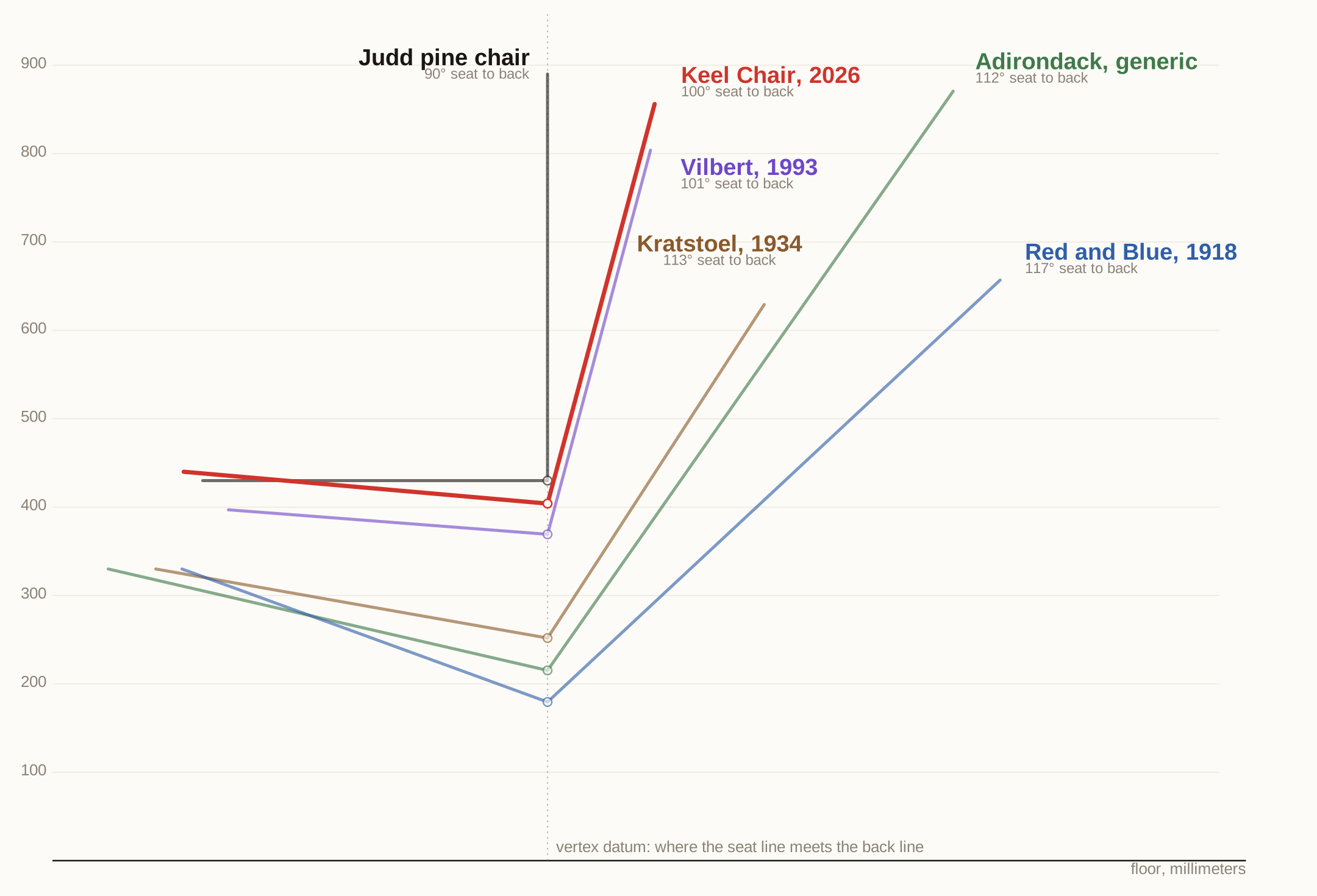
I found the shape of all this in a picture I asked for at the end of July, when the project was a week old. I wanted the seat and the back of a handful of famous chairs drawn as line segments and laid over one another in one frame, on the theory that the market's revealed preference would be visible in the overlay. The first question was where to line them up. Register the chairs on the floor and their front edges and the drawing is a tangle. Register them on the sitter, at the point where the seat line meets the back line, which is where the hips go, and the tangle closes into a fan: the seats splayed to the left, the backs opening to the right, the pivots stacked down the middle, high for the upright chairs and low for the reclined ones. The fan is not a picture of furniture. It is a picture of one body choosing a posture by how long it means to stay.
| chair | seat front | pan | rake | seat length | back length |
|---|---|---|---|---|---|
| Judd | 430 | 0° | 0° | 390 | 460 |
| Keel Chair | 440 | 5° | 15° | 413 | 468 |
| Vilbert | 397 | 4.4° | 15° | 362 | 450 |
| Adirondack | 330 | 13° | 35° | 510 | 800 |
| Kratstoel | 330 | 10° | 33° | 450 | 450 |
| Red and Blue | 330 | 20° | 47° | 440 | 700 |
Measurements in millimeters, angles in degrees; seat to back is 90 + rake − pan and is marked on each chair in the figure. Only the Keel Chair is drawn from this project's construction values; Judd's right angle is by design, the Vilbert and the Kratstoel are measured (the Vilbert from a photograph, the Kratstoel from its 1934 sheet and the Centraal Museum record), and the Adirondack and the Red and Blue are estimated from photographs. Estimated chairs are drawn lighter.
I froze this chair's posture in the first week and never moved it: seat at 440, pan tipped 5 degrees, back raked 15, 100 degrees between them. Those numbers were not designed. They are where the fan puts a chair for eating and writing, and when I measured Verner Panton's Vilbert of 1993 from photographs it landed within a degree of the same station, notwithstanding Judd's austere rules. The posture, two angles and a height, was settled before the first cut, because the body had already decided. What the numbers buy is the absence of discomfort. Ergonomists since Helander and Zhang have treated that as a separate thing from comfort. Discomfort is pressure, posture and fatigue, and it yields to geometry. Comfort is a feeling about the chair, and geometry alone will not produce it. The feeling is the business of the chapter Lovable, Legible, Maintainable.
The floor is always an option, and often the better one
Sitting up is not the only way. In much of the world it is not even the usual way. Most people, for most of history, have sat on the floor, on a mat, on a cushion, on their own heels. The resting squat that costs me a yoga session and a running shoe is, for a great share of humanity, just where you are between standing and lying down. It is comfortable. It is free. It needs no object at all, and it keeps a flexibility in the hips and ankles that those of us raised in chairs quietly give up. So the squat put a question to me. Was the chair so novel and so necessary an invention that it never occurred to a weary farmer resting on his heels in a paddy in Fujian?
No. The farmer in Fujian was not failing to invent something. He was declining an object he did not need, because he had a better free alternative already under him. A study published in the Proceedings of the National Academy of Sciences in 2020 by David Raichlen, Herman Pontzer, and their colleagues put a sharp version of this to the Hadza, a hunter-gatherer people in Tanzania who own almost no furniture. The researchers measured how much of the day the Hadza spend at rest: nine or ten hours, roughly the same non-walking total a person in an office country racks up. The Hadza are not more active in their resting hours. They rest differently. They squat and they kneel, postures that keep a low but real hum of activity in the muscles of the leg, where a chair lets those same muscles switch all the way off. The authors suggest that the human body may have evolved expecting its rest to still cost the legs a little something. On that reading the chair, by making rest completely effortless, is the novelty, not the squat.
I am an example, twice a day. I teach for a living. I can stand in front of a room and lecture for six hours with a break for lunch, on my feet the whole time, and I suspect I am better at that than Wendy would be; standing endurance is its own trained thing. At the lunch break I do not fold down onto my heels like a Hadza forager or a Chinese farmer. I walk into my office, drop into my Aeron chair, kick off my shoes, and feel the mesh take my whole weight while every muscle from my hips to my toes goes quiet. It is exactly what the study describes. The Aeron is a magnificent machine for switching the legs off. That chair simply works for me. I have bought it four times, one for each place I have worked or lived since the 1990s, and none of them has worn out; one was sold with a ranch, and I still sit in the other three. It is the rock refined so far that it asks the body for nothing. A body asked for nothing slowly loses what it is not asked for: two minutes of squat for me, an afternoon for Wendy. A culture that sits on the floor did not fail to invent the chair. It noticed that the floor is always there, costs nothing, never breaks, and asks a little healthy work of the body in exchange.
The chair solves a real problem, holding an intermediate posture at a work surface for a long time. For that specific job, eating at a table, writing at a desk, it beats the floor, and cultures that ate and wrote at tables converged on it independently. But the chair is not necessary. It is a made thing that answers a want, in competition with a free thing, the ground, that answers a related want at no cost. Every claim in this book about a chair worth keeping for a century has to survive that comparison. I am not making a thing people need. I am making a thing people choose, over an alternative that is always available and always free.
The chair that costs nothing
One thought experiment reorganized this for me. What if chairs were free? Not the floor, which is free and is not a chair. A good, comfortable, sound chair, at no cost, always within reach, as many as you liked, forever. What would happen to chairs?
They would become worthless, in the exact way that things you can have infinitely for free are worthless. No one would keep one, no one would repair one, no one would carry one home from a house fire or hand one down to a grandchild or write a book about how to make one last a century. Why mend a chair when the next one costs nothing? You would use it and drop it and take another. What makes a chair worth keeping is not that it is good. It is that it was made: some wood, some hours, some skill, a cost to bring it into the world. That cost is what makes it worth preserving rather than discarding.
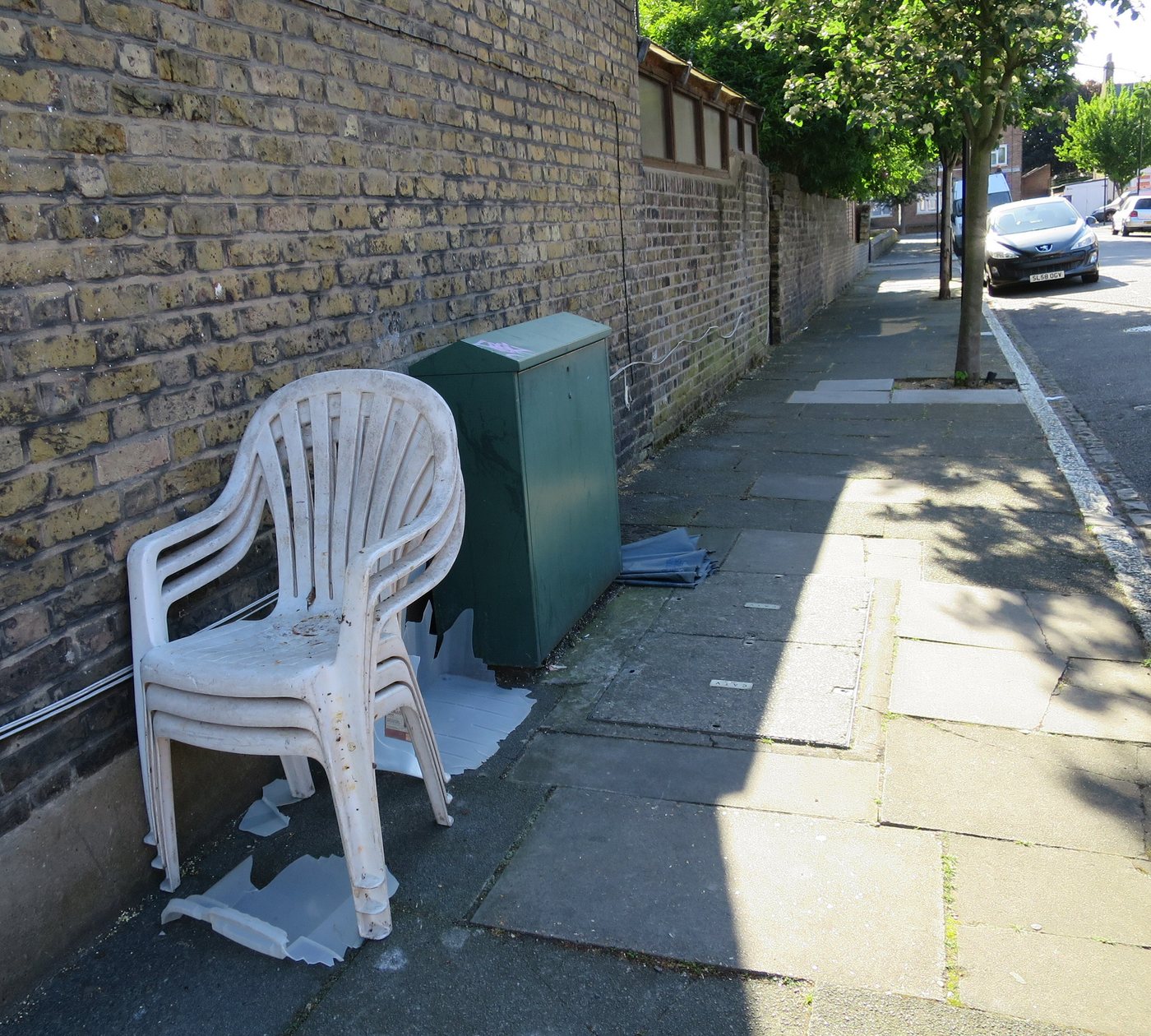
Chairs are not free, but one chair has come close within my own lifetime. The white plastic monobloc, the stacking chair in every parking lot and café terrace and wedding tent on earth, is very nearly a chair off a tree. It is made of polypropylene, the whole chair, legs and seat and back and arms, formed in a single shot of an injection mold. There are no joints to fail because there are no joints. The modern form dates to the early 1970s; the French engineer Henry Massonnet's Fauteuil 300 of 1972 is the version most often named as its origin, though there were one-piece plastic chairs before it. They have been sold in the billions, and one estimate, not a hard count, puts a billion in Europe alone. A monobloc costs a few dollars to make. When it cracks you throw it away; a new one costs less than the afternoon it would take to care about the old one. Effectively no one on earth repairs a monobloc. It has crossed the line where keeping is irrational. A thing worth keeping has to be worth more than the trouble of keeping it, and cheapness, past a point, destroys that worth as surely as ugliness does. The monobloc is the closest a chair has come to free.
What a person is really asking for
So when someone asks for a chair, what are they asking for? They are asking for the specific ease of a held intermediate posture at a surface, the two angles and a height, the thing my Aeron gives me at lunch and my heels will not. They are also, whether they know it or not, asking for a made object of a certain value, something with enough cost and care in it to be worth having and, if it is any good, worth keeping. The chair sits in a strange spot in human life, more than a tool and less than a monument, cheap enough to be everywhere and dear enough, sometimes, to be loved. That is the spot I am trying to design into. Too cheap and no one keeps it; that is the monobloc. Too precious and it goes behind glass and no one sits in it; that is the throne. A hundred-year chair has to live in the narrow band between the disposable and the untouchable, the same band an ordinary good chair has always lived in.
Ten thousand years of people raising themselves off the ground onto something, and the something has been a rock at the right height, a stump, a gold-sheathed throne dug out of a pharaoh's tomb, a graffiti-scarred oak in an abbey, a crate, a shell of injection-molded plastic, an Aeron bought four times over, and a truss of two triangles I cut in my shop out of an argument. All of them are the same move, the one my body makes and Wendy's declines. What changes across the cultures and the centuries is how much the something is worth, and whether anyone thinks it worth keeping. Before I could ask that of my own chair, I had to do what every designer eventually does: stop theorizing about chairs and go make one. Chairs turned out to be much harder to make well than they look.
For sources, citations, and the technical notes behind this chapter, see hundredyearchair.com. The resting-squat account, the 23andMe result, the teaching-and-Aeron routine, and the Westminster graffiti are my own (22 Aug 2026). The spoon's antiquity follows Stefanović and colleagues, PLOS One 2019, on Neolithic bone spoons and the older finds they review; the etymology is standard (Latin cochlear, spoon, from cochlea, snail shell). The first-sitter illustration is a generated image after Carrión et al., "Greening a lost world," Quaternary Science Advances 14 (2024) 100185. The posture numbers follow the project's ergonomics brief of 24 July 2026 and its verified sources: seat height for the median adult from Sydor and Hitka, Biomimetics 8(1), 2023; lumbar disc pressure against backrest angle from Andersson, Örtengren, Nachemson and Elfström, Scandinavian Journal of Rehabilitation Medicine 6(3), 1974; the comfort and discomfort distinction from Helander and Zhang, Ergonomics 40(9), 1997. The Judd sentences are from his essay "It's Hard to Find a Good Lamp" (1993), as published by the Judd Foundation. The Fan's values and their basis are printed in the table beside it; the K2's from the pattern in the appendix, the Vilbert's from this project's photographic measurement, the Kratstoel's from the 1934 sheet and Centraal Museum record 27058. The Hadza rest study is Raichlen, Pontzer, Zderic, Harris, Mabulla, Hamilton, and Wood, "Sitting, squatting, and the evolutionary biology of human inactivity," Proceedings of the National Academy of Sciences, March 2020. Tutankhamun's throne (Howard Carter, 1922; c. fourteenth century BCE) and the monobloc (Massonnet, Fauteuil 300, 1972; the billion-in-Europe figure an estimate) are queued for the pre-print pass. The resting squat is treated here as trainable practice rather than ancestry; limb-proportion differences between populations exist but do not account for it, and my own trained heels are the evidence I trust most.
A chapter of The Hundred-Year Chair, drafted and refined in public. The same text lives in the book; the interactive tools and the fully-sourced technical notes live here. home · the book · the technical notes · hundredyearchair.com