The Hundred-Year Chair · a chapter
Prologue: The Stranger's Chair
Within five meters of the desk where I am writing are two chairs that are a hundred years old. A hundred years is not much of a test for wood. Kept dry, it can last more or less indefinitely. Yet most of the chairs built alongside these two are gone, though many were probably just as strong. These two survived because generations of people wanted to keep them, could understand how they were made, and could repair them when something failed. At some point, no one loved the others enough to keep them, could still make out how they were built, or could mend what had broken. Objects do not endure on their own. They endure through a chain of custodians. To design something that lasts is to improve the odds that this chain will continue.
Those two chairs sit on a ladder, and the rungs are powers of ten. A year asks nothing; a chair that is not defective lasts a year. Ten years asks for manufacture, joints that stay tight and a finish that does not lift, and most decent chairs clear it. A hundred years asks almost nothing more of the wood, because wood kept dry lasts more or less indefinitely. A century is often more a custody problem than a materials problem, and somebody has had to solve it for the two chairs by my desk in every generation since they were built.
At a thousand years the ground gives way. No board survives, and no glue, no finish, no fastener, no company that might have sold the thing, no website. What can cross a thousand years is a pattern simple enough to be read straight off the object, and a succession of people who keep bothering. The chair stops being the thing that lasts. It becomes a vessel for the information that makes the next one.
The book is called The Hundred-Year Chair. That is a little bit of a bait and switch. A hundred years is a low bar for a chair and table stakes for a designer who cares about longevity. The reason to go up another rung is that the thousand changes what you are designing. No object in daily use crosses a thousand years. Only a pattern does, carried by people who keep making it. So the question stops being how do I build a chair that lasts, and becomes what would I have to write down so that a stranger builds it again. That is a different problem. It is the one this book is about.
I have been interested in chairs for as long as I can remember. I have bought the same Herman Miller Aeron, graphite, size B, four times. I have photographed strangers' chairs in shops and museums for twenty years and taught from the famous ones. I have built benches from logs, tables from the oak of spent wine barrels, and a few chairs I did not believe in. I did not have a chair of my own to make, or a reason to make one.
The reason arrived from two directions. The first was a display of Piet Hein Eek's furniture in a Paris department store in May 2019, built from reclaimed and scrap wood with the patchwork boards worn openly. It lodged a question: what would a chair made of scrap look like as an open design anyone could build, rather than as a precious object made one at a time by a famous hand? The second was my warehouse. I co-founded a company called MakerStock that supplies materials to people who build things. Like any business that cuts sheet goods and lumber to size, we make scrap: something like five percent of a considerable volume, most of it less than three hundred millimeters wide. We try to give it away. It piles up anyway. In the middle of 2026 the pile and the Paris question met. I had a chair to design.
From the end of July through August 2026, while in Queensland, Australia, isolated from my day job by fourteen time zones, I went on a search for my chair. This book is about that quest, and what I learned along the way.
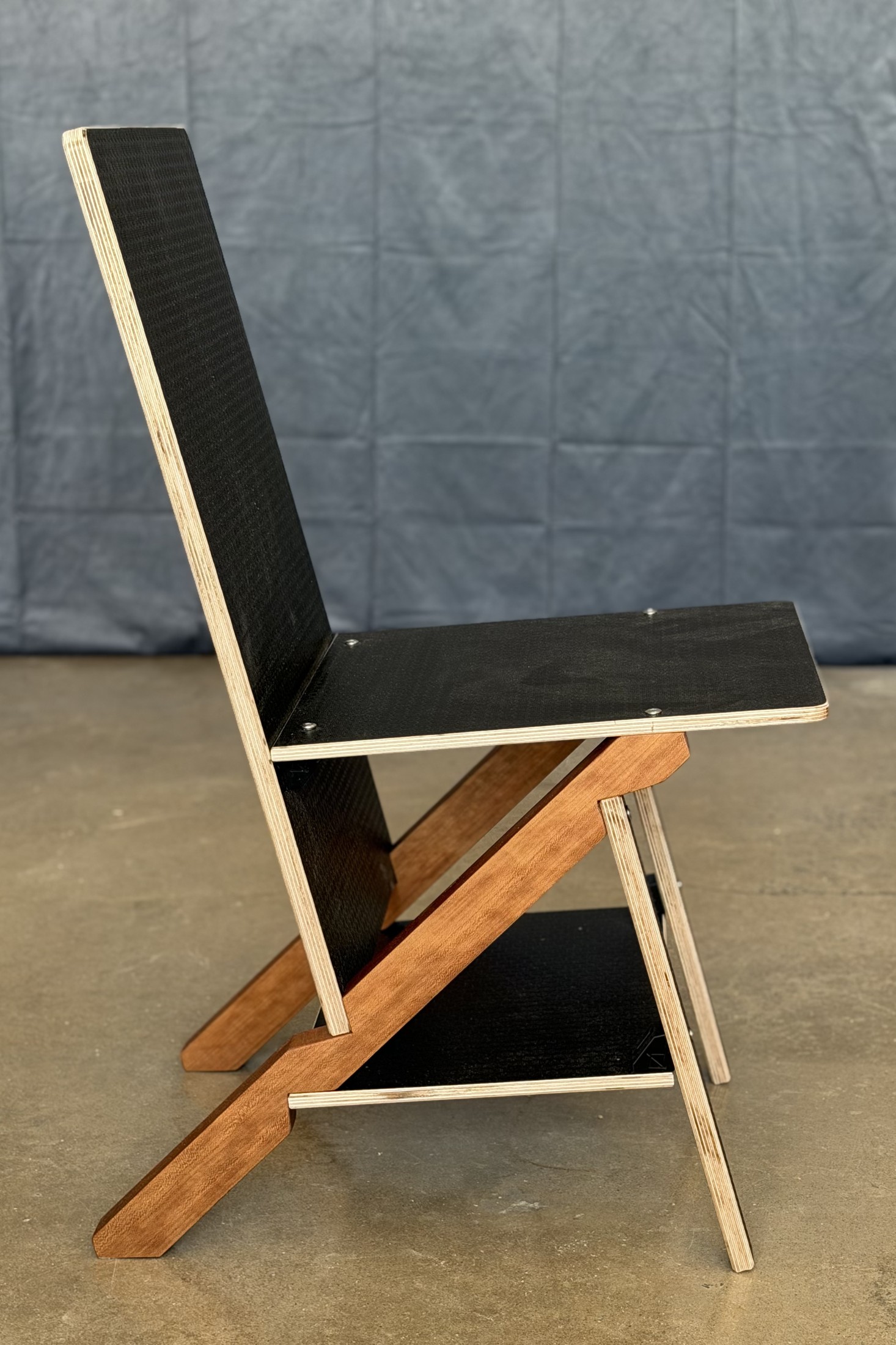
The chair I designed is built as a truss of two identical triangles that share a single raking spine I call the keel, after the way a boat is built spine first. I call it the Keel Chair, a name that arrived late; through the months this book covers it was called the K2, and inside the story it still is. Three wide plywood panels for the seat, the back and the tie, and four narrow members, two keels and two legs. Scrap mostly comes narrow. The three panels are too big to come from scrap. The chair is clean and efficient, and it wears its structure on the outside. It came out looking like that after I took structure seriously and removed everything that was not doing work.
This is not a book about one chair. Three play central roles. The first is not mine: Gerrit Rietveld published a crate chair in 1934 as a drawing anyone could build, and I built it from his drawing in the first week. The second is the Keel Chair in the picture above. The third arrived a week after I thought the writing was done, when the same two triangles produced another chair from the same scrap pile, this time from the narrow stock alone, still sharing one spine, with the joint between the triangles moved from the seat to the arm. It went from a sketch at five in the morning to a thing I was sitting in that night. The two chairs I designed share no part and no dimension. What they share is the pattern: two congruent triangles sharing a keel on the diagonal.
This book is sort of a lab report. Don't panic. The technical details have been pushed online. Every chapter also lives at hundredyearchair.com, and under each one sit the technical notes that check its claims and the tools that let you push the numbers yourself.
It follows lab rules. Every factual claim carries its source or its measurement, estimates are marked as estimates, and when something turned out wrong, and several things did, the error and its correction stay in the text. You will watch a chair I admired turn out to be hiding its structure under its seat, and a naive question from a drawing outperform an optimizer.
I did not design these chairs alone. I designed them in conversation with a machine, and the machine kept a record. I can say almost to the dollar what the thinking cost and almost to the minute how long it took. The thinking was cheap and the making stayed expensive. The book's subtitle comes from there.
What is the point of a chair built to outlast everyone who will ever sit in it? Is it anything more than vanity, a man whittling his own monument at one tenth scale? I would rather ask that myself than leave it to a reviewer.
The Paris encounter is dated to 27 May 2019 by my own photographs and told in full in "The Chair I Met in Paris." The scrap figures are from the founding message of 24 July 2026. The second chair is the K3 popsicle chair, sketched before dawn on 2 September 2026 and sat in that evening, per the build log; its chapter is So Similar, Yet So Different. The design record that dates and prices the thinking is the subject of the chapter The Centaur. Hero photograph: the K2-Keel in side view, August 2026, this project.
A chapter of The Hundred-Year Chair, drafted and refined in public. The same text lives in the book; the interactive tools and the fully-sourced technical notes live here. home · the book · the technical notes · hundredyearchair.com