The Hundred-Year Chair · a chapter
First Principles: Two Triangles
Sit down and lean back and forget wood, and brackets, and glue, and joinery. What, exactly, does the object we call a chair have to do? What is the cheapest shape that does it? The answer is not a clever joint or a special material. It is a triangle, and then a second triangle like it.
Put your weight into a chair and two different things happen. The first is easy. Your weight runs down through the seat, into the legs, into the floor. Any pile of sticks stout enough not to snap will manage that much.
The second thing kills chairs. When you shift, when you lean back, when you tip onto two legs to reach something, you are no longer pressing straight down. You are pushing the frame sideways, trying to fold it flat the way you can fold a cardboard box with the ends cut off by pushing on one corner. Engineers call that racking. A chair spends its whole life fighting it.
Racking is the real enemy, and weight is not. A four-sided frame, a square of four sticks pinned at the corners, will carry an enormous load straight down and still fold sideways under almost nothing. Push its top corner and it leans into a parallelogram, then a flatter one, then it is on the floor. Nothing in the wood has to break for this to happen. We have all sat in the wobbly version. The wood is fine and nothing is cracked. It sways anyway, because its four corners don't hold their angles.
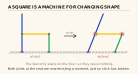
The whole game is stopping that fold. Only two moves can do it. We can make the corners rigid, so stiff they refuse to change their angle. A heavy mortise-and-tenon joint or a fat steel bracket is trying to do exactly that. Or we can arrange the sticks so that folding the frame would force one of them to get longer or shorter, which wood flatly refuses to do. The first move fights racking with joints. The second fights it with shape. Almost every chair ever built chose the first. I chose the second.
Take three sticks, pin them into a triangle, and try to fold it. You cannot. There is no second shape for it to take. To change a triangle at all you would have to change the length of one side, and a wooden stick under a person's weight does not stretch or squash in any amount you could measure.
This is not a property of good triangles or expensive ones. Fix the three lengths and you have fixed the shape, completely and for good. A triangle is the only flat figure that does this. Bridges and roofs and cranes and bicycle frames are all, under their skins, made of triangles for that reason. The engineer's word for a frame that carries load by the arrangement of its members rather than the stiffness of its corners is a truss.
That difference is why my chair is shaped the way it is. A rigid-corner chair is only as good as its corners stay, and wooden corners do not stay. A pegged or bolted joint is tight because something in it is held in tension. Wood does not sit still under tension. It dries, it shrinks across the grain with the seasons, and the tightness quietly leaks away. A joint that was heroic the day it was cut is merely snug in year five and frankly casual in year forty. So a rigid-corner chair is in a race with its own joints. I would not bet on the chair.
A triangle does not enter that race. It stays a triangle even when the pins rattle in their holes, because the stiffness lives in the shape and geometry does not loosen. For a chair meant to survive a century of strangers and neglect, I could not think of a property worth more.
Here the trouble starts. A chair is not free to be any truss it likes.
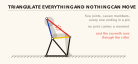
Take the five points the problem actually gives you, the two feet and the three corners of the seat and back, and close every triangle between them. Seven members, all pin-ended, nothing able to move. The result is an honest truss and not a chair. The member that closes the top triangle runs from the top of the back to the nose of the seat, straight through where the sitter goes. Every chair problem is this one. The empty volume where the person goes is a constraint, and the obvious answer violates it.
So a chair should be a truss. That does not tell you where to put anything. Draw the side view and list what you actually know:
- a seat; - a back; - the angle between them, a hundred degrees in my case, which the body decided and I froze in the first week; - two places where the chair meets the floor.
That is the whole list. Nothing in it is a triangle.
Start with the angle, the part most likely to fail. A corner holding a hundred degrees for a century is exactly what a wooden joint cannot promise. A length can. So lay a stick across that corner, from under the seat to behind the back. The seat, the back, and the stick now close a triangle. The angle is held by a dimension instead of by a joint.
That triangle holds the seat-back angle and floats in the air. Nothing in it reaches the floor. Carry the same stick on downward past the seat and it reaches the ground. Now it is the rear leg as well as the brace, one member doing both jobs. The front foot then wants the same treatment, a front leg up to the seat and a short tie across the bottom to close it against that same stick. That is a second triangle. Make it the same triangle as the first, slid along the shared stick. Then the whole chair needs only one set of angles.
Two triangles, one above the other in the side view, sharing one long member.
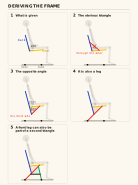
That's the carefully constructed argument as a sequence of structural engineering moves. It would be tidier to claim I reasoned from first principles to two triangles in a single pass. I did not. The evening the double triangle was born, the fifth of August, the same night Wendy's chair slid, was a local search over truss shapes in a conversation with the machine, every step drawn and checked before the next was proposed. The tape holds the whole walk to the minute.
In a rare evening work session, between twenty to nine and half past ten I considered seven architectures. I began by making the front leg parallel to the back, which roughly halved the thrust at the feet. Eleven minutes later I was asking how much steeper the rear leg could go before it flexed, with a note in parentheses that a longer leg deflects as the cube of its length and so softens fast. The brackets grew into whole side panels, then into a trestle, structurally excellent and shaped like farm equipment. The trestle taught me the move that killed the brackets: "just put a horizontal shelf between the front and back legs. Actually the whole thing becomes a truss ...no brackets." A few minutes later the walk arrived:
"Run the back leg all the way to the seat. Terminate the front leg when it tees into the rear leg. Voila. Two triangles."
A triangle is fixed once you fix its three sides. Here I had the first genuinely free choice in the whole design. Any three lengths that close would give a rack-proof frame. Two things set the actual numbers. One is the sitting body, which wants the seat and back at particular angles. The other is a wish for lengths that fall on round numbers on a tape measure. I settled on a triangle whose sides are 219, 295, and 335 millimeters, opposite corners of 40, 60, and 80 degrees. Because the chair is two of these triangles, there is a fourth number: they sit 70 millimeters apart along the long diagonal they share.
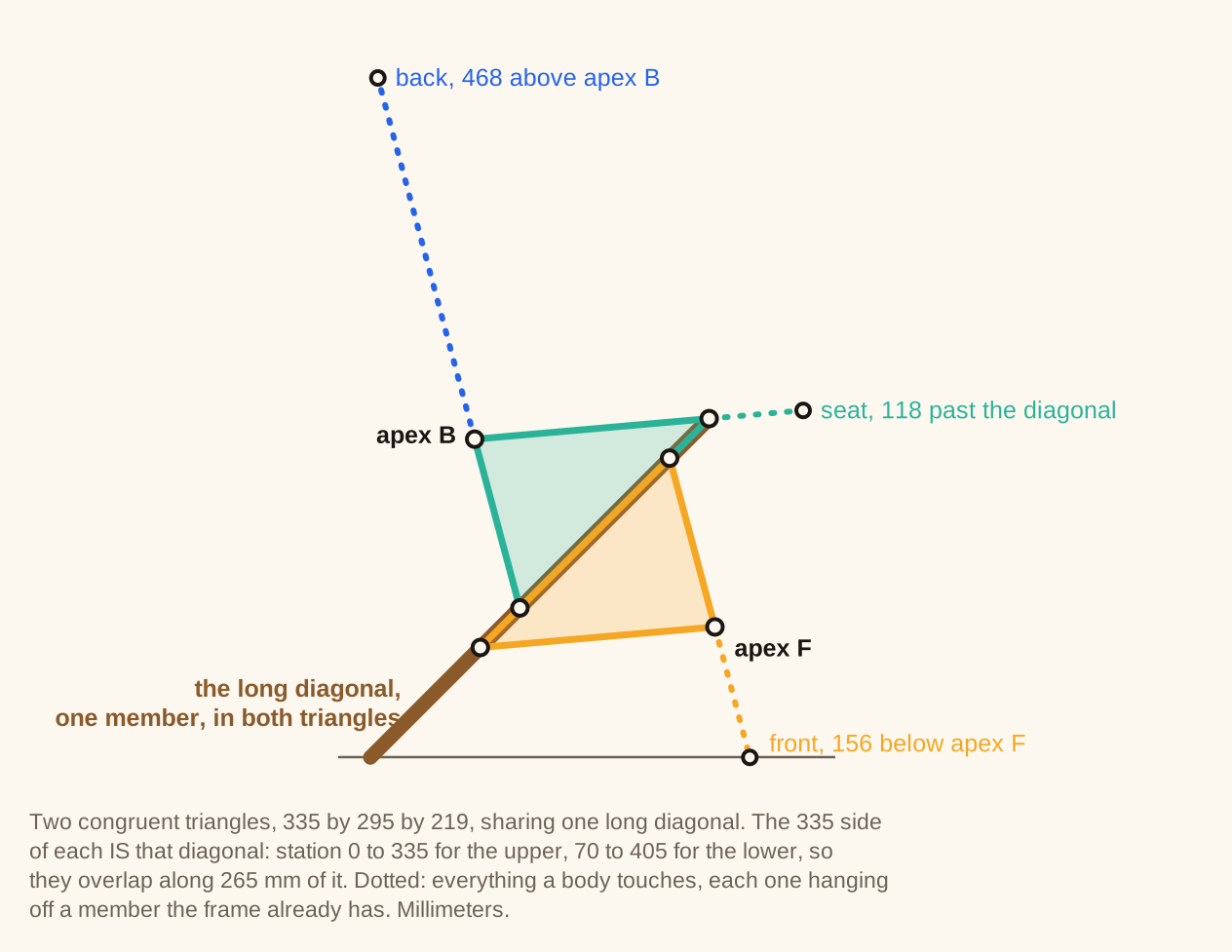
219, 295, 335, 70. That is the chair, at the level that matters. I still find it a little startling that a full-size chair you can lean back hard against reduces to four numbers you could write on a thumbnail.
Two confessions about the numbers. The first is the rounding. With the sides fixed at whole millimeters the corners come out 40.1, 60.1, and 79.9 degrees. The integer millimeters are the definition; the round angles are only the name. A tape can hold a millimeter. No shop protractor can hold a tenth of a degree.
The second is the parallels. Because the second triangle is the first one slid along the shared diagonal, every member has a twin it runs exactly parallel to, the front parallel to the back, the tie parallel to the seat. Nothing in the structure demanded that. The machine's own line that night was that the twins were "fraternal, not identical." I made them identical on purpose. I typed at the time that seat and back and front legs all parallel was "pretty nice." That is an aesthetic criterion, not a structural one, and the chair looks the way it does because I preferred it that way.
Four numbers became a chair inside the week. The first double triangle went together fast, brad-nailed in an afternoon of black film-faced plywood, and my note that evening ran to two words: "very robust."
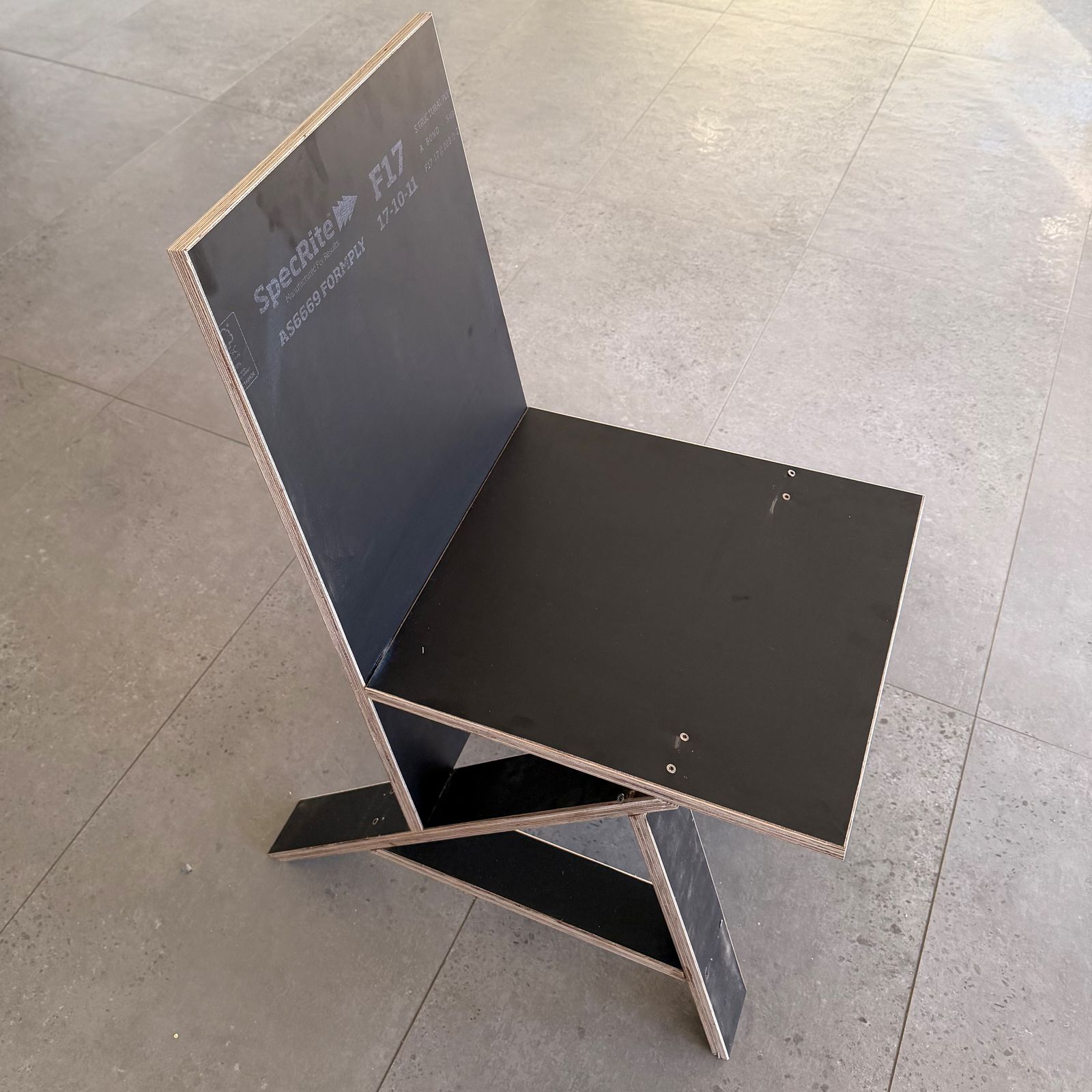
Once there was a chair to sit in, I handed the frame to a computer and asked it to solve the forces member by member. Under load, almost every member is in compression, squeezed along its length. Only one member is pulled. The tie, the short stick low down, is the single member in tension. So the sitter's own weight comes down into the truss and presses nearly every joint harder shut. A joint being squeezed shut needs nothing holding it together.
So the fasteners at those joints are, in my shorthand, location devices rather than structure. Their whole job is to stop a part falling out of place while the chair is empty, or being carried, or dragged across a room by its back. The tie is the exception, the one place where fasteners really do have to hold. Everywhere else the geometry has arranged for gravity and compression to do most of the work.
Four days later I put the same problem to a structural optimizer with no stake in my answer, and let it grow a chair from scratch, putting material where there was stress. It was a worthy side trip and it did not deliver. Nothing it returned was this chair. It delivered slightly better solutions from the narrow perspective of materials use, but did so with geometries largely infeasible from ordinary wood boards and panels.
A clean, simple five-component chair sits at the end of several dozen documented states. This may come as a surprise to those first learning about the weedy details of the creation of an artifact, but will feel totally normal to a designer. Divergent and convergent processes of exploration appear to be intrinsic to the activity of design.
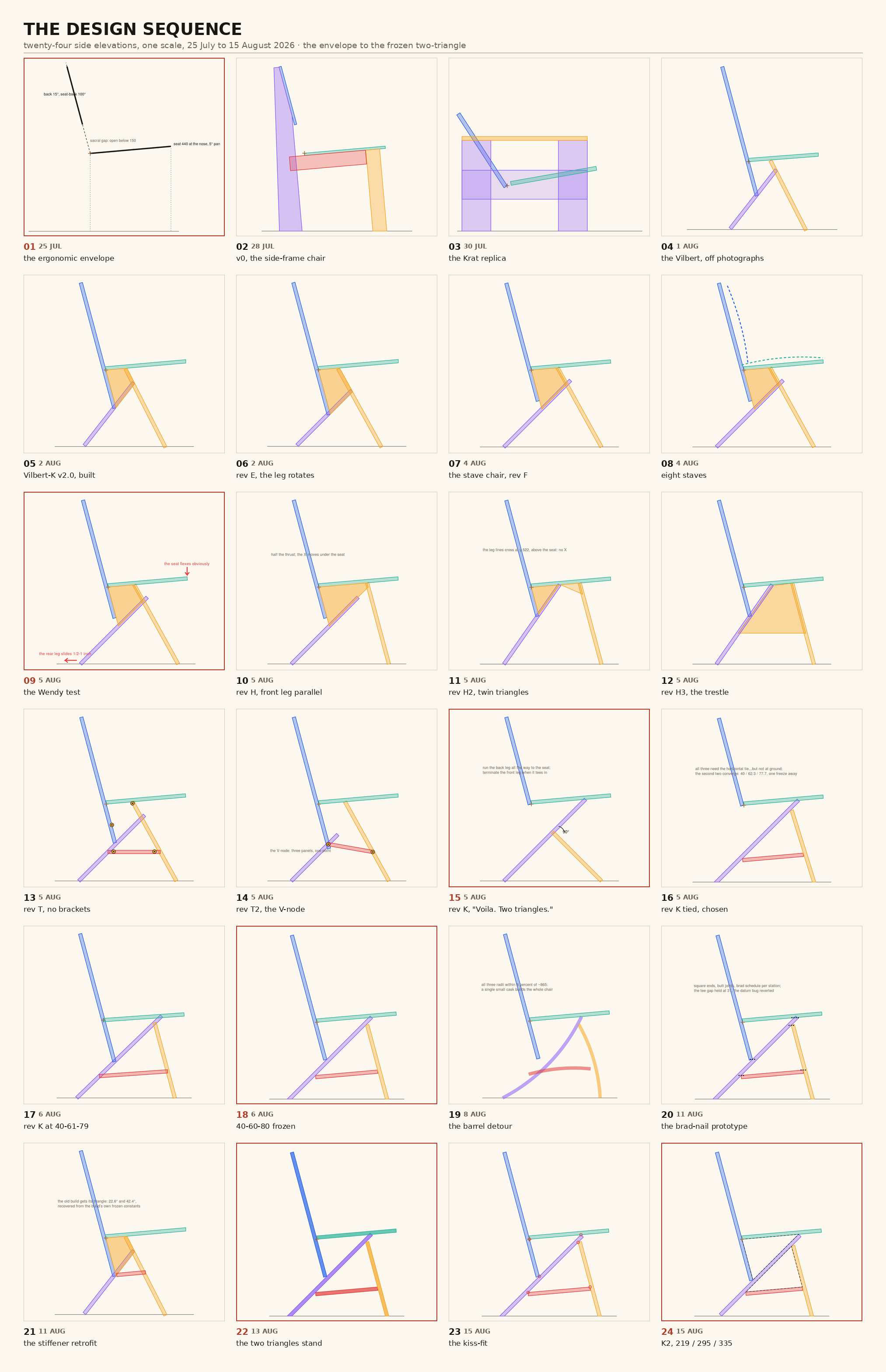
The double triangles arrived on the fifth of August. I had the architecture of a chair I believed in and no way yet to hand it to a stranger to make. A sketch of two triangles is not a recipe for a chair someone else can build twice and get right.
For sources, citations, and the technical notes behind this chapter, see hundredyearchair.com.
A chapter of The Hundred-Year Chair, drafted and refined in public. The same text lives in the book; the interactive tools and the fully-sourced technical notes live here. home · the book · the technical notes · hundredyearchair.com