The Hundred-Year Chair · a chapter
So Similar, Yet So Different
On the second of September I woke at five in the morning with a chair in my head, and by a quarter to eight it was a drawing, and by that night I was sitting in it.
I can be exact about this because the record is exact, and because I wrote it down in the scratch pad in the state I was in:
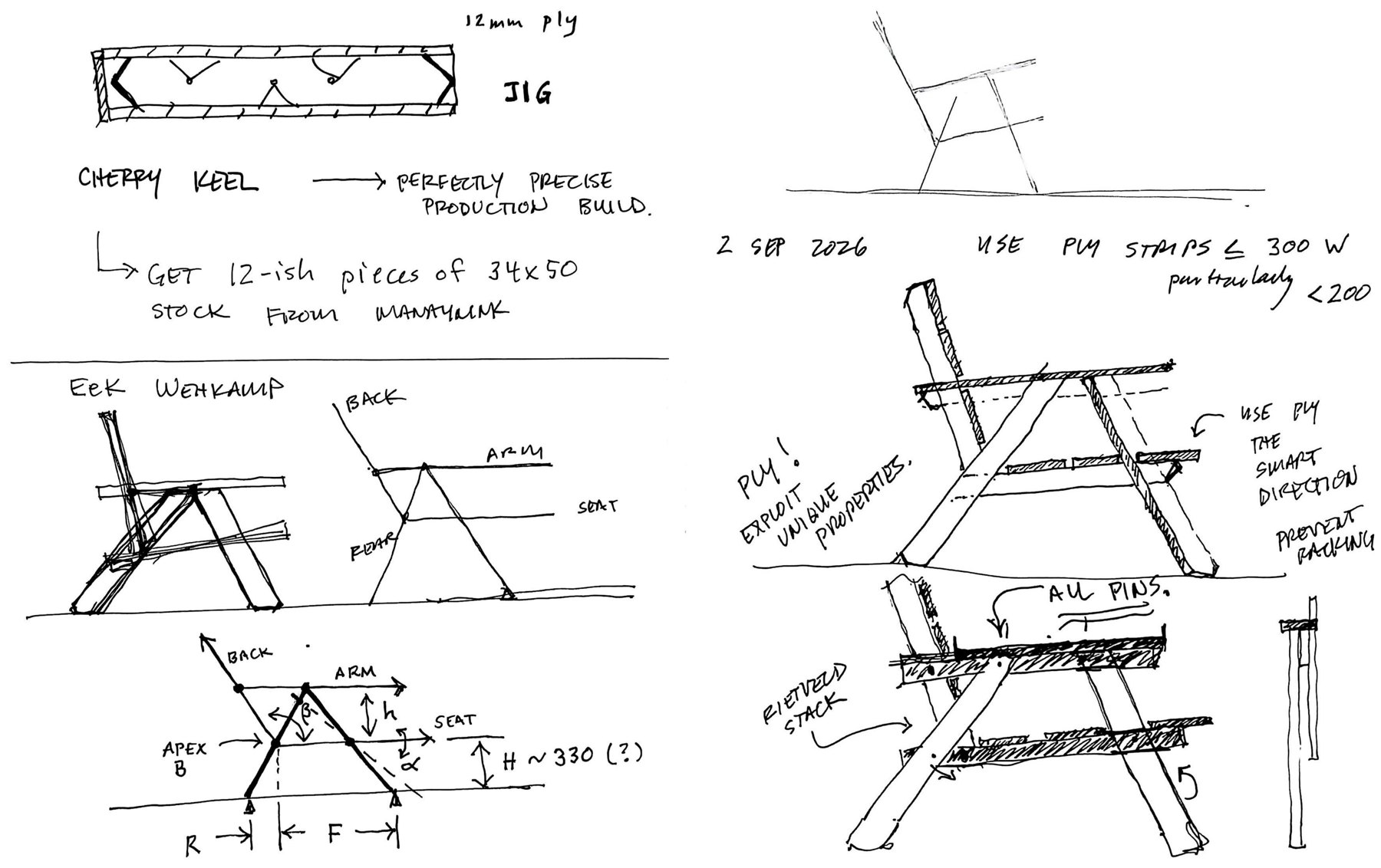
"holy shit. manic burst at 5am resulting in popsicle chair. Slept on the Wehkamp chair...and then started to think about the ply problem and the advantages of ply and what we have to work with (a lot of strips). Somehow made the stack work as a double triangle pinned truss."
The chair I mean is Piet Hein Eek's, from the flat-pack oak collection he did for the Dutch retailer Wehkamp beginning in 2011. I had been looking at photographs of it and of its lounge sibling, the way you look at a chair you envy. I had also, weeks earlier, built Rietveld's crate chair from his 1934 drawing, which is assembled as three layers of board crossing one another. And under everything, as under every page of this book, were the two triangles. Somewhere in the night those three things fused. What came out at five in the morning was ten sticks, all the same width, pinned at their rounded ends into two triangles that share a keel, with the triangles meeting at the arm instead of at the seat. I got the geometry straight in Illustrator and sent it to the machine for comment. It came back with one real improvement, a better stacking order for the three layers. I took it and wrote: "Bam...developed design by 7:45." In the afternoon I cut the sticks on the router table against a printed guide that rounds each end to a twenty-five millimeter radius centered on its pin. That night I sat in it.
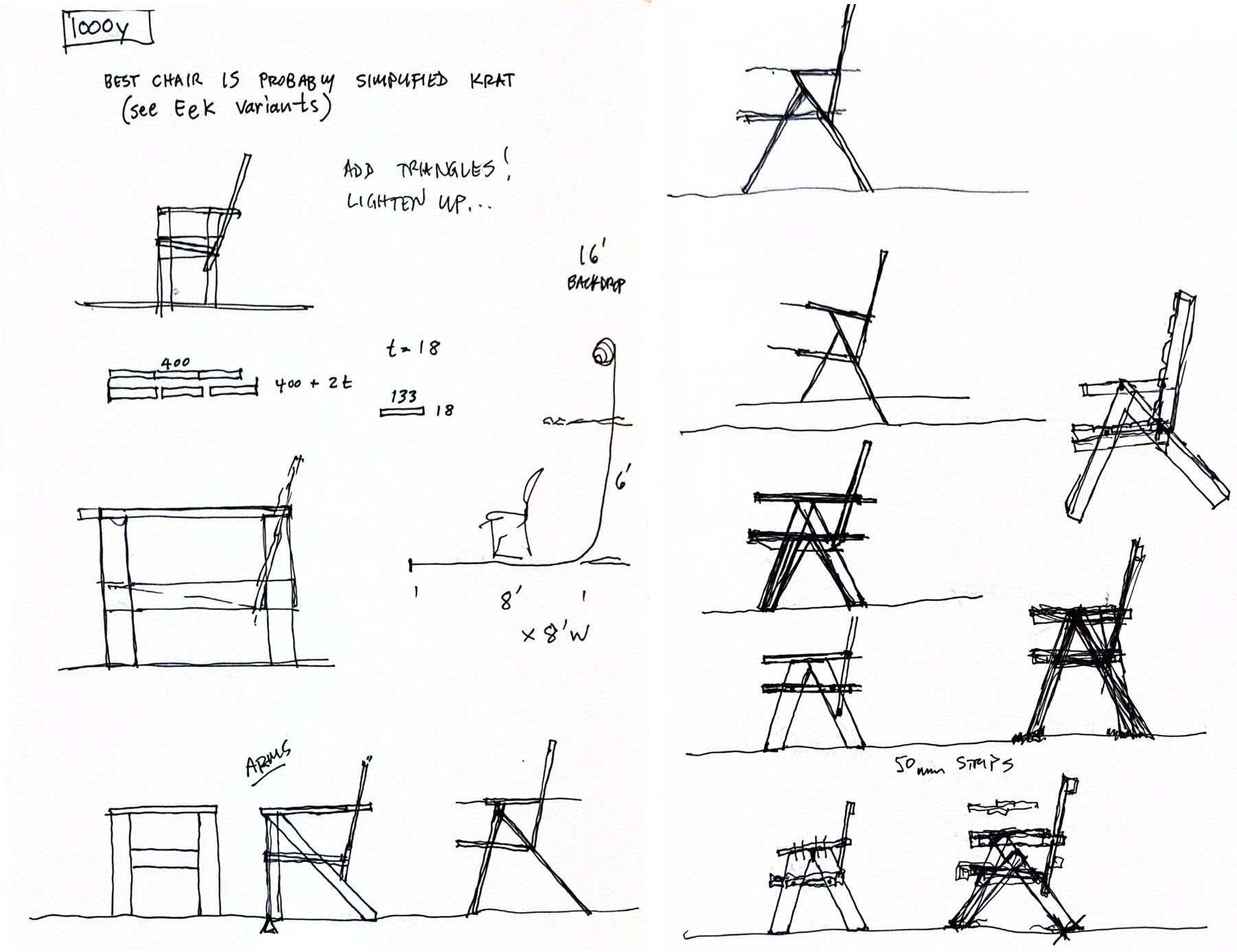
That is how I told it for three days and how the scratch pad tells it. In one respect it is wrong, and the notebook caught it when I went back through a few days later. The idea did not arrive in the night. Under a boxed heading that reads 1000y, on a page that sits between entries dated 26 and 27 August, a week before the burst, I had written: "Best chair is probably simplified Krat (see Eek variants). Add triangles! Lighten up..." Below it the Krat's front elevation is redrawn with a diagonal through it, the word ARMS is underlined at the foot of the page, and the facing page carries the idea into a column of A-frame and X-frame profiles of a chair with arms, over the note "50 mm strips." It is the popsicle chair, a week early, arrived at from the other direction. I was not thinking about the scrap bin that day. I was thinking about the thousand-year chair, and about whether a Krat could be lightened and triangulated enough to be worth keeping for that long, and I answered my own question in two pages and turned to the next thing. What happened on 2 September was not invention. It was recall, arriving the way recall does at five in the morning, dressed as a new idea. The scratch pad recorded the feeling truthfully. The notebook recorded the fact. They are not the same record.
I have been describing the feeling this gives a person for most of this book, and I had it again, and I distrusted it again, and I wrote both things down within a minute of each other: "Definitely another 'nailed it' moment. But we've seen these false summits before." The keel chair had arrived on a morning like this one, a few weeks before, and the book you are holding had been built around it. It was, as far as I knew, finished. And here, in the last week before I meant to stop, was a second chair. It was better.
The promise I had stopped keeping
To see why it was better I have to go back to the first thing I ever typed about this project, which the chapter on messing around quotes to the minute. On the twenty-fourth of July, at five past noon, between errands, I asked for a chair that could be "produced from scrap and reclaimed material of some standard thicknesses," and I said what I wanted it to look like: "beautiful mosaics made of otherwise scrap material." That was the whole brief. Scrap, standard thicknesses, mosaic.
The keel chair did not keep that promise, and I knew it, and the coda that follows this chapter was written to admit it. The Keel Panel is a fine chair and an elegant one, and it needs a panel four hundred millimeters wide. A panel four hundred wide is not scrap. It is a sheet you cut down, or a good offcut you were lucky to have. The bin at MakerStock, the business whose leftovers started all this, is mostly strips, in every thickness we stock, in film-faced black and brown and white and gray, in clear-finished birch, in the odd colored stain. The keel chair could not eat any of it. I had solved a chair and quietly walked away from the problem.
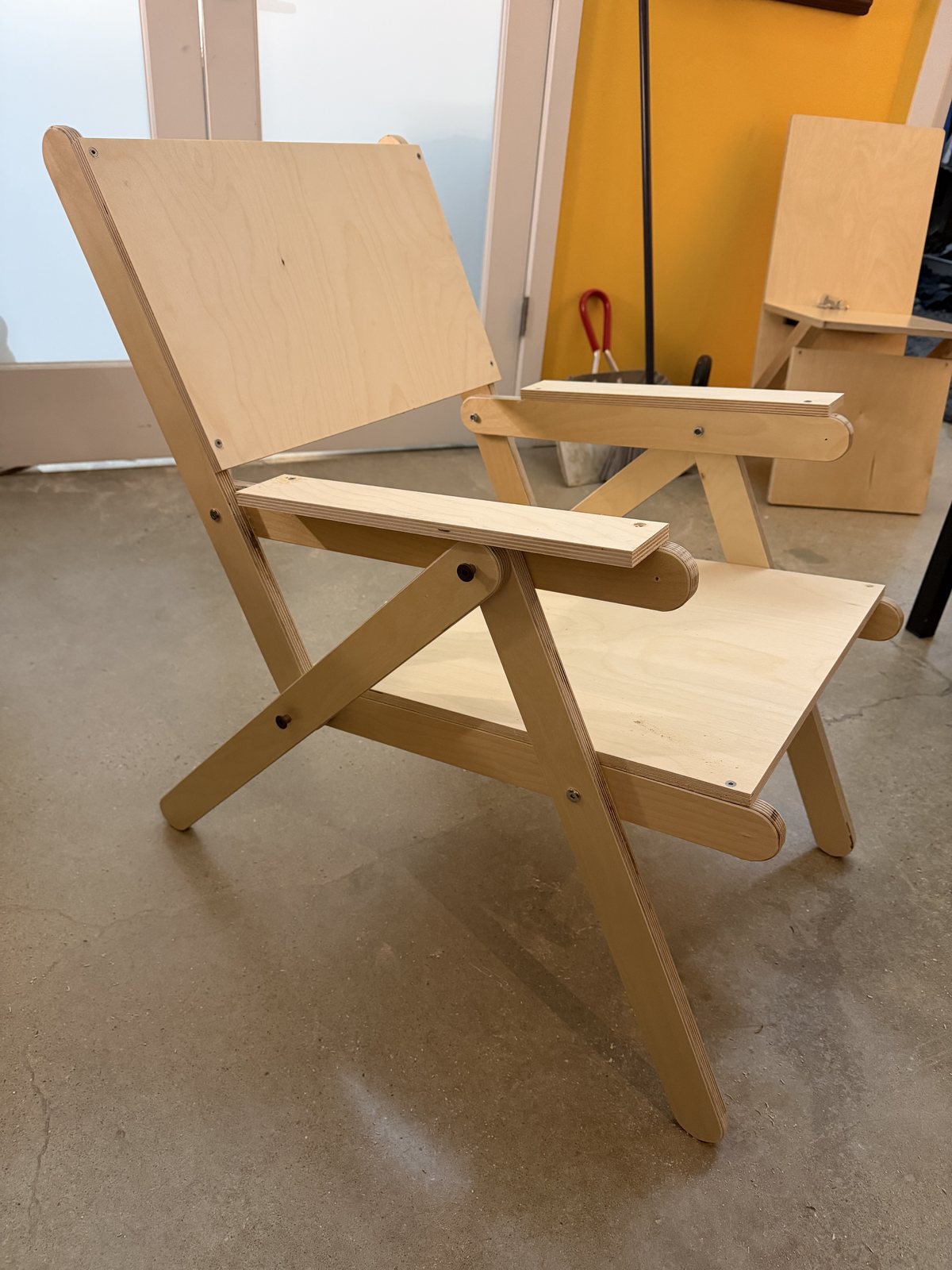
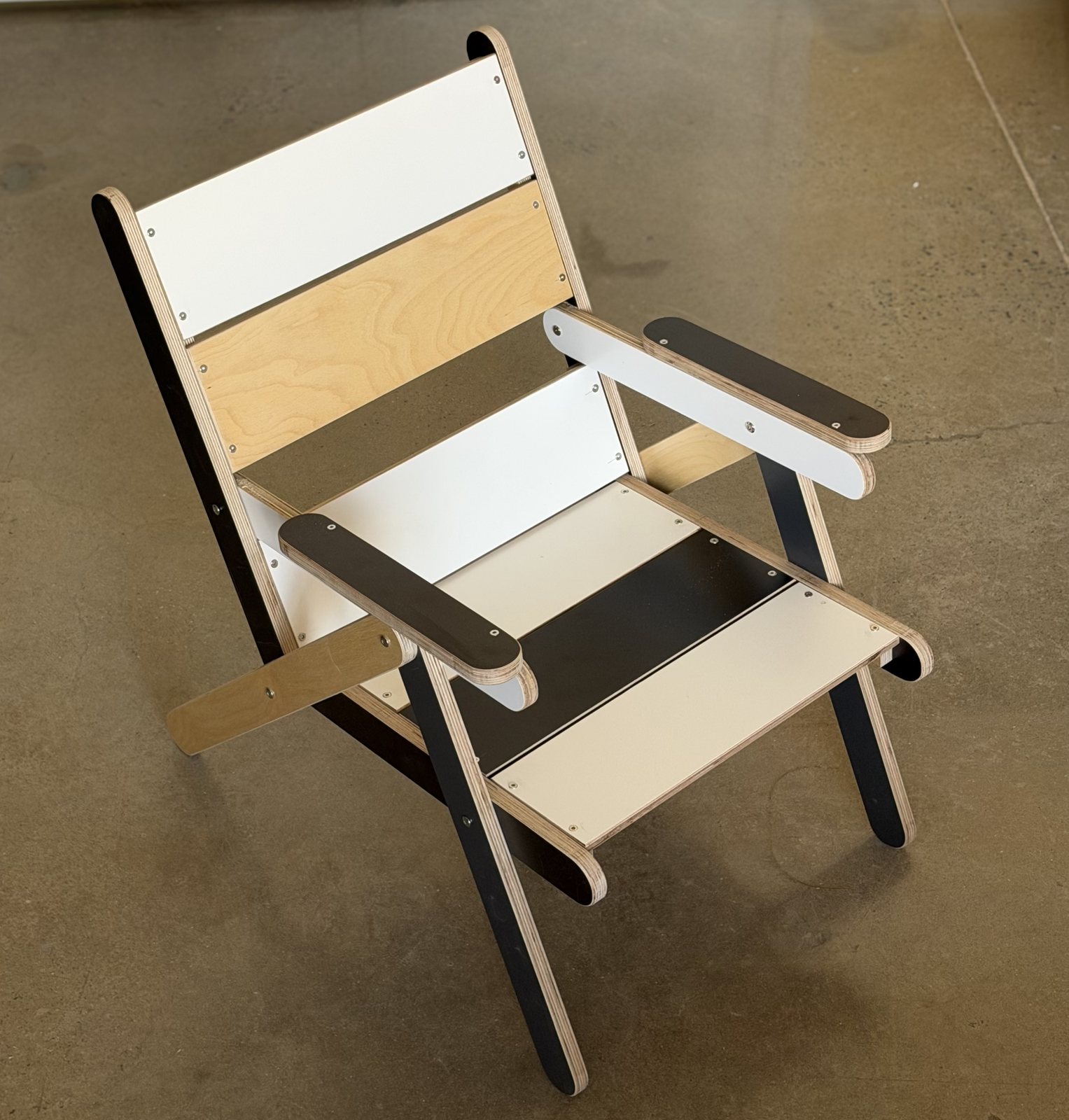
The popsicle chair is made of the bin. Ten sticks of strip, rounded at the ends, and a few small panels that drop between the sticks and rest on cleats. The widest piece in the whole chair is a hundred and forty-three millimeters. When I finished the third build on the fourth of September I wrote, and I meant it as an accounting rather than a boast: "I think it is lovely and interesting. That is all actual scrap." And because the strips come in every finish we sell, each chair is whatever the bin held that week: a white arm and a darker one, a black front leg beside a birch keel, a gray seat. The first line of the founding document, the mosaic, had been sitting in the scrap pile the whole time, waiting for a topology that could be built from strips.
The name came with the idea, and I did not choose it either. On the page after the five o'clock drawing I wrote "This is the popsicle stick chair. Fun." and drew an arrow to a name that appears in the chapter on the verdict of the builds: Mr. Grove, "triangles." Peter Grove taught my son Jamie science in elementary school, and when the class built bridges from popsicle sticks his entire doctrine was that one word. He died in May, a few weeks before this project began. The keel chair, I wrote in that chapter, is two of his triangles. The popsicle chair is two of his triangles built from the sticks he taught with. The name was never going to be anything else.
The same chair
The part that took me a day to see is this. The popsicle chair is not a different chair. It is the same chair.
Two congruent triangles, sharing one member, the keel. That is the genotype. The pattern chapter argues that this small unvarying thing is what makes a chair this chair, and that everything else, the material, the joint, the finish, the species, is free. What I had not understood until I built it is how much "everything else" includes. The Keel Truss keeps the two congruent triangles and the shared keel, and moves one thing. In the Keel Panel the triangles meet at the seat and a tie closes the bottom. In the Keel Truss they meet at the arm, and the arm is the tie. That single relocation turns a dining chair into a lounge chair. The keel is a spine in the Keel Panel and in the Keel Truss is both a triangle member and the rear leg, so the rear stance is proportional to how high you sit. Raise the hip to dining height and the back feet sprawl into the room. Lower it, open the back, and the chair lies down into the Adirondack family as if it had been born there. Same DNA. I wrote the whole of it in one line in the scratch pad, and I have not improved on it: "So similar, yet so different."
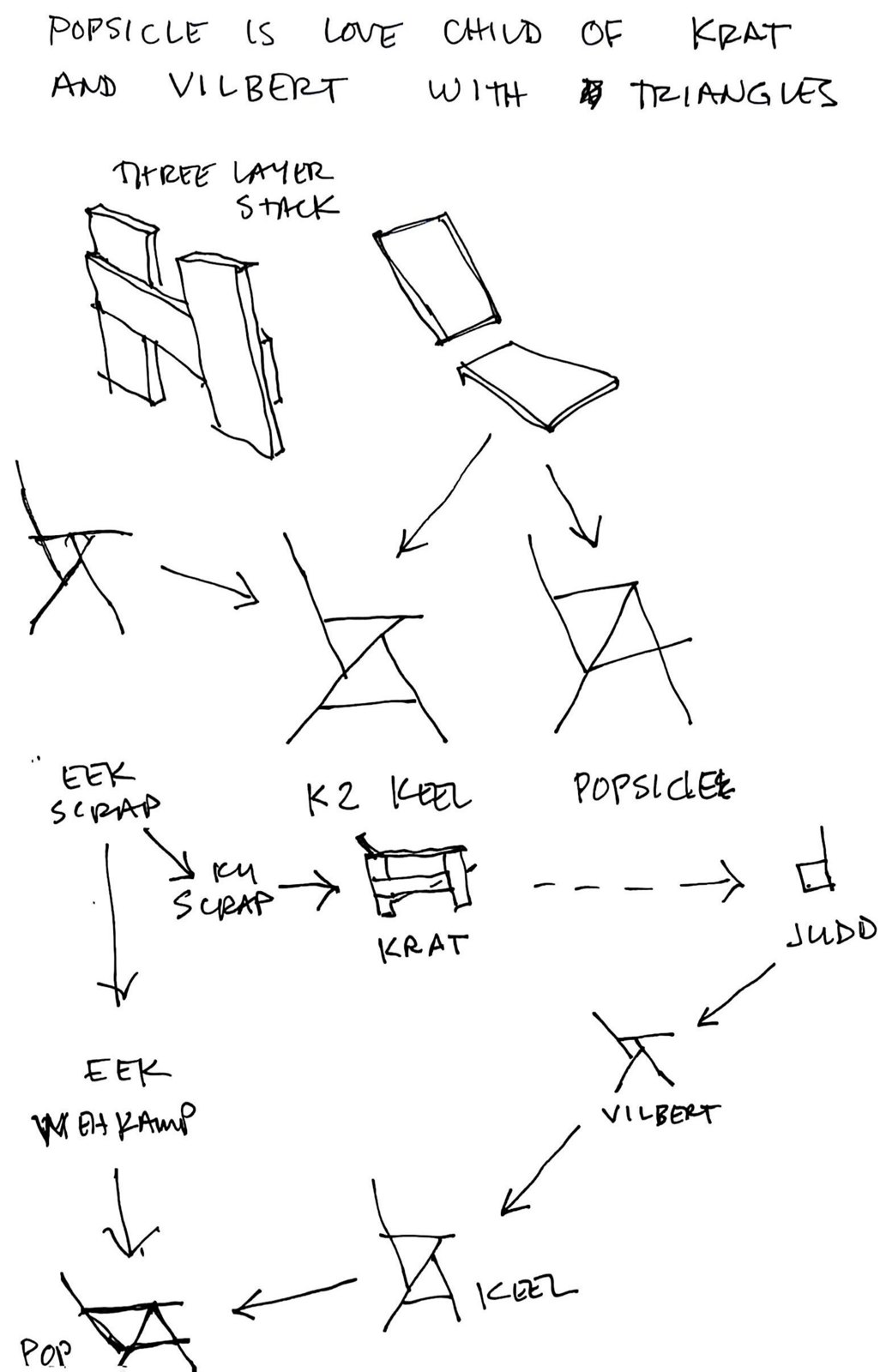
The pattern chapter claimed that a genotype could wear many bodies. Until this week that claim had one body to point at. It now has two, a dining chair and a lounge chair from the same three words, as unlike each other as any two chairs in the book. I did not build the K3 to prove the pattern. I built it because I could not sleep. But it is the proof, and it arrived after the argument was written.
There is one difference between them that is not free, and it took me until the naming to find it. Count the parts. The Keel Panel is two keels, three panels and two front legs. The seat, the back and the tie are each four hundred millimeters wide and serve as a member of the left side frame and the right one at the same time. The front is already a pair of narrow legs, and the triangles still cannot stand beside the sitter, because the seat and the back are the triangles. The Keel Truss is ten sticks: five sticks and four pins to a side, each side a whole statically determinate truss, standing clear of the body, with the sitter carried between them rather than inside them. To put a complete panel triangle beside a sitter you would have to cut a hole in it for the person, which is surgery, not design.
That is why panels and sticks are two lines and not two finishes. The pattern is indifferent to both. Where the structure may stand relative to the body is not, and the width of the members settles it before any question of species or thickness comes up.
The verdict I got wrong, and the one that held
These three days left the same kind of record as the rest, a ledger of who caught what. Three entries mattered.
On the first day the machine ran the geometry and told me the topology could not make a dining chair. It showed the arithmetic: at dining height, with the arm where the K3 puts it, the rear foot lands three hundred and forty millimeters behind the hip, and no choice of apex fixes it. "K3 is a lounge topology," the log said, and gave the reason. I believed it for a day. Then I did not:
"claude says no go on making this an upright chair, but yes to 'Adirondack.' What if we relax isosceles requirement. Can obviously change back angle arbitrarily. Seems we can change alpha arbitrarily. Can change leg lengths arbitrarily...so why can't locate rear pivot and angles arbitrarily?"
I was right. The correction is the most useful thing in the log. The side frame is four pins and five sticks, a statically determinate truss with exactly five shape degrees of freedom. Any five lengths that close give a valid chair, and every valid chair is reachable. The dining verdict was not about the topology at all. It was about a constraint I had added without noticing. Congruence pairs the back with the front and forces the front leg parallel to the back, so at a dining rake the front leg stands nearly upright and cannot reach forward to catch the sitter. Relax congruence and the dining chair closes, with an ordinary splay and a tall arm. The machine rewrote its verdict on the page: no dining chair in the congruent family; the topology is fine.
What I took from that is a ladder, the K3's version of the hierarchy of confidence. Add no constraint and you have five stick lengths and five drill settings. Fix the arm parallel to the seat. That costs nothing, because it is what makes an arm an arm. Add congruence and the ten sticks collapse to three part numbers. Add one more condition, that the seat-to-back angle be ninety degrees plus half the apex, and the drill settings collapse to two. Each rung is a constraint, and each constraint buys a smaller cut list. The keel chair's four numbers had been a thing I chose. The popsicle chair's three part numbers were a thing the constraints handed me, one rung at a time, in exchange for freedom I did not need.
The second verdict was mine. It held, though not in the way I claimed it. On the third day I pulled one pin per side on the assembled chair, the pin at the apex where the arm, the front and the keel all stack on one bolt. The chair fell into a standing bundle on the shop floor. Two days earlier I had complained about exactly that joint: "no real way to release just the keel and not the other two links at that upper right joint." Three sticks on one bolt was the defect. It turned out to be the feature. Releasing all three at once is what turns the side frame from a truss into a bundle of sticks that swing until they lie parallel, and a bundle has nothing in it to bind. The chair that had annoyed me for stacking three members on a pin folds because it does. "The most annoying thing about buying deck chairs on line is that wretched assembly," I wrote. "This is two bolts."
Flat until the keel is pinned
Then, on the fourth day, assembling the third build, I noticed the thing that I think is the best structural observation of the whole project, and I noticed it with my hands rather than with a solver:
"Amazing how the chair is essentially flat until the keel is pinned."
It has an exact explanation, and the explanation puts the keel back at the center. Take the keel out and the four remaining members form a closed loop: back, arm, front, seat. Four bars, four pins, one degree of freedom. That is not a structure. It is a mechanism. It lies flat on the bench. Because the two triangles are congruent, opposite sides of the loop are equal, so the loop is a parallelogram. That is why it folds flat with every member staying parallel to its partner. The rule I had been carrying around as geometry, front parallel to back, arm parallel to seat, is the same fact as the fold. Then you fit the keel. The keel is the only member that belongs to both triangles. Pin it and both loops close at once, and the mechanism becomes a chair.
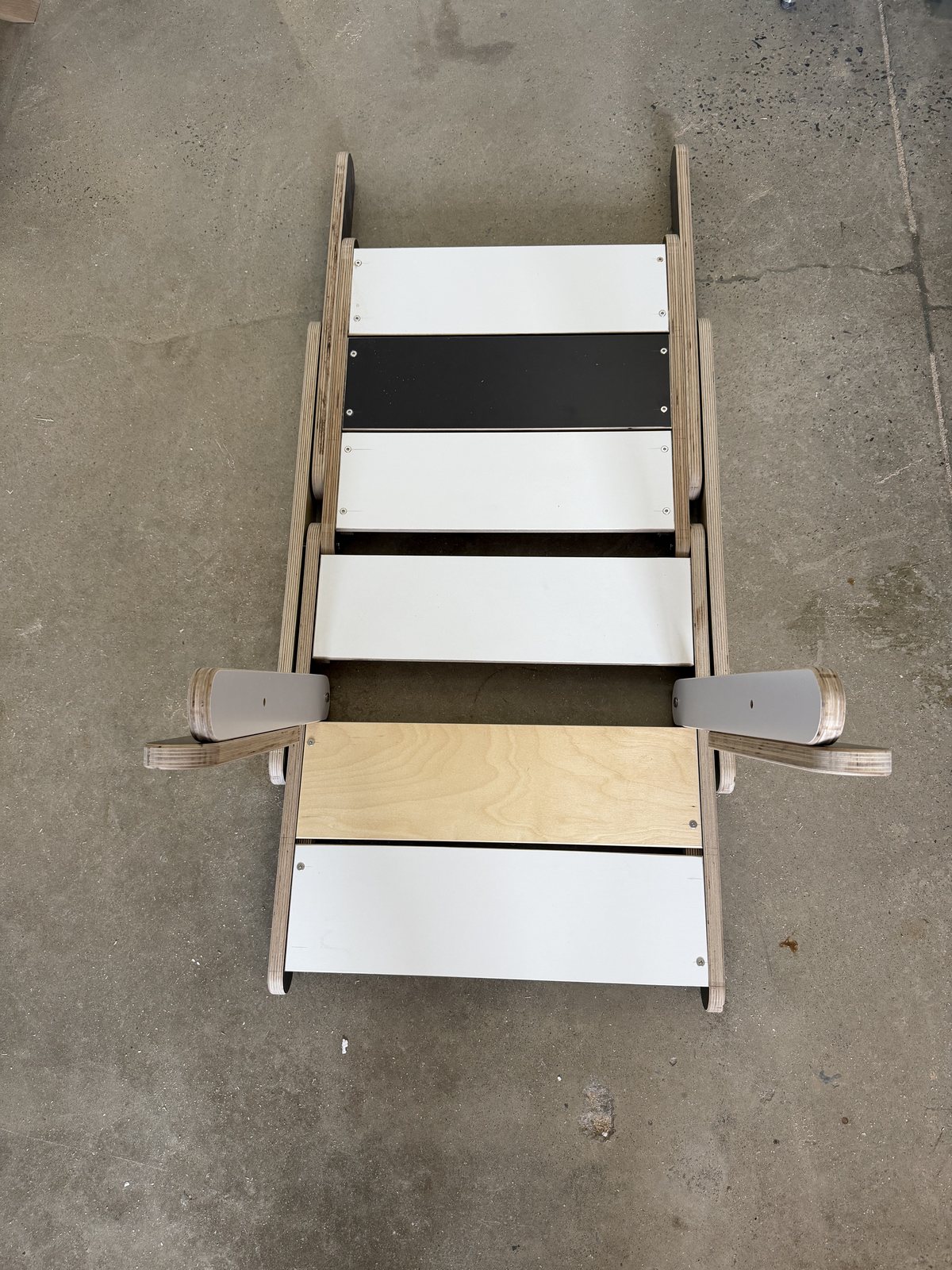
In the keel chair I called the keel a spine and a datum: the member every hard joint lands on, the one end every station is struck from. Those were reasons of manufacture. The popsicle chair adds a reason of physics. Its keel is the only member whose removal turns the chair into a machine. Everything else can be taken away and something rigid remains, a triangle with two sticks hanging off it. Take away the keel and you have a hinge. I had spent a book on the word without knowing that was true, and I learned it by pulling a pin.
What the wood knew that the drawing did not
Twice on the last day the physical chair overturned a prediction the machine had made from a drawing, and both misses ran the same way, so I am keeping them.
The first was the keel's color. Planning the mosaic, the machine wrote that a birch keel against dark members "reads as a missing part rather than an emphasised one." My third build is exactly that, a pale birch keel between black film-faced legs. It does not read as absence at all. The eye goes to it. Birch has figure and the black films have none, so the keel is the one member with something in it. The drawing had shown a flat fill where the wood has grain. Withdrawn, on the record.
The second was the screws. The panels are twelve millimeters thick and sit on hardwood cleats, and I had screwed them down from the top, through the panel into the cleat, with small stainless screws on an even inset. The machine suggested the fastener heads were the busy element on the back and that they should run up from underneath, out of sight. I said no, for a reason of mechanics. Twelve millimeters of panel leaves eight or nine of usable thread, and on a melamine face a breakthrough is visible and unrepairable. Down through the panel puts a clearance hole in the ply and full thread in hardwood, and the head bears exactly where the cleat supports the panel from beneath. The machine conceded the mechanics. Then it enlarged the photographs and conceded the looks too, for a reason I had not articulated and think is right. The screws are one size, one inset, evenly spaced. They read as a stitch line, not as hardware. And on a chair whose panels are visibly different materials, a regular line of fasteners declares them as separate, replaceable parts rather than pretending the seat is one surface. Hiding the screws would make the mosaic look as if it were trying to be monolithic and failing. Showing them makes the modularity legible, which is what the chair actually is.
Both misses run the same way, and the way is a caution against my own method. The drawing had no material in it. A vector fill has no grain, so it could not show that the keel would carry figure. A drawing of a screw has no finish and no rhythm, so it could not show that a row of them would read as stitching. Neither of these is a failure of the machine's arithmetic. They are the ordinary blindness of any drawing, mine included. The only instrument that corrects them is the built thing in the room. That is the verdict of the builds, again, a month after I thought I had learned it.
There was a third correction that week, smaller, and about me. Arguing the seat pan down from ten degrees toward six, the machine reasoned that an indoor armchair "that older guests get out of wants less" pan. I replied: "for the record...I'm an 'older' user (66) and none of these are problematic :)" The argument was withdrawn. Then I settled the pan the way the book says to settle things, by shimming the chair's feet and sitting in it at each angle. The answer came back "pretty subtle. Both are good." Four degrees of pan, which had consumed an afternoon of analysis, was barely perceptible to the only instrument that counts. The chair got pan eight. The afternoon was not wasted; it told me what I could stop defending.
One stick
By the end of the third build the chair had become something I had wanted since the first week and never quite reached with the keel chair: a thing you could make from one instruction.
"the full design is one storey pole with three drill guides."
The story pole is a stick, the same section as the chair's sticks. Its left half carries three drill guides with hardened bushings: one at the datum, then one spacing for the back and front, then a second spacing for the keel, the arms and the seat. Its right half carries four notched length stops: seat and arm, front, back, keel. Ten sticks, three drill positions, four saw stops, one pole. Set a stick against the pole, drill at the guides, cut at the stop, round the ends against the router guide, and you have made a part that will pin to any other part made the same way. The two drill settings the log had been claiming since the geometry was first solved were an abstraction until this stick existed. This is what the claim looks like when it is true.
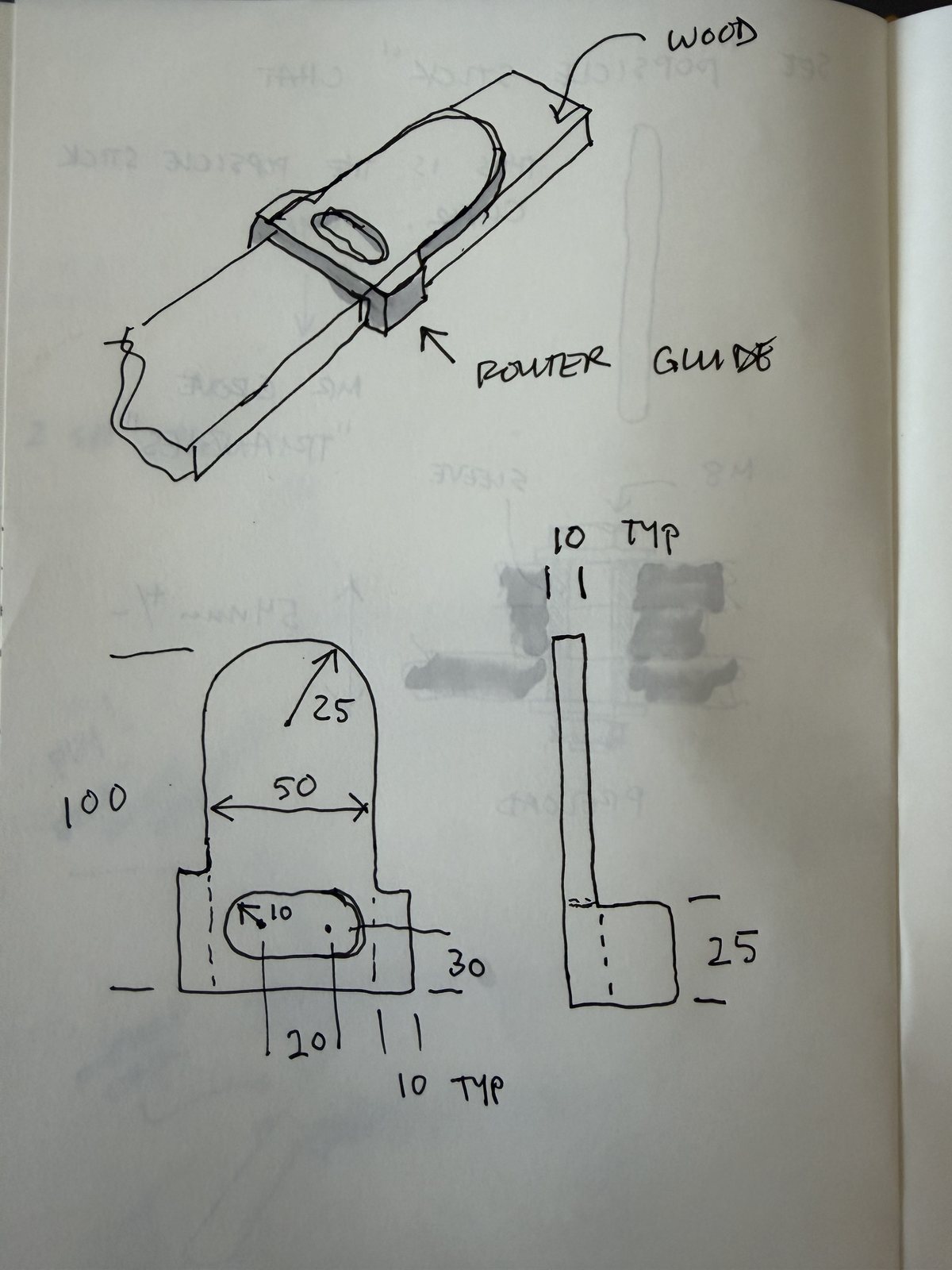
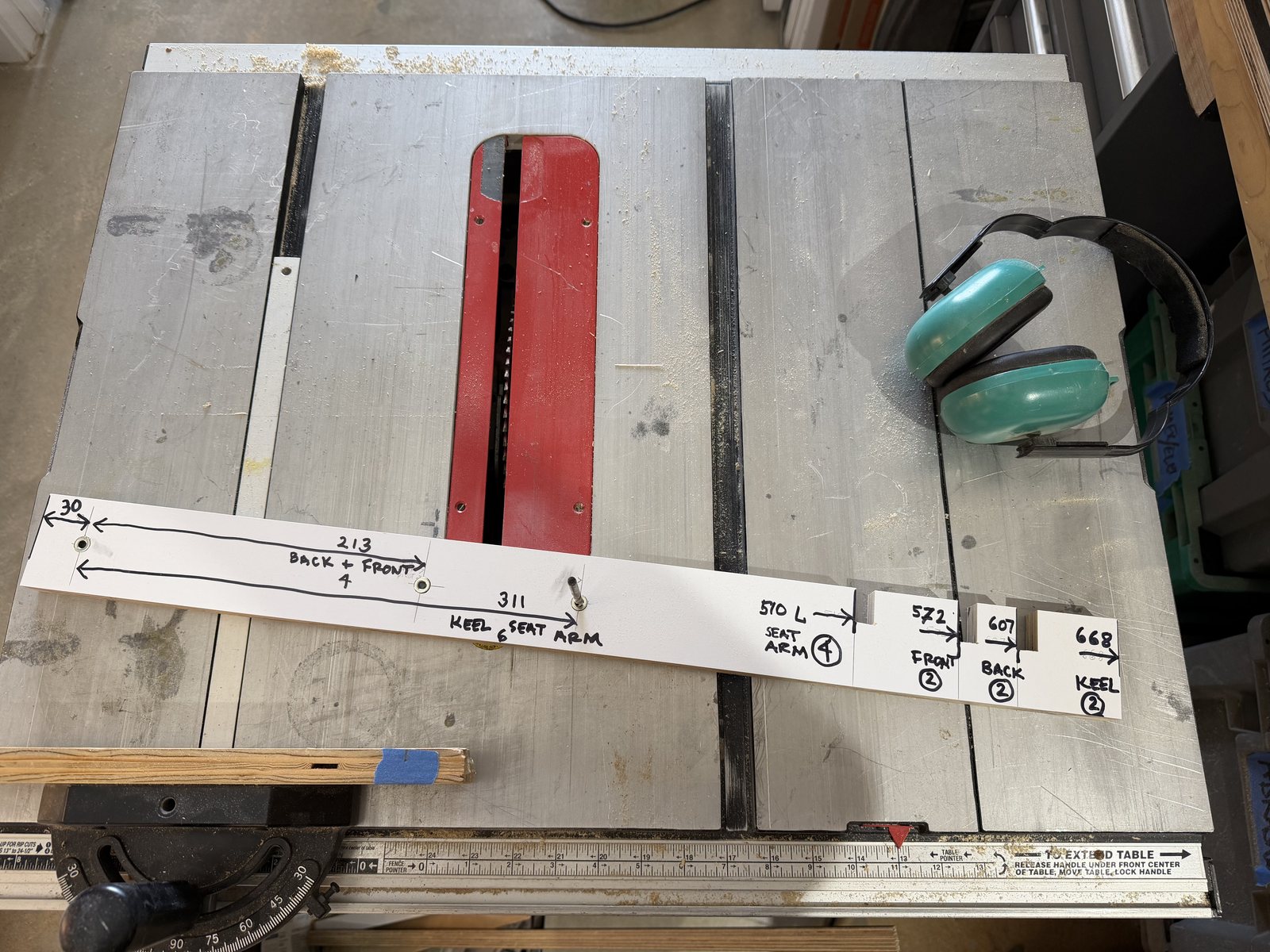
I keep returning in this book to the trade's old word for this, the story pole, and to the keel chair's version of it, where the keel itself was the pole and stayed in the chair to take the load. The popsicle chair's pole does not stay. It is a jig, consulted and set aside, which is what a story pole is supposed to be. But it is a jig for the entire chair, and the first artifact in this project that is purely about making rather than about the object. The Keel Panel's pattern is three drawings. The Keel Truss's pattern is a stick with seven marks on it, and a router guide, and a bin of strips. I do not know a shorter description of a chair.
The fasteners resolved themselves the same way. Eight barrel bolts, four short and four long, because two of the four joints on a side stack two sticks and two stack three. The cleats are screwed rather than bolted, which is what keeps it at two lengths rather than three. A buyer who receives the chair assembled and folded fits exactly two of them, the apex pins, and never touches the rest. The log calls those two pieces "jewellery" and the others "structure," and says the two can look identical while only two have to work as a mechanism. I like that division. It is the chair telling the truth about which parts a stranger will ever need to understand.
What does a designer do with a better idea?
I wrote that question in the scratch pad on the second of September, the day I built the first one, before I knew the answer. The rest of the entry is the whole shape of the problem:
"I noticed Eek just keeps designing. No 'one best way', but that's also partly the business model. He's a designer with a studio and a practice and a business. Feed the beast. But I have two interesting designs here. Both are very interesting...Popsicle better for my original quest; K2 Keel more elegant in some ways, and interesting use of materials. I don't think it's either/or, but the designer has a hard time letting go and accepting when a better idea might be lurking."
That is the whole dilemma and I have not resolved it, so I will report where it stands. The keel chair is the more elegant object. It is the one whose keel went out to a factory for quotation this week, and the chair on the cover. The popsicle chair keeps the promise the book opened with, solves the problem the coda was about to concede, folds with two pins, ships assembled, and can be built from a stick and a bin. It also, and I noticed this with some alarm, may be the better thousand-year chair: ten pinned sticks in white oak, with oak pegs where the bolts are, would need no metal at all. Two days after I built it I wrote: "A product, really. It's better than the K2 Keel in many ways, but primarily in that it solves the scrap problem." Then: "So now we have two chairs." Then, on its own line, the question this chapter exists to ask: "Is this a problem or an opportunity?"
The answer I have arrived at is not the one this book's title suggests. The protagonist was never the K2. I thought it was. I built the whole argument around one object and defended that choice, in these pages, on purpose, because a book about one chair can say things a book about chairs cannot. But the thing that actually lasted across the two builds, the thing that survived the move from seat to arm, from panels to sticks, from a dining room to a deck, was not an object. It was three words: two congruent triangles sharing a keel. The Keel Panel is one body of that idea. The Keel Truss is another. A book called The Hundred-Year Chair turns out to have been about the pattern all along. The pattern has just proved it can outlive its first chair, by producing a second one in four days, from the scrap pile, after its author had stopped looking.
I do not know whether this is the last chair. Eek, whose Wehkamp chair started the night that started this, does not seem to believe in last chairs; he keeps designing, and I used to think that was the business talking. Now I think it may be what the material does to you once you have learned to listen to it. On the fourth of September, at about a quarter to six in the evening, I finished the third build, took the first photographs, and had the feeling again, the click, the scaffolding falling away, nailed it. I have had it several times now on this project. I no longer believe it means I am finished. I have come to think it means I am on the right street. False summits or one long ride, the question I opened with, has an answer I could not have given a month ago. It is one ride. The summits are just where you can see the next one from.
Which leaves the coda with more to hold than it was written to hold: not one chair but two, the same idea in two bodies, and a scrap problem that turned out to be solvable by the second body and not the first. The atoms that are the information, my ship of Theseus, now have a sister ship, and that is where this book finally ends, a little later than planned.
The dates, dimensions, and quotations are from the K3 build log of 2 to 4 September 2026 and my scratch-pad and notebook entries of those days; the founding-message quotations are as printed in Messing Around, and the panel and piece widths are from the Appendix.
A chapter of The Hundred-Year Chair, drafted and refined in public. The same text lives in the book; the interactive tools and the fully-sourced technical notes live here. home · the book · the technical notes · hundredyearchair.com