The Hundred-Year Chair · a chapter
Other People's Rooms
In September 2026, I put the Keel Panel and Keel Truss chairs in my living room in Park City, Utah, and waited for my friends to arrive. I offered no explanation.
For twenty-nine years, with the exception of 2020, we had gathered each September to ride mountain bikes in the Rocky Mountains. For the last fifteen, we had usually met at my house. Some of the bikes now had electric assist, but the gathering had not changed much: riding, talking, catching up on ventures and setbacks. It was a rare and precious stretch of time with people I knew well.
Tom arrived, sat in the truss chair, and joined the conversation.
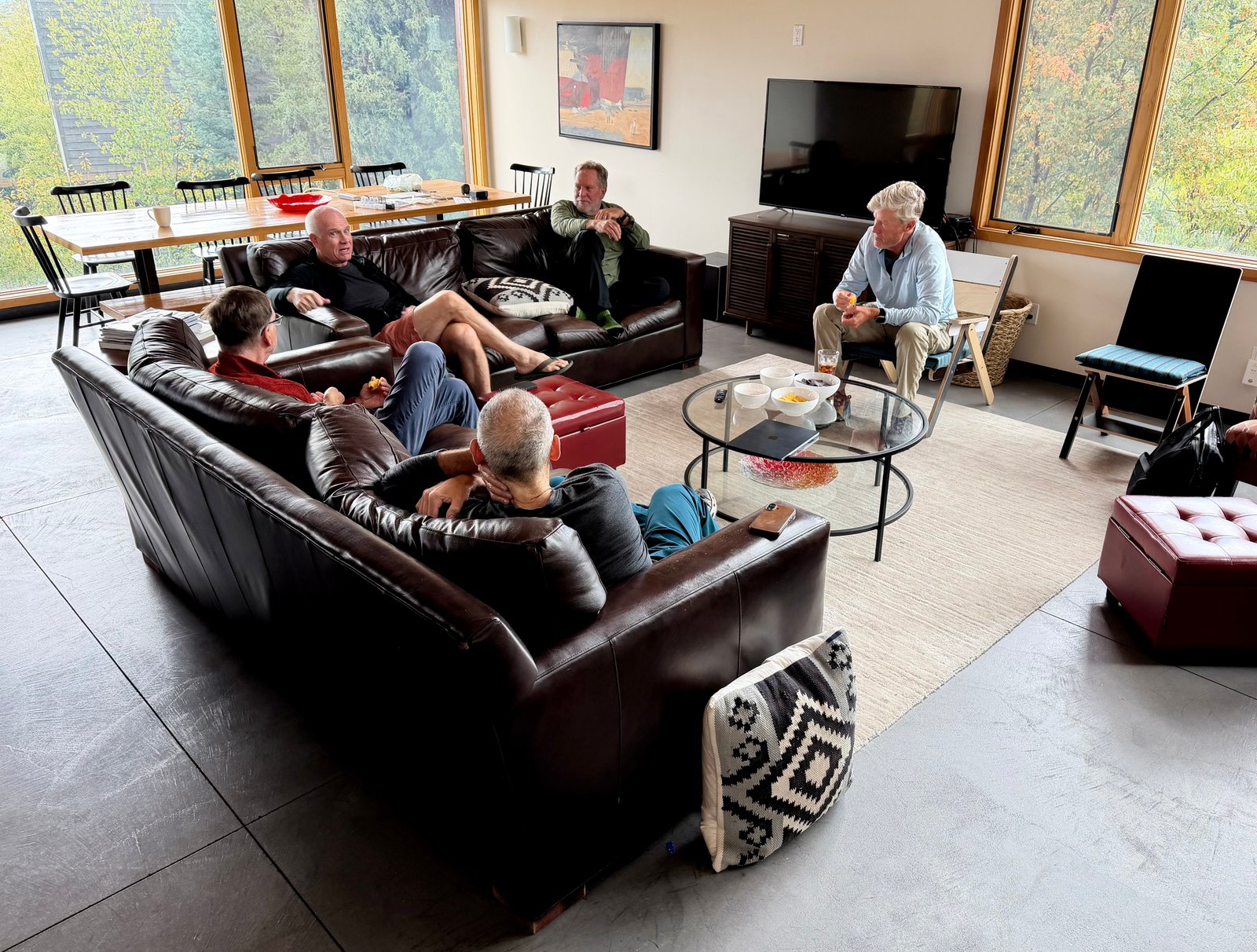
I had known Tom for forty-six years. Together we had faced the hardest job either of us had ever done: converting Italian Catholics, within literal sight of Vatican City, to a weird American religion that required giving up espresso and wine. I am not now a religious man, but I did what nineteen-year-olds did in the faith I was raised in. Tom and I had since been best friends and business partners in many ventures. I cared what he thought.
At that moment I mostly cared whether the pins would stay in the chair. I had made them myself, with 3D-printed caps to hold them in place. Tom did not know he was sitting in a prototype. For ninety minutes I could not relax into the banter. Would a cap break? Would a pin come out? He shifted and leaned diagonally into the back corner. I held my breath. The chair held.
Later Matt, an accomplished industrial designer, walked over to a chair and pushed it sideways from the top of the back. Who does that? A curious designer does. The chair wobbled. I wanted to apologize. I resisted.
Only as the questions mounted did I talk about the project. For at least ten years, by the end of the first day together, David had reliably asked, "what is it this year?" I go deep on projects, often on an annual cycle, and usually have some new pursuit to explain. This time I made him wait until everyone was gathered. Then I pulled up a PowerPoint: eighty-eight slides, no text, just photographs of chairs and designs.
My friend Nathan, an oil painter, said "super cool," though he is a kilt-wearing artist who loves everything. Bob liked how the project brought together so many aspects of my life. I loved that too.
Steve is a perfectionist and he grew up around his father's custom furniture business. He had been building a cottage near his grandchildren, and while perhaps not ready to put my designs in the precious few square feet he had to work with, asked lots of questions and started scheming about furniture designs of his own.
Matt surprised me. He really liked the first scrapwood chair, the one I had not wanted to send pictures of to my kids. He also liked the rounded ends of the popsicle-stick chair. We went deep on how to finish the cap at the top of the arms, a detail I had struggled with on my own. On balance, I thought I had earned a B+ from Matt. I'll take it.
Earlier that month I had taken a chair to my mother in Bryn Mawr. She had been making things all her life. On September 8 I left it in her room with upholstery fabric, blue tape, foam, and scissors, and asked whether she might like to play around with a seat pad. She suggested that my sister Mindy, who was about to visit, was the real maker.
When I returned on September 26, the chair was nowhere to be seen. Mindy had redecorated the room. A collection of ceramic mugs added color, and familiar art from my mother's home was on the walls. The chair had been stowed in the closet.
I offered to take it away and heard no objections. I do not know who had put it there or why.
It was hard not to take that personally. My mother was the person I had sent the first written account of the chair adventure to, back when it was barely an adventure. This time I had brought her the object, along with something we might work on. To me it carried weeks of decisions. I had thought about making the chair and making a seat pad with her. I did not know what she had made of either invitation.
A separate encounter went quite differently. Cyd, a former student and mentee, met me for coffee in my office at the University of Pennsylvania. A Keel chair was there. Some visitors notice it and some do not. Cyd noticed it immediately and asked about it. I gave her the five-minute version of the undertaking. Later came a text:
I can't stop thinking about the Keel chair. So beautiful.
That was a response to how the chair looked, offered again after the encounter was over. It differed from sitting in one for an evening, and from finding a place for one in a room. I wanted all of those things for the chairs, but I had not asked each person the same question. Their responses were not a vote I could add up.
Cyd had taken my Product Design course. She knew me and knew something about design before she encountered this chair. Her delight pleased me without establishing what an unfamiliar customer would think. I was showing the work to people close to me, though closeness plainly did not produce one response.
A result I could measure was easier to defend than a judgment about appearance. I had been arguing about that distinction since college.
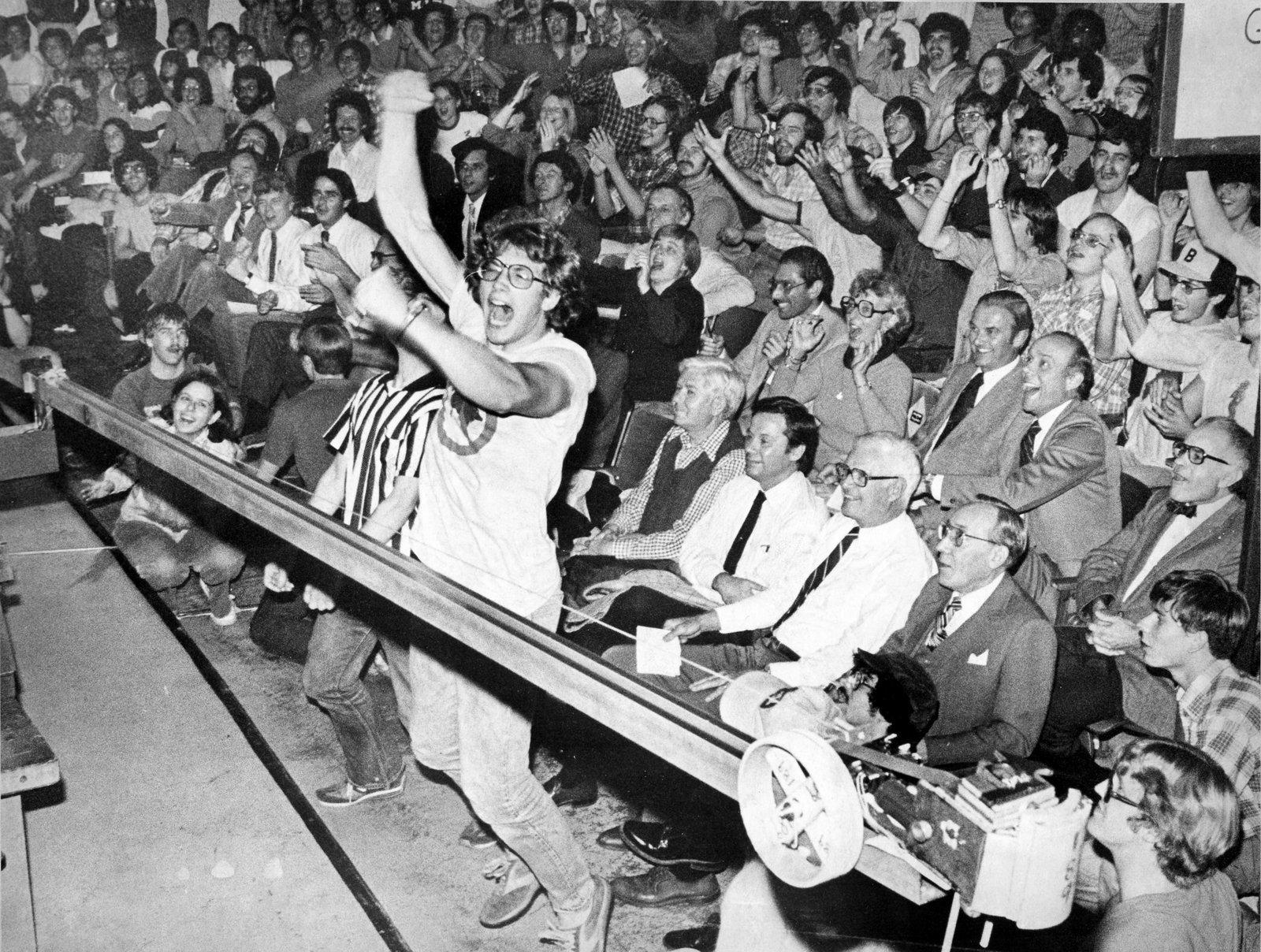
In November 1979, at MIT, I built a machine to win a contest called "a couple of moments of truth." The contest apparatus was a twenty-two-foot seesaw made from a two-by-two, with twelve-volt power strips running along the top. We each received a brown paper bag of parts: wire, a little motor, cardboard tubes, wood. We could use those parts and glue. At the end of thirty seconds, the contestant whose end of the beam was lower would win.
This was the design course numbered 2.70, taught by Woodie Flowers. I had arrived at MIT thinking I might become a physician. Organic chemistry had discouraged that plan; a manufacturing course with work in a basement machine shop had suggested another. Woodie's course settled it. I wanted to study design and do design.
My machine was a tractor. It carried the maximum permitted mass out to my end of the beam, arriving at about twenty seconds. It was not pretty. Nor did its trip along the beam look like much of an accomplishment. But arriving at twenty seconds was deliberate. I had estimated that the beam would take about fifteen seconds to complete a back-and-forth swing. With ten seconds left in the contest, I wanted my machine's arrival to set the beam swinging in my favor when time ran out.
I had also noticed how often a contestant lost because the machine malfunctioned. A clever maneuver was of little use if the thing failed to perform it. I put mine through hundreds of cycles, finding and fixing the failures. By the competition, reaching the end of the beam had become a very reliable accomplishment.
In the final I faced Rich White. The beam went down on Rich's side first. Then my tractor reached the end and the beam slowly swung toward me. It began to swing back. At thirty seconds, it was exactly horizontal.
Indicator lights showed which end was lower when time expired. Both came on. I do not know how they were wired. Rich and I had tied for first place.
The room was stunned. So was Woodie. He had made an acrylic board with a bottle of Jim Beam whisky glued to it, and he tipped the beam in celebration.
I still sometimes put that win in a biographical sketch when the audience includes MIT alumni. About thirty years after the competition, my classmate Fred Wilson was still lamenting his own performance in a conversation about something else. We had not forgotten.
My recitation instructor, Erik Antonsson, gave me something else to remember. On my final report, in red pen, he wrote: "good win, but no class."
Ouch. It still hurts. I concede that the machine was ugly. I am less willing to concede that all it did was trundle to the end of a beam. The timing was part of the design. So was the work of making it run reliably. I had nearly got the swing right, and the tractor had done what I asked of it. It had more class than Erik recognized.
The result was easy to establish: both lights were on. The judgment in red pen was harder to settle. I could point to decisions I was proud of without making the machine any nicer to look at. Decades later, explaining my keel to a visitor could leave me in much the same position.
With another project, I did ask for help with the form.
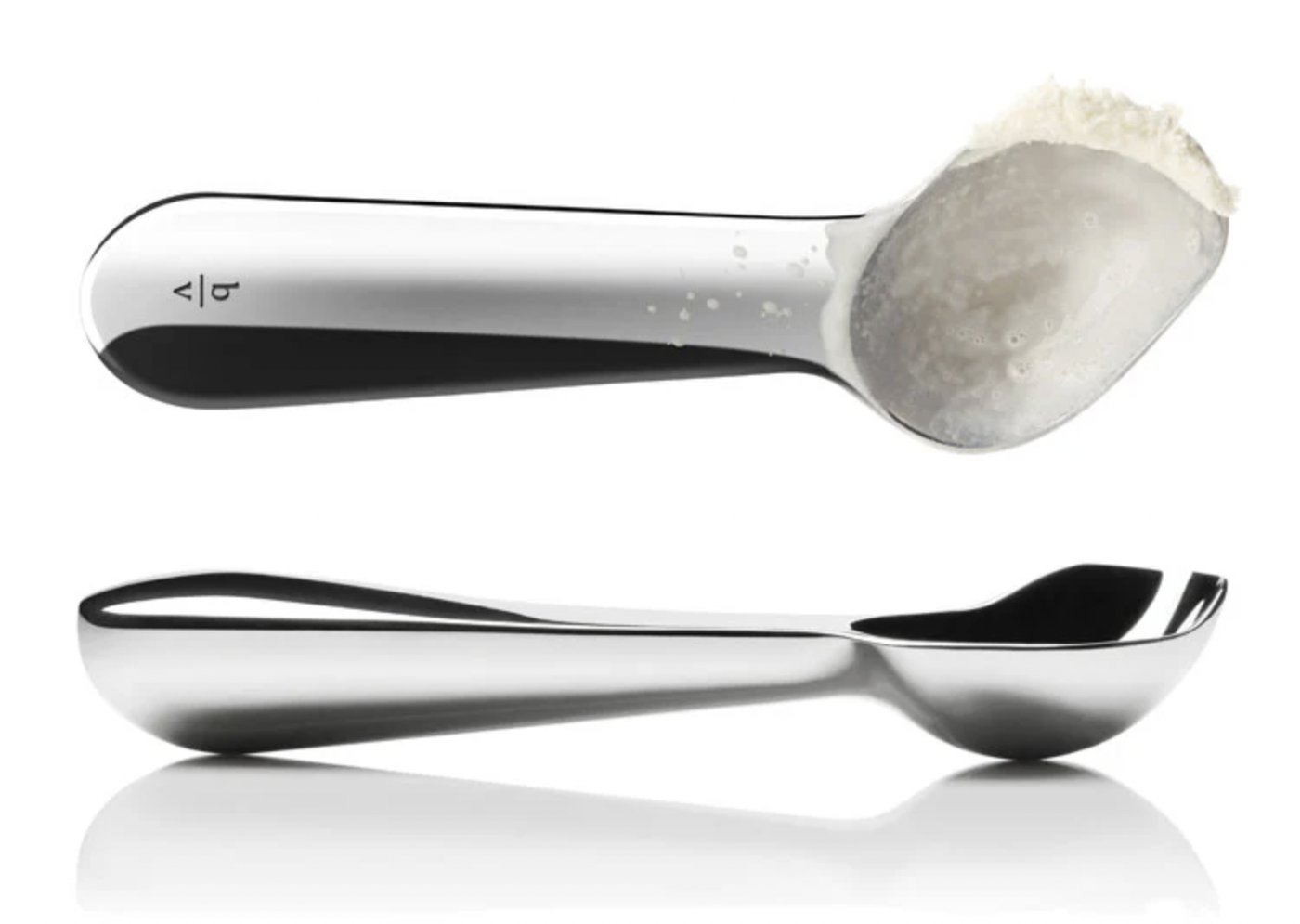
The best thing I have ever designed is an ice cream scoop, and the part of it that people call beautiful I did not design at all.
It started, the way these things do, with a small daily insult. Premium ice cream comes out of an American freezer at about the hardness of a hockey puck, and the scoop in the drawer, some stamped-steel spade with a rubber grip, would either bend, skate off the surface, or send a knuckle into the rim of the carton. I am an engineer by temperament, which mostly means I cannot leave a bad tool alone. I worked out two things. The bowl wanted to meet the ice cream at an angle rather than head on, to carve a curl instead of chiseling a crater. And a solid slug of metal in the handle would do quiet thermal work, carrying the warmth of the room and the hand down into the bowl so the leading edge was always very slightly melting its own path. I built the thing that tested both and proved out the ergonomics, on my own hands and a lot of other people's. It worked. It was also ugly. It looked like what it was, a functional prototype made by a man who cared about scooping and not at all about how the scooping looked.
I took the working prototype to my friends at Lunar Design. They gave it the fluid form of the Belle-V scoop. I had worked out the angle and the heat-conducting mass; they made the object something I wanted to pick up. The finished scoop still reminds me how much another designer can contribute after I think the functional problem is solved.
With the chair, I was reluctant to invite that second pair of hands. I thought the chair was beautiful. I also wanted it to be mine. Those feelings were harder to separate than the two contributions to the scoop.
I can point to some of what pleases me. In the panel chair, the front runs parallel to the back and the low tie runs parallel to the seat. The long diagonal connects those pairs. I had chosen that repetition while working out the triangles. The structure did not require me to make them identical. I liked the way it looked.
I also liked knowing what the keel did. The same piece located the other parts and remained in the finished chair as structure. That economy was a source of pleasure quite apart from a particular wood or color. By elegance I mean that satisfaction in accomplishing several things with little complication. Here it was also personal: I knew the succession of brackets and drawings that had led to the keel. Someone encountering the chair for the first time would see none of that work unless I explained it.
Knowing the work can make me enjoy looking at the object. It cannot tell me whether the proportions will please someone who knows nothing about it. I can explain what I accomplished with the keel more readily than I can explain why the whole chair looks right to me.
The notebook contains a choice I could hardly blame on structural necessity. Early in September I drew the panel chair as a tribute to Rietveld's Red and Blue chair: red back, blue seat and tie, black keel, and yellow accents. On September 4 I made a tenth-scale model. The yellow went on the front legs, since there were no brackets at that scale. I had not built it full size or decided whether to do so.
Nothing in the load calculation had requested those colors. I wanted to see a familiar palette on a different arrangement of parts. Calling it a tribute acknowledged the borrowing, but did not settle whether it made my chair better. The little model let me consider that question with an object on the table. It also complicated the wish for a chair that was entirely mine. I could trace influences in the construction and name this one in the paint.
The scoop leaves me with an awkward question. Am I reluctant to call Lunar because I like the chair as it is, or because I want to remain its designer? I could make a respectable argument about how little remained to change. I had made the same mistake often enough in my career: good industrial designers found a move in a space I had declared empty. They might change proportions, an edge, or something I had not thought to question. I would have to see their work to know.
I still want this one to be mine. The risk is accepting a chair I like partly because I made it, when another designer might make something I would like better. The student's delight does not remove that possibility. The chair in the closet does not tell me which part to change.
Making the chair only for myself would let me settle a disagreement about taste by making what I like. A business does not have that convenience. It needs enough other people to want the result, at a price and under conditions that let it keep making it. A friend can admire the chair without wanting to buy one. Someone might buy one for reasons I had barely considered. I could not answer those questions by explaining the geometry more persuasively.
The scrap problem belonged to a business, but much of the pleasure of the project belonged to me. I could keep making chairs for myself and people who shared my interests. If I wanted to sell them, I would need to learn what place they might occupy in other people's lives: a dining table, a porch, a small apartment, a room with furniture already in it. My mother's room already had a history before my chair arrived.
Writing about the chairs leaves room for another response: someone might want the story without wanting the furniture. As a young man I read everything Tracy Kidder wrote, starting with The Soul of a New Machine. His book House held me like a thriller. I cared about the architect and the builders and wanted to know how they would get through the job. The house itself struck me as perfectly nice, rather than an object I needed to go and see. That possibility has stayed with me while writing about a chair. You might enjoy the undertaking and look up from the page at the object and say, meh.
I would prefer you to love the chair. I also remember how much I enjoyed Kidder's book without wanting his subject in my own life. You can see my chairs in the photographs and disagree with my taste.
The gray rocker in my living room had arrived there by a different route. I had known it since childhood and asked for it when my parents were downsizing, with one repair still unfinished. I wanted that particular chair, including the work my father had done on it.
Notes
- "Keel Panel and Keel Truss": Author's September 30, 2026 scratch-pad account and accompanying editorial correspondence identify the two chairs in his Park City living room. The earlier scratch-pad entry dates the gathering to September 19, 2026.
- "For twenty-nine years": Author's recollection of the annual mountain-biking gathering, the 2020 interruption, and its usual Park City setting over the preceding fifteen years, recorded September 30, 2026.
- "Tom in the Keel Truss": Photograph supplied by the author as photos/inbox/IMG_3817.heic; the author confirmed Tom's identity on October 4, 2026. The original records a September 18, 2026 capture date. The publication derivative preserves the complete frame, with no cropping or retouching; it is resized for the website and stripped of metadata. The caption's account of the author's attention comes from his recollection of the gathering, not something established by the photograph alone.
- "known Tom for forty-six years": Author's recollection of their religious mission near Vatican City, friendship, and subsequent business partnerships, recorded September 30, 2026, with wording revised by the author October 11, 2026. The characterization of the mission and religion is the author's retrospective view.
- "3D-printed caps": Author's account of the homemade retaining pins and his anxiety during Tom's ninety-minute use. The chair holding during this encounter is an informal observation, not a structural test or evidence of long-term safety.
- "pushed it sideways": Author's September 30, 2026 account of Matt's informal examination. The account does not specify which of the two chairs Matt pushed; the draft does not assign one.
- "what is it this year?": Author's remembered wording, recorded in the September 29 and 30, 2026 scratch-pad accounts. In his October 11, 2026 correction, the author identifies David as the friend who reliably asked the question by the end of the first day together. The eighty-eight-slide presentation is also from the author's account.
- "super cool": Author's recollection of his friend Nathan's words, recorded September 30, 2026. Nathan is the oil-painter friend, not the author's late brother of the same name. Bob's response is paraphrased from the same account.
- "Steve is a perfectionist": Author's account supplied October 11, 2026, describing Steve's family furniture-business background, cottage project, and response to the chairs. His possible reluctance to use the designs in the cottage is the author's inference, not a quoted verdict from Steve.
- "earned a B+ from Matt": Author's retrospective assessment, not a grade or quotation supplied by Matt. The reported preferences and arm-cap discussion come from the author's September 30, 2026 account; no resolved detail or subsequent change is claimed.
- "On September 8": Author's scratch-pad account of taking the chair and upholstery materials to his mother, and returning on September 26, 2026. He does not know who stored the chair or why, and the record does not establish that he took it away.
- "coffee in my office": Author's September 30, 2026 scratch-pad account and explicit correction in the editorial conversation that day. There had been an earlier sushi meeting; the actual chair encounter was over coffee in his University of Pennsylvania office.
- "I can't stop thinking": Author's relayed wording of Cyd's text. [VERIFY] Obtain the original message, its date, and permission for quotation and the chosen identification before publication.
- "taken my Product Design course": Author's September 30, 2026 scratch-pad account. Cyd was his former student and mentee; no claim of a representative customer response is made.
- "a couple of moments of truth": Author's September 30, 2026 recollection supplies the November date, title wording, beam dimensions, power strips, parts kit, and thirty-second rule. Sarah H. Wright, "Tiltillator" conquers 2.007, MIT News, May 16, 2001, https://news.mit.edu/2001/2007-0516, confirms a beam contest in 1979 but gives the title as A Couple Moments of Truth. [VERIFY] Check a contemporary rule sheet or program for the exact title and specifications. The author's remembered wording is retained pending that check.
- "taught by Woodie Flowers": Author's September 30, 2026 account of course 2.70 and his change from an intended medical career to mechanical engineering. The response to organic chemistry and the machine-shop course is personal recollection; no general claim about either discipline is intended.
- "arriving at about twenty seconds": Author's recollection of his timing strategy, maximum permitted mass, and estimated oscillation period. Fifteen seconds describes his estimate of a back-and-forth period, not a frequency or a newly verified dynamic calculation. The uncertain numerical mass limit is omitted.
- "through hundreds of cycles": Author's September 30, 2026 account of testing and debugging. His observation that many competitors lost through malfunction is not a measured competition-wide failure rate.
- "Rich and I had tied": Wright, "Tiltillator" conquers 2.007, MIT News, May 16, 2001, https://news.mit.edu/2001/2007-0516, identifies Karl T. Ulrich and Richard P. White as joint first-place winners in 1979. The beam's sequence of movement, horizontal finish, and two illuminated indicators are the author's firsthand recollections, not details established by the retrospective. The indicator wiring is unknown to him.
- "bottle of Jim Beam whisky": Author's September 30, 2026 account of Woodie Flowers's celebration with the bottle attached to an acrylic board. The supplied image, photos/inbox/dept_me_2.70.1979.jpg, shows spectators, the beam, and a young man with raised arms; it does not establish the bottle story. At the author's request on October 4, the complete photograph is included as an FPO, resized and stripped of metadata without cropping or retouching. The author identifies the scene as the tied finish. [VERIFY] Establish the photograph's source, photographer, reproduction rights, and final credit before removing the FPO designation; confirm any named-person identifications before adding them to the caption.
- "my classmate Fred Wilson": Author's recollection of a conversation roughly thirty years after the contest. This is a paraphrase, not a recovered quotation or an account of Wilson's later career.
- "good win, but no class.": Author's recollection of Erik Antonsson's red-pen comment on his final report, recorded in the September 30, 2026 scratch pad. [VERIFY] Check the original report if it survives. The interpretation of what the machine accomplished follows the author's later clarification in the editorial conversation, which supersedes the scratch pad's earlier unqualified agreement with the criticism.
- "ice cream scoop": Author's account of developing the Belle-V scoop and working with Lunar Design. [VERIFY] Reconcile the division of contributions with project records, collaborators, and patent documents; patents identify inventors but do not alone allocate visual and mechanical contributions.
- "warmth of the room and the hand": [VERIFY] Support the proposed heat-transfer mechanism with the scoop's design record or measurements. Distinguish the intended mechanism from an experimentally established melting rate.
- "tribute to Rietveld's Red and Blue chair": Author's notebook, gallery/notebook2-p22-red-blue-tribute.jpg, and September 4, 2026 model photograph, gallery/2026-09-04-red-blue-model-scale.jpg. The preserved aesthetics chapter records the palette, yellow front legs, and undecided full-size version.
- "Tracy Kidder": [VERIFY] Verify publication details for Kidder's The Soul of a New Machine and House against the editions the author read. The response to the books and the house is the author's recollection and opinion.
A chapter of The Hundred-Year Chair, drafted and refined in public. The same text lives in the book; the interactive tools and the fully-sourced technical notes live here. home · the book · the technical notes · hundredyearchair.com