The Hundred-Year Chair · a chapter
The Search
The founding message opens with a vision, that these chairs would be beautiful mosaics made from otherwise wasted material, and then, in the same breath, it lays down the rules:
- standard thicknesses only, six, twelve, eighteen, twenty-four millimeters; - one fastener, the 43mm T20 stainless flathead we stock; - rectangular pieces, made by ripping and crosscutting and nothing else; - and the line I would spend the next two months inside, "Hopefully we don't need complex profiles, faceted edges, or bent features."
That is four constraints before anyone has drawn a line. I thought I was describing what a person with a saw and a pile of strips could reasonably do. In fact I was spending most of a design's freedom in advance. A brief that tight is not a neutral start. I had already decided the answer to the scrap problem is a chair, mostly based on my interest in chairs and the Piet Hein Eek inspiration. I had also constrained the way scrap could be used to make the chair, probably somewhat unreasonably. How much did that narrowing cost me? Less than the tightness suggests, I think. Within a few days I had ignored most of it, and by the second week I had even changed the goal itself, from a chair that consumes scrap cheaply to one meant to last a hundred years. Nothing about longevity appears in the brief.
The same kick-off message asked for one more thing: "please research the benchmarks and create for me a catalog of exemplars, including images, sources, and descriptions." Fourteen minutes later it was in my folder, twenty chairs in five groups, Eek's scrapwood pieces, Enzo Mari's Sedia 1, Rietveld's crate chair of 1934, some pallet chairs, some open-source fabrication chairs, Donald Judd's Chair 84. Nearly every object that ultimately shaped this story was in my hands before lunch on the first day, and I barely opened it. I was in action mode and apparently not in the mood for a study of the past.
My next step was sensible and foundational. What is required by the human body for a comfortable chair? I had an answer by the next morning. I asked what reviewers say about sitting in an Eek chair, what the ergonomics literature gives for dining-chair angles and dimensions, and whether a sliding backside is really a problem on a seat that is tilted up a bit. Then three questions in a row about padding, because I was thinking about those rectilinear planks and hoping the complexity of supporting the curved surfaces of the body could live in a cushion instead of in a structure. Then lumbar support, which almost no dining chair has where the textbooks recommend. On that Saturday morning I asked for the answers as a drawing: seat height set, the seat and back planes at their angles, dimensioned, the seat and back left flat because the contour was still open.
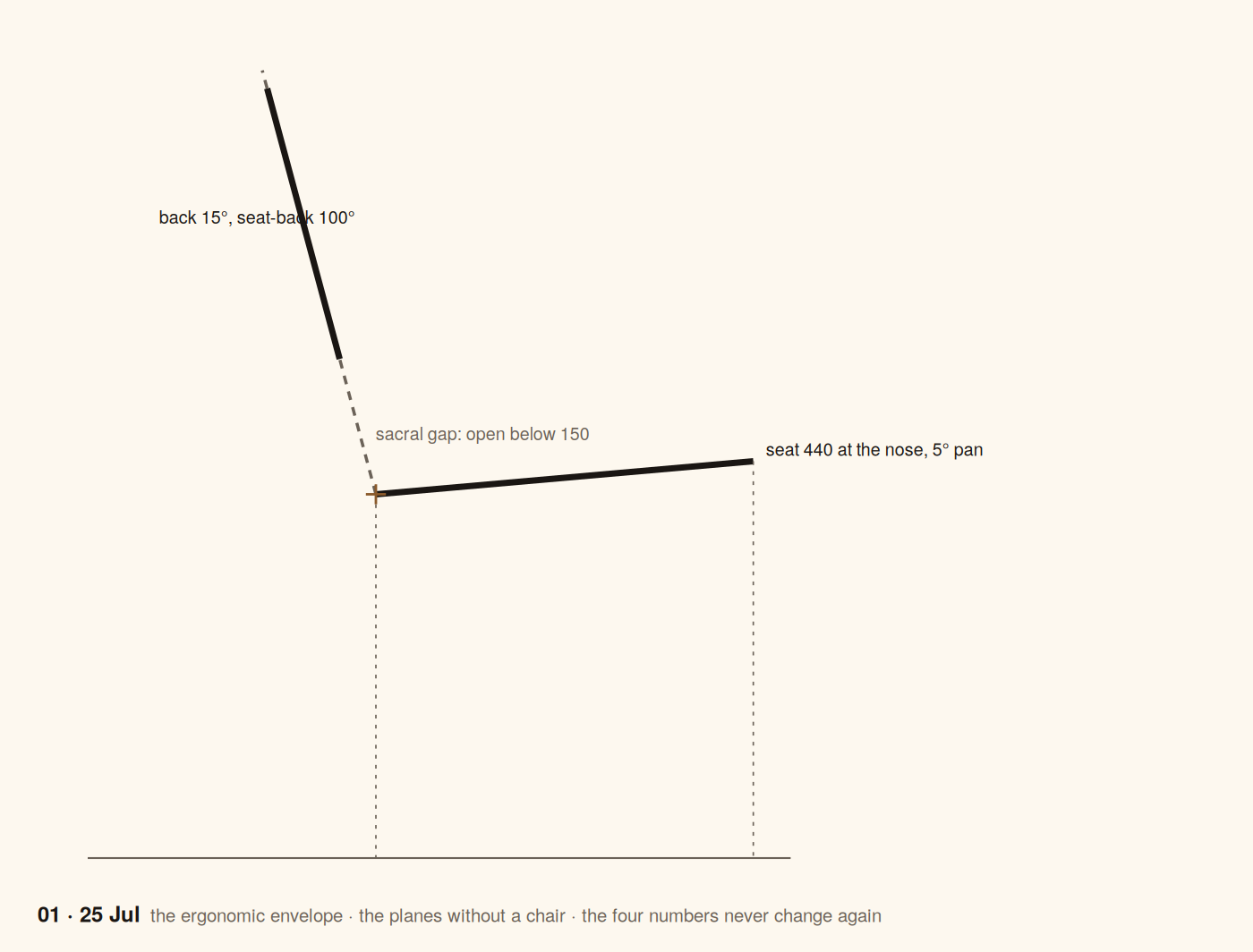
Everything else in this book moved around a lot, some parameters many times. Seat pan angle, back tilt, and seat height have not budged since July 25.
Despite my enthusiasm, the record went quiet for two days. On Sunday, Wendy and I took a road trip to Noosa Head, a gorgeous beach town on the Sunshine Coast north of Brisbane. On Monday I went shopping for scrap. I went to my favorite salvage place and found some nice hoop pine wall paneling, about 20mm thick and 100mm wide and with various layers of paint, including some funky lavender. I also couldn't pass up a screaming deal on salvaged black film-faced 18mm plywood pieces that were 5 dollars each. I got back to my desk on the morning of the 28th at 3:40am. I must have been feeling some anxiety about scholarly research again, because I was asking the machine to help me make a plan about what academic research projects I could reasonably finish before a retirement date I estimated at June 2033. The machine and I had settled what ought to be my real priority, a paper on why American houses stopped getting cheaper. At five I was choosing a journal for a different paper. Between queries I was sketching chair designs. By 7am, the machine and I were building a computer model of a design of a chair to use scrap wood. At one minute past seven, with all of the other threads still open I typed, "I am going to build a v0 as shown in this drawing." By then I was multitasking like a man avoiding his own seven-year plan. The chair was the shiny thing that kept pulling me off it.
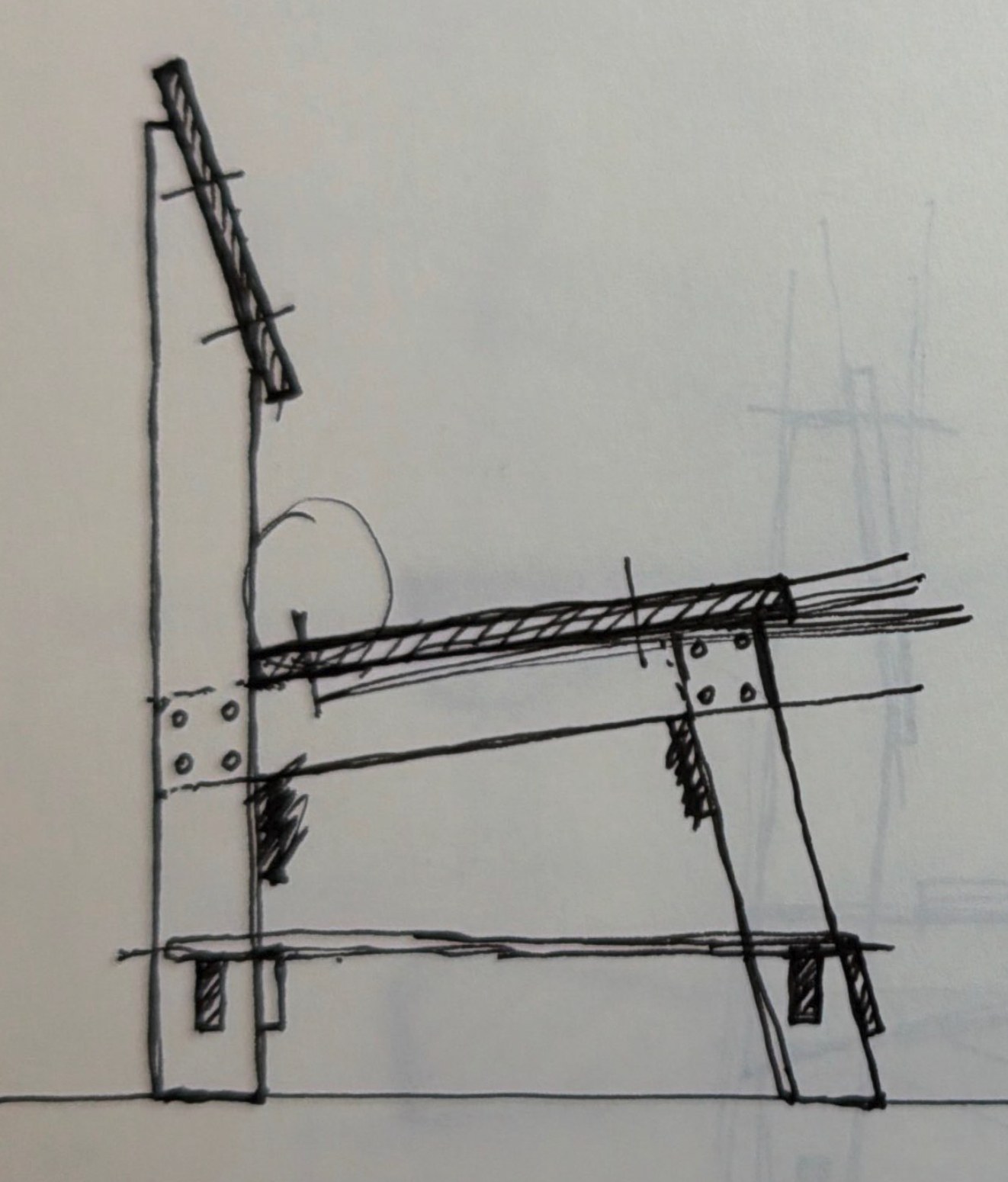
The machine and I spent about two hours finalizing the design:
* "so close! adjust position of rear leg/back assembly"
* "I intended that the front corner have an aligned front edge"
* "does the rear leg have to be this far back? I'd like 30mm of overlap"
* "how much shorter can the seat supports be?"
* "the back/rear-leg interface is now visually awkward. Rotate the rear leg back"
* "shorten the rear leg by 28mm"
At ten to nine I looked at the rendering on the screen and wrote this sentence:
"This is a clean and efficient chair that doesn't look bad. Indeed it's hard to imagine a chair that is more efficient and that would make better use of materials. How can this exact design not be the default vernacular chair design?"
Read the praise and you can hear the reservation in it. The efficiency gets a superlative and the looks get a double negative. The useful part is the question at the end. The machine and I had designed what looked like the simplest, most material-thrifty chair a person could build. That made me ask why it was not already the chair everyone builds. That question, not the chair, is what sent me back to the original research on precedent chairs I had ignored.
I built that chair from the black salvage plywood that afternoon. The photographs from the shop put me at the mitre saw by half past eleven, the four cut strips on the bench ten minutes later, and the two side frames screwed up by a quarter to one. I was back at the keyboard by ten to two.
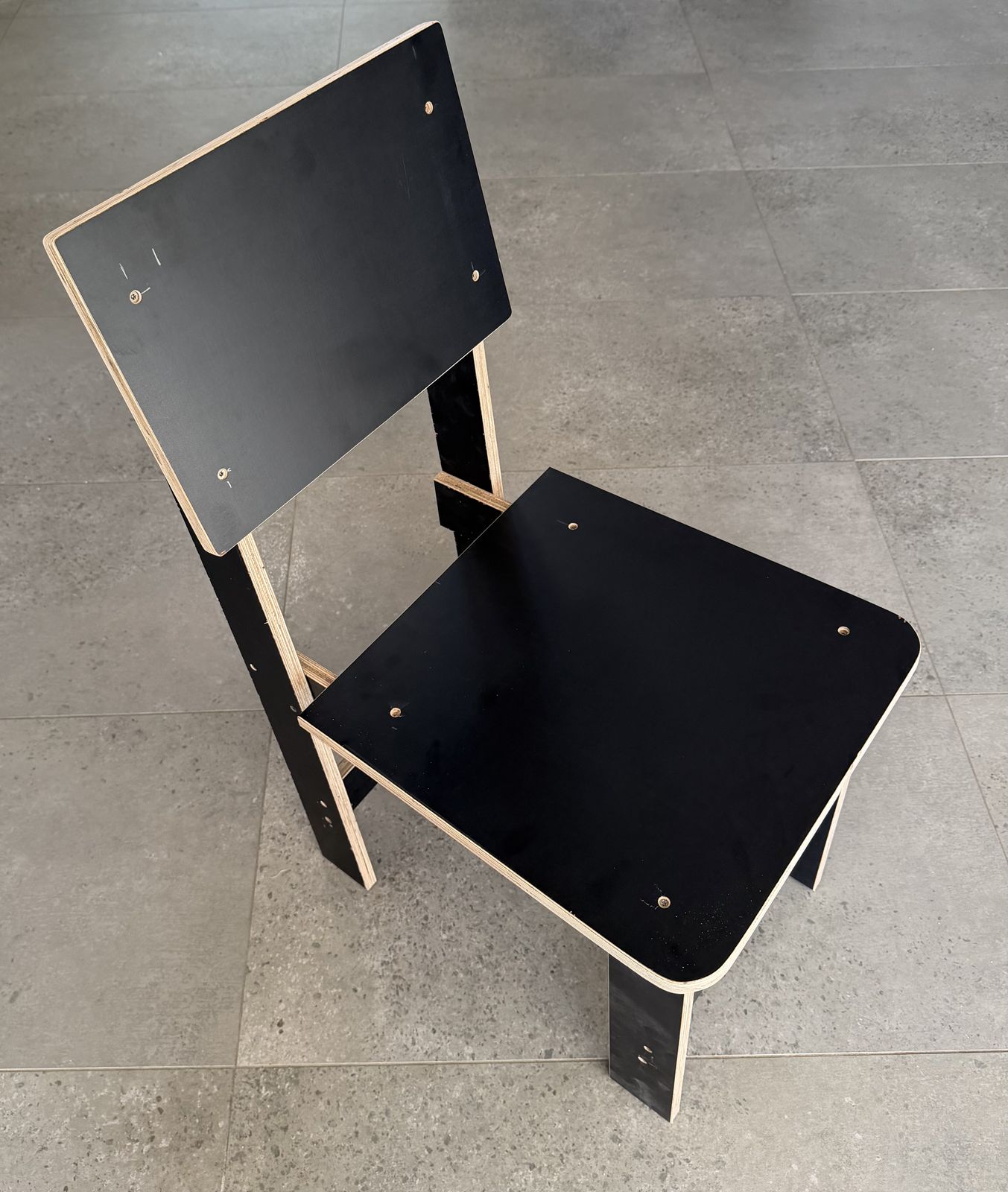
One more thing about that first chair. I photograph pretty much everything I make and send it to my children. I photographed this one. I did not send the pictures. That is the tell. On the record I defended it as efficient and functional, and I meant it. The photograph stayed on my phone. A thing can pass every test you set it and fail the one you never wrote down. I did not stop designing with this chair, and I did not mistake it for the answer. This was not a false summit. It was a quieter signal, the kind you read only in hindsight, that I not yet found my chair.
Now that I had a chair, even it not my chair, I asked for the precedents again, this time as a wall, with my own chair rendered in the header so everything else could be placed against it.
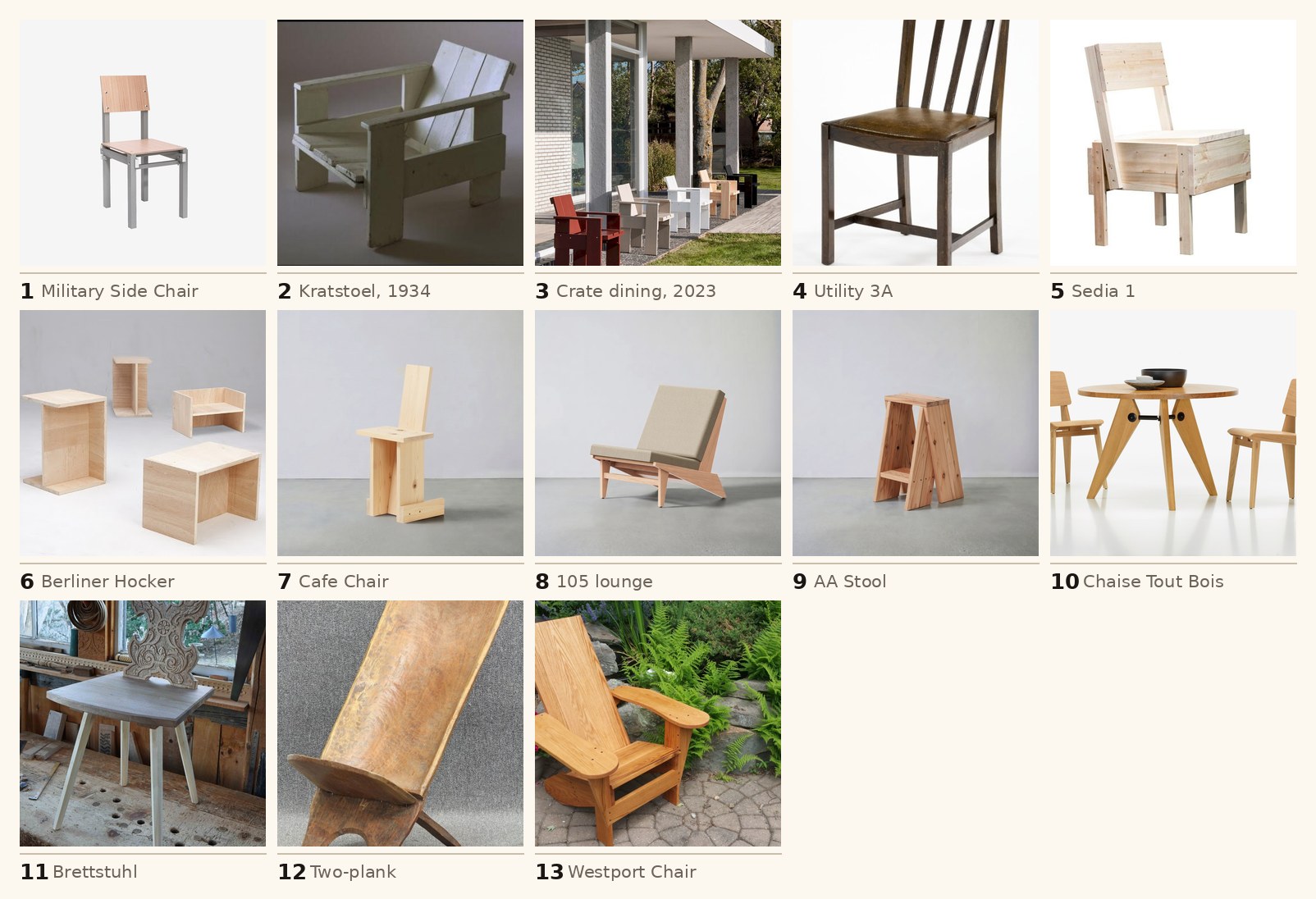
The objects were the same ones from the previous Friday, so why did the wall teach me something the first catalog had not? I had ventured out into the world of experience and built a chair. It did not move me, which gave me some humility and gave me a reason to look a little closer at what others had done. I was compelled by the Rietveld's crate chair, by the contemporary Hay version of it, and by a question that is really a MakerStock question: could a crate-type chair be a better cut-the-scrap chair than my design?
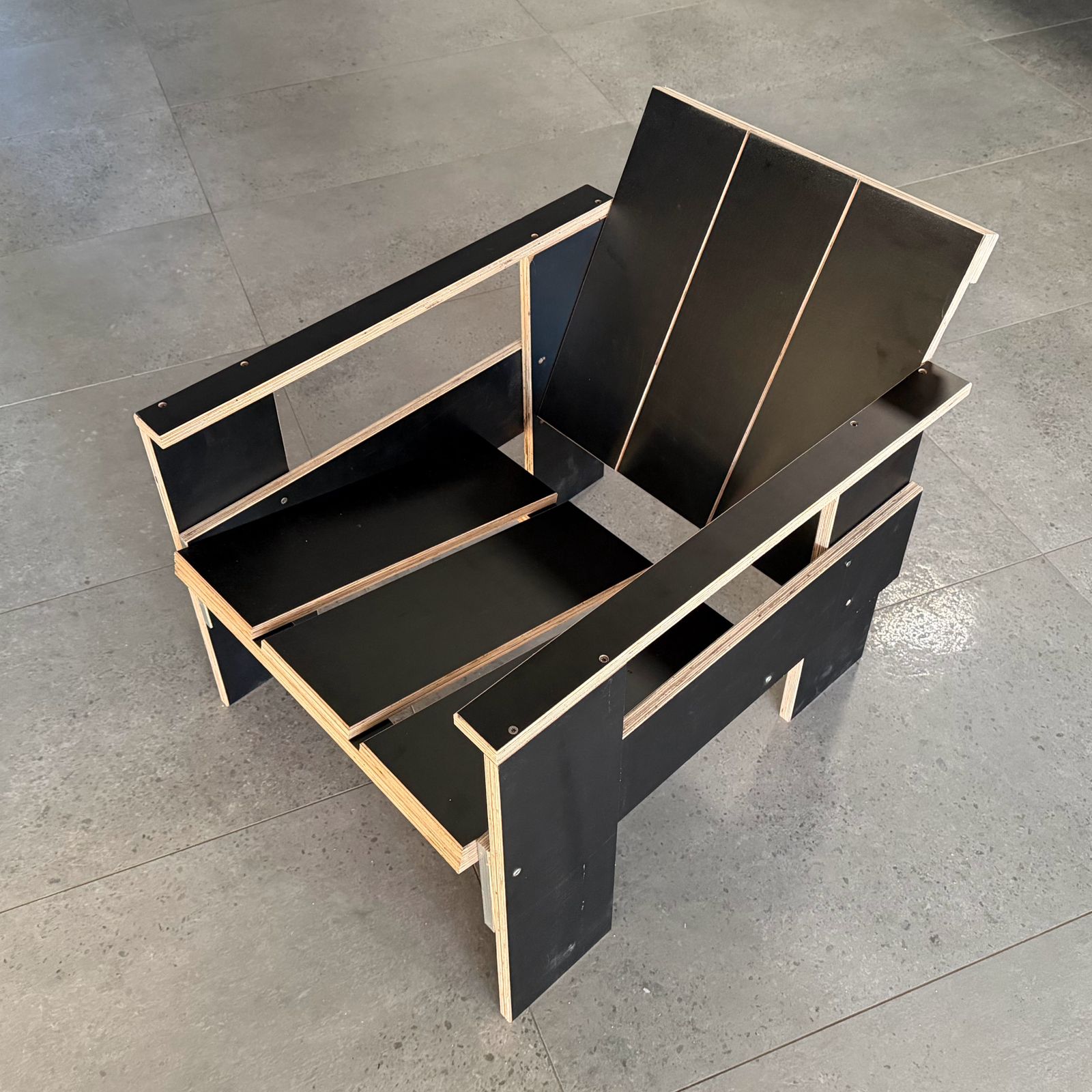
I built the crate chair from Rietveld's own published sheet, from more salvage plywood, and an afternoon. He had drawn it in 1934 as plain boards, square cuts, screws, a parts list with costs, on the premise that the buyer could be the builder. That premise was exactly the property I was after. Mine came out sharp. I was proud of it. I said so, and I sent the photograph to my children.
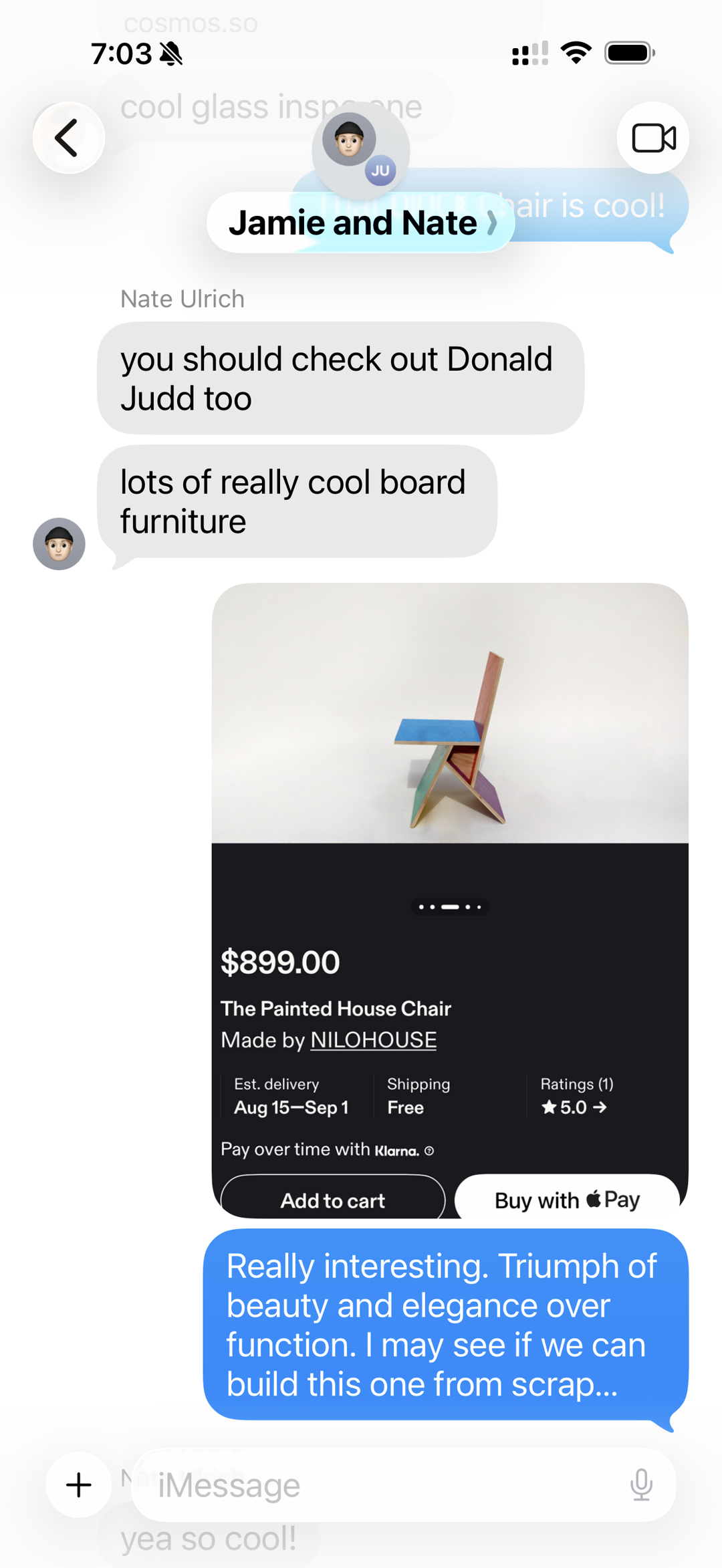
The most useful thing I did that week was make a mistake and keep it. On the thirty-first my son Nate texted me about Donald Judd, and I brought it to the machine in the tone of a man handed extra homework: "Geez...now we have to bring in Judd." Judd's Chair 84 had been on my own wall since the first morning and I had never noticed it. I looked at the furniture and mostly bounced off it, interesting in a spare architectural way, but form ahead of function, and I said so. Then I found one I thought was genuinely cool, a bright four-panel chair, and I texted it to Nate as a Judd.
It was not a Judd. It was a Verner Panton, the Vilbert, which IKEA carried for about two years in the nineties. My notes only start saying so about a week later, so for that week I worked from an object that carried Judd's name in my head and Panton's color in the photograph. Why does that matter? Because if we could name what we wanted, we would already have it. A search that returns only what we ask for cannot hand us anything we did not already know. Had Nate texted "look at Panton," I would have found the molded plastic and the famous cantilever, and I doubt the Vilbert would have surfaced at all. Trusting a name I should have checked put an object in front of me that neither correct search would have reached. When I learned it was not a Judd, my first instinct was to go back to the real Judds. The real Judds had nothing for me. The mistake had the chair.
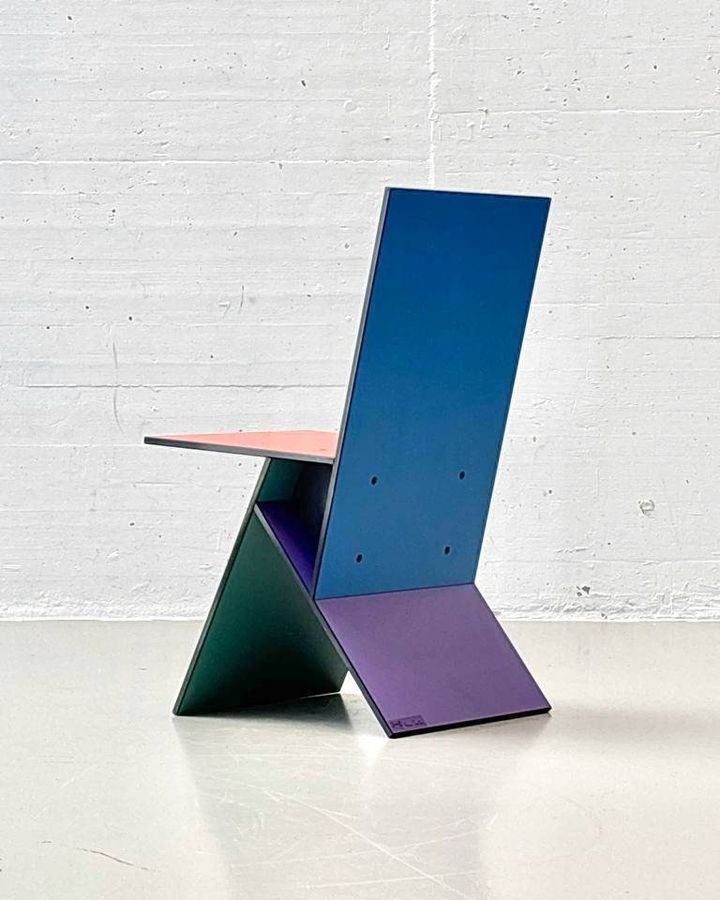
The Vilbert grabbed me. It struck me as a fine MakerStock chair, a good chair you could make from our materials and sell as a kit. Probably not a cut-the-scrap chair, though, since it wants panels more than strips. Those are two different goals, and I was already, without quite admitting it, drifting from the second to the first.
Because there were no public drawings, I estimated dimensions with photographs and fitted line segments to estimate its angles, then drew a central bracket to hold the panels at the right angles. Then I did the cheap thing. I scaled the bracket to a tenth, 3D printed it, and built the whole chair at one to ten out of two-millimeter plywood and superglue, a few minutes of work.
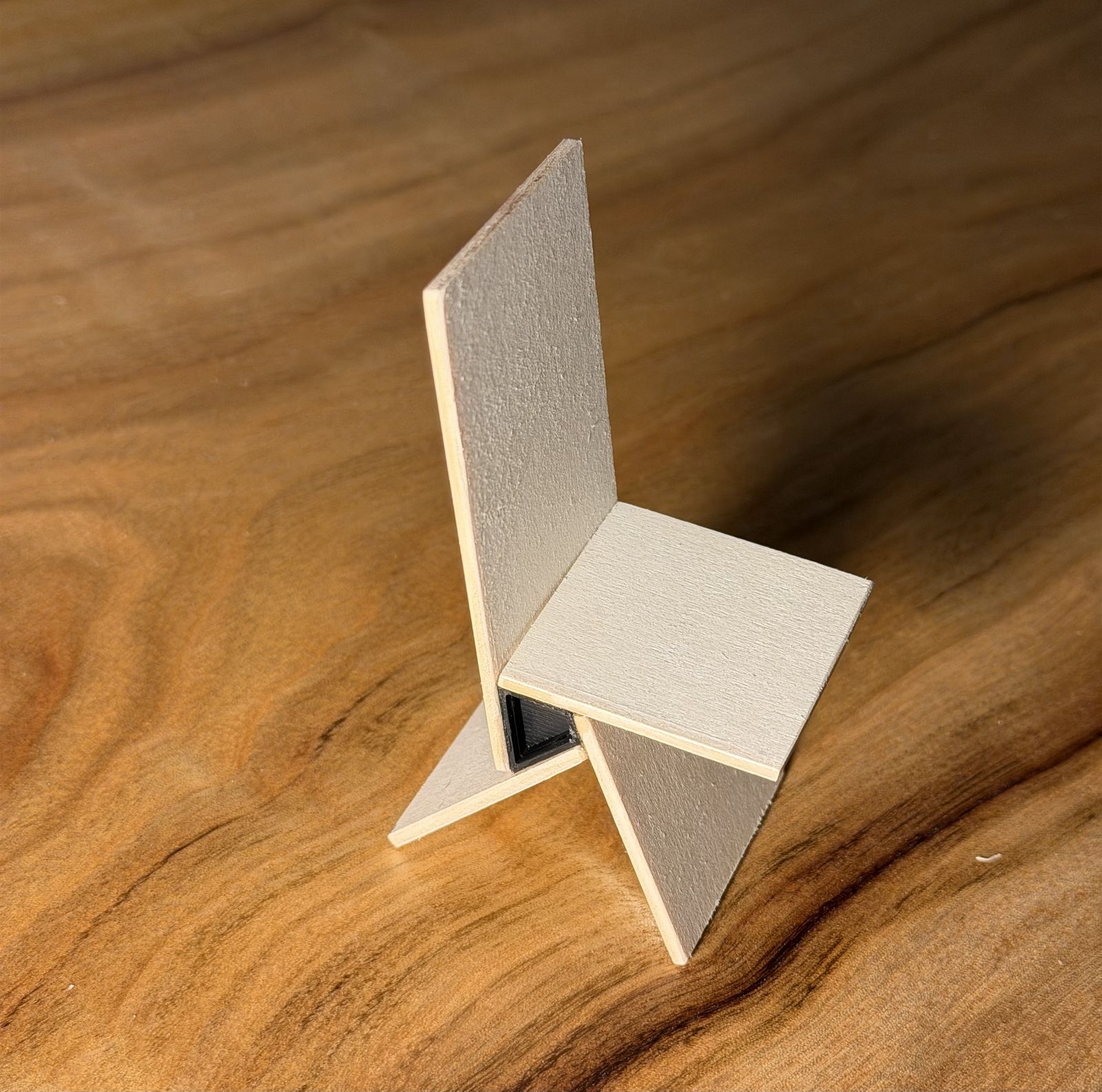
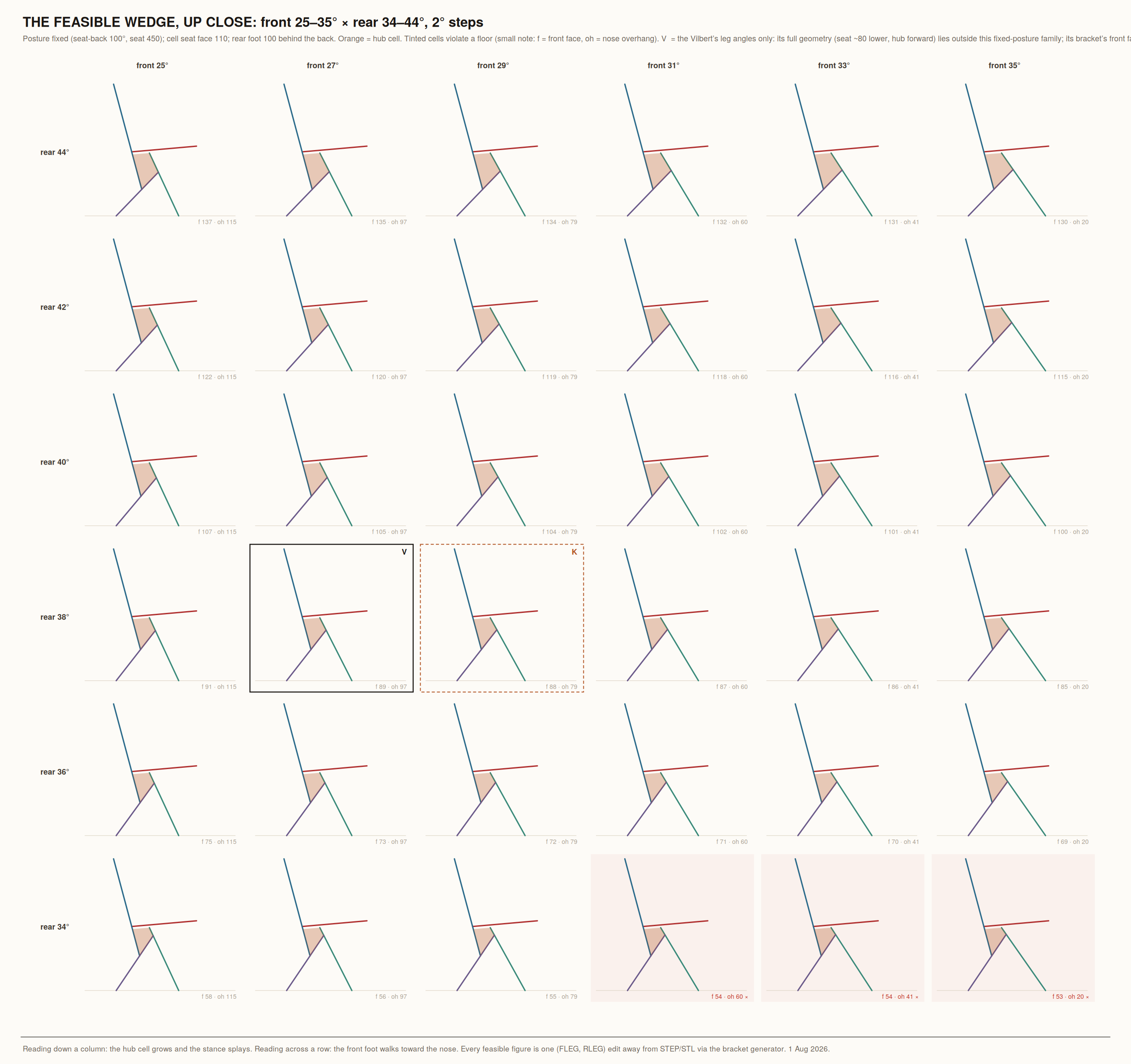
I liked it. Nothing I had drawn so far had done that. "Brackets printed. Came out nice," I wrote the next morning, and in the same breath, "I wonder what parametric exploration would show." A model that cost me nothing had bought the right to ask a much bigger question. I asked for the whole Vilbert family at once: hold the architecture, sweep the angles in two-degree steps, check feasibility at each one. Thirty-six chairs came back in a fan, and I zoomed into the green zone where the good ones clustered. Then, at five past five in the morning, I wrote "Fascinating to see 'Memphis' emerge from literal pure functional geometry. Not arbitrary aesthetic gesture in this case!"
Memphis was a Milan-based design initiative led by Ettore Sottsass in the 1980s that generated colorful not-bauhaus objects. A whole family of my chair designs, driven purely by geometry and feasibility constraints, had come out looking like a design movement.
That same morning is also why any of this got written down. My mother is a historian. During that period she was eighty-eight and in the hospital, and at seven minutes to seven I asked the machine to write the adventure up in a way a historian might enjoy, and I sent it to her. That is the first time anyone suggested this was a story. The folder for the book was made the next morning.
I built the full-size Vilbert on the second of August, on the same bracket geometry. The original is colored melamine-faced MDF, 415 wide, held together by its own internal panels. Mine was bare plywood 15mm narrower, on recomputed lengths and built around a plastic bracket I had designed. The thing that crossed from Panton's chair to mine was a set of angles fitted to a photograph.
By that evening I already knew the chair had a problem. The front leg pried disconcertingly off its bracket every time I sat on the chair. I felt it go faintly spongy under me and noted that it read as if it might let go. Then I ignored that signal.
At twenty past five the next morning I opened a cheerful new thread, "OK now a fun little project which strengthens the story," and spent the morning tuning the dimensions so a single sheet of plywood would yield as many chairs as possible. It worked beautifully, generating scrap of about a percent when a batch of 25 chairs is divided across a few sheets. Then I asked for something with no engineering purpose at all, "a lovely abstract graphic of the tiles in memphis colors that is geometrically exact but a composed mosaic that is intended to be a piece of visual art," and the machine made me one, ignoring some of my directions as artists should.

It is, I still think, a genuinely nice piece of art. Now look at what that morning contained. I tuned a chair to eat its sheet whole, hung the result on the wall as a Memphis mandala, and started planning production twenty-five chairs at a time, while the chair at the center of it had already told me, through the seat of my own trousers, that it did not work. The machine called it "a rather good day of engineering." So it was, and I was out over my skis.
I had built that first Vilbert-style chair around a plastic bracket because plastic is what a 3D printer can print. Then, I had two insights. First, those central four-sided brackets could be made of an interesting hardwood and give the chair more character. Second, the lower panels could become staves, maybe 75mm wide on each side, instead of one 400mm wide piece. "The staves are growing on me," I wrote, "but I'm not ready to commit to the branch." The next day I committed. I made the brackets out of wood, and I made them well. I slaved over one in particular, cut from reclaimed timber. It came out precise and clean. I caught myself dreaming of making it from salvage timbers with interesting provenance and selling the chair as a kit built from MakerStock stock. I built the second Vilbert-style chair around those brackets. It went up fast. It could be made from a single 600-by-1200 project panel, the size the Australian hardware big box store Bunnings sells off the rack.
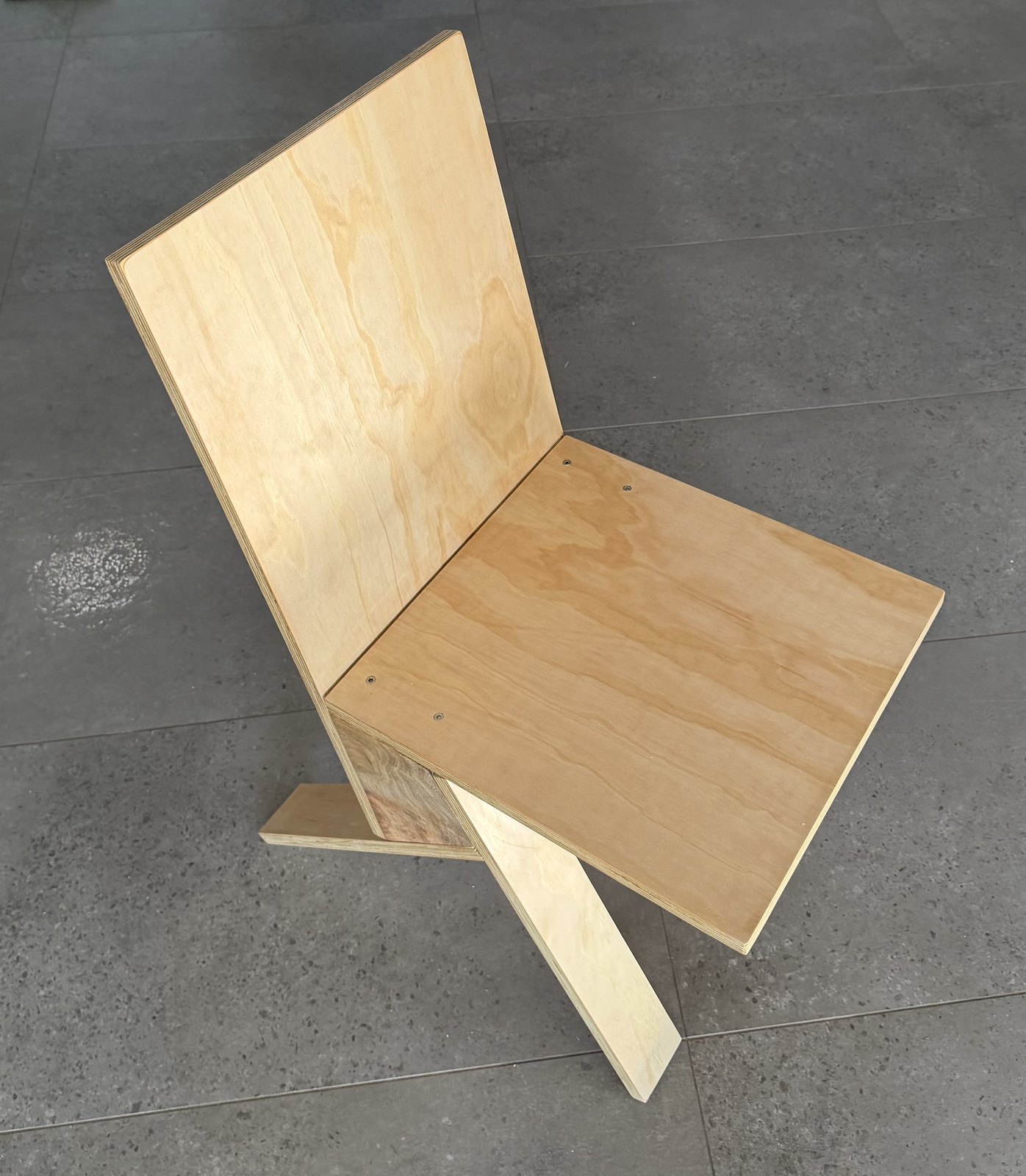
My notes from that evening are a maker's notes, pleased with themselves. "Made the brackets quite carefully and they fit up perfectly." "Build goes really fast, including cutting material." And, in the middle of it, two words I had not written about anything since this began: "Looks nice."
The stave chair was finished by half past two. That evening my wife sat down in it.
For sources, citations, and the technical notes behind this chapter, see hundredyearchair.com.
A chapter of The Hundred-Year Chair, drafted and refined in public. The same text lives in the book; the interactive tools and the fully-sourced technical notes live here. home · the book · the technical notes · hundredyearchair.com