The Hundred-Year Chair · a chapter
Signing Work You Will Not Outlive
When I was in college my mother gave me a book for Christmas called Inversions: A Catalog of Calligraphic Cartwheels, by a young designer named Scott Kim. Among the cartwheels are words drawn so that they read the same when you turn them upside down. You rotate the page a full half-turn and the word is still there, unchanged. At nineteen, that felt like proof the world had more give in it than I thought. Kim called these inversions. Douglas Hofstadter later called them ambigrams; the two have since written a book together about them. What makes them feel like magic is that they are exact. There is no cheating and no squinting. The mark is genuinely invariant under rotation.
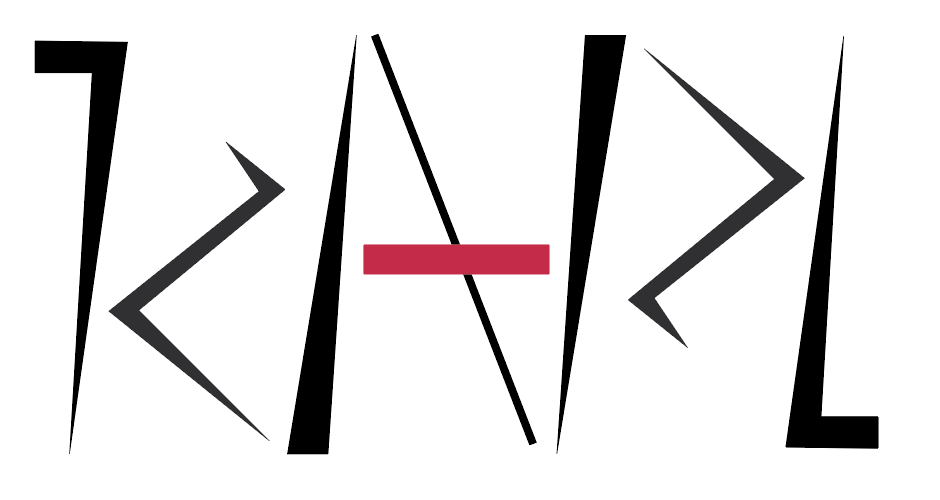
I have been making them ever since, which I recommend to anyone as the finest defense I know against a boring conference call. The trick, once you see it, is almost embarrassing. You do not design a whole ambigram. You design half of it, the left or the right. It does not matter which. Then you rotate that half a hundred and eighty degrees and join it to itself. The join is the whole art. I start with a pen in a notebook. When something half-works I move to Illustrator, where the software does the rotate-and-join and the two halves come out exact. I have made them for everyone in my family and for a good many friends, always as a gift. The one I made for myself in the 1980s is lost. The one on this page is dated the 29th of December, 2009, made over a holiday snowed into a house in Park City, Utah. It reads KARL. Turned upside down, it still reads KARL.
I dragged this old thing out of a folder because I needed a maker's mark for a chair. It turned out to be the right one, for a reason I was slow to work out. It is all chisel strokes, straight lines a tool makes quickly. It can be struck into bronze or cut into wood without losing itself. That is the smaller reason. The deeper one is that I make marks for a living. Everything my profession knows about a mark is the opposite of what this chair needed. The ambigram was the one mark I had ever made that already knew the difference.
For a nerdy engineer I have real branding chops. I teach branding and naming in the entrepreneurship course at the Wharton School. I once co-authored a working paper on the sound of domain names, on phonemes, of all things, that has been downloaded eight hundred and seventy-one times. I have run identity projects for university programs and for six startups, and worked with real mark-makers to get them made. I have had a hand in naming Xootr and Belle-V and MakerStock. In my own course I teach that a brand is one of the few flywheels of durable competitive advantage, one of the few things that compounds instead of decaying.
A brand mark claims a source. It concentrates the goodwill of everything you have ever done into a single ownable name. It is defended as property against anyone who would copy it. Its entire value is that it points to one owner and no other. Naming makes a word you can own. Branding makes it worth owning.
Now hold that up against the problem of signing a chair meant to outlast everyone who will ever sit in it, and watch every one of those instincts reverse. The design is given away. The mark must invite copying, not forbid it. The maker will be forgotten, as the census of old chairs proves, so the mark cannot concentrate value in a name. There is no owner in 2200 to defend it. It cannot be property. Its whole job is to be added to by strangers, not reserved to one hand. Everything I do for a living says a mark should claim, protect, and concentrate. Here those are the wrong moves. It took a branding professional an uncomfortably long time to see that the mark he needed was the anti-brand.
To sign a thing is ordinarily to claim it: I made this, it is mine, credit me. To sign a thing you know will outlive you by centuries is a stranger act, and a more interesting one. You will not be there to receive the credit. The people who read your mark will not know you, cannot thank you, and owe you nothing. A signature on a thousand-year object is not addressed to your contemporaries at all. It is addressed to strangers not yet born, and the only thing it can ask of them is that they keep the thing going. So before I signed my own chair I went looking at how makers have signed work that outlived them, across the history where the experiment has already run.
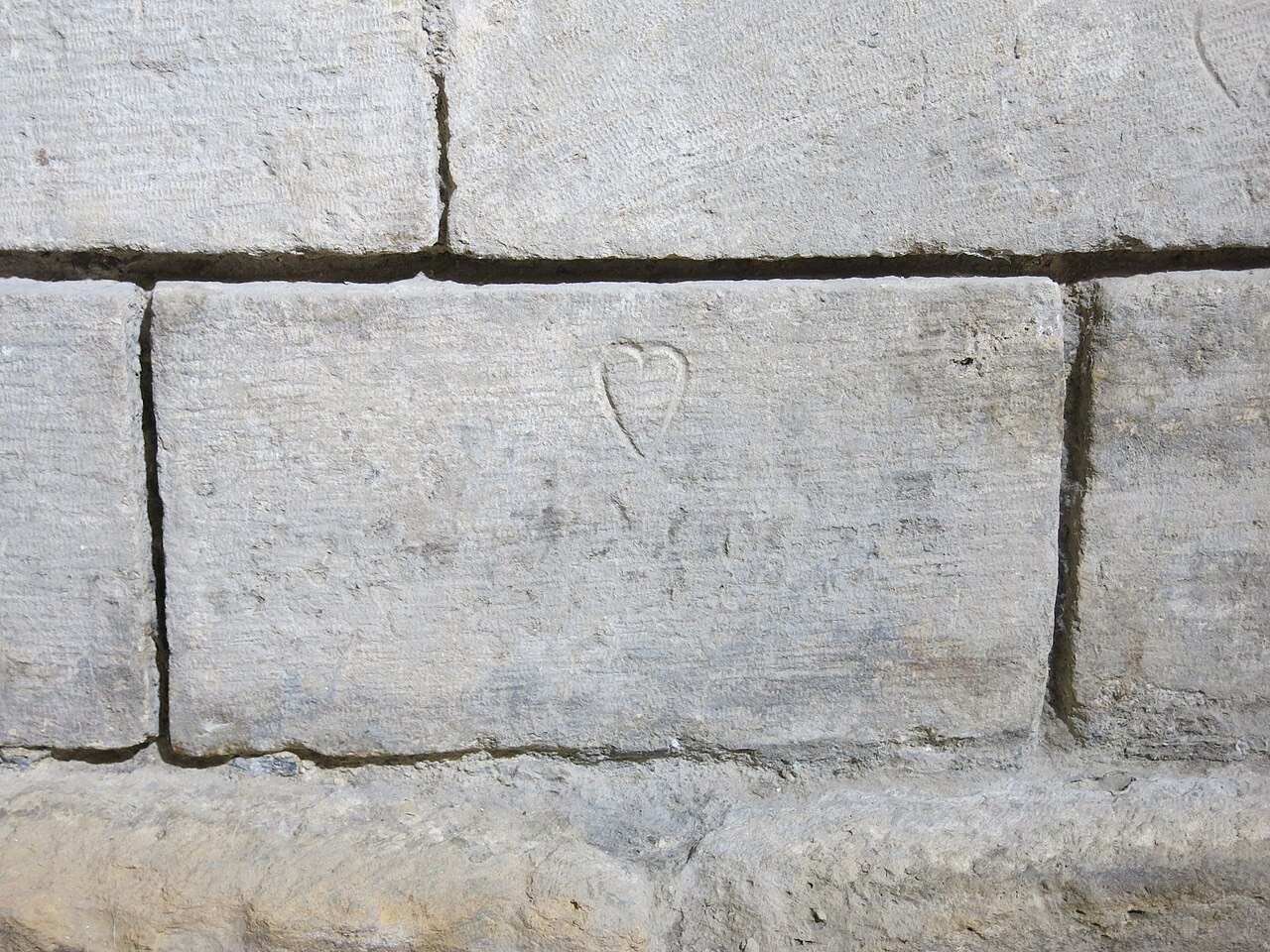
Begin at Chartres. Cut into the cathedral's stones, on the Romanesque narthex wall and up the north tower staircase and in the attic above the Gothic triforium, are small incised figures. One photographic campaign for an image archive recorded twenty-eight distinct ones without claiming to have found them all. Each is a mason's signature. A mason was assigned a mark, or chose one, or inherited his father's. He cut it into the stone he dressed, so his work could be told from the next man's when the measuring and the paying were done. The banker, incidentally, is the bench he worked at and not the clerk who paid him; the source I first read this in gets that wrong, and so did I. Quite how the marks fed the accounts is contested. The idea that a man carried one figure for life has thin evidence behind it. What is not contested is the shape of the act: a mark about wages, cut by a man who expected to stay anonymous, into a building that took generations and that he would never see finished. Many of the marks were then plastered over and vanished for centuries. The ones we can still read are used today to argue the order in which the cathedral went up. The mark outlived the man on purpose. Sometimes it outlived even the intention that it be seen.
The graphic is worth a designer's attention. A few straight strokes, cut fast with a chisel, often built on a shared armature of crosses and triangles. One mason's figure differs from his neighbor's by a single added line. Straight, because a chisel makes straight lines quickly. Simple, because a figure of few strokes survives the weather that erases a fine curve. The Roman potters who stamped their ware pressed the mark into the clay before firing. It was not on the surface but in it, and two thousand years later it is still legible. A mark of the thing outlasts a mark on the thing. My own mark is nothing but chisel strokes, which happen to serve that end. I did not design it that way; the straightness is an accident.
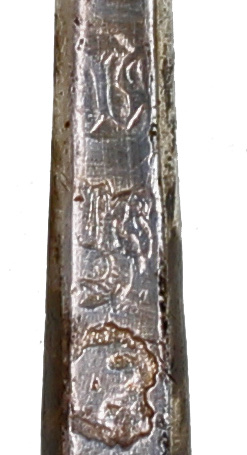
Silver solved a harder problem: how to sign a thing so that the signature also guaranteed it. Look closely at old English silver and you find not one mark but a little row of them, each struck as a separate punch by a separate authority: the town, the standard, the maker, the year. The genius is the separation. My trade forgot it. A modern logo fuses the two claims a mark can make, who made this and is it genuine, into one defended symbol. The hallmark pulls them apart into different marks that different authorities answer for. Neither can forge the other. That distinction became the basis of the chair's mark. The chair carries an impersonal type mark and a personal maker's mark as two separate things rather than one logo.
East Asia carried the personal signature furthest from legibility and closest to identity. The kao is a name worked into an abstract cursive cipher, so distinctive in its overall shape that it authenticated even when no one could read it. It is the opposite instinct to the mason's shared armature. The mason wanted a figure anyone could reproduce, to keep the accounts straight. The kao wanted a figure only one hand could make. I recognized it the moment I read about it. It is what I have been drawing for friends for forty years without a name for it. My ambigram is my kao, a name folded into a cipher only I would have made. A chair turns out to need both instincts at once: the constructed, reproducible type mark for the standard, and the gestural, inimitable cipher for the person. The contrast between the two is not a problem to smooth away.

Read them together and a shift appears as the timescale lengthens. A mark on a coin or a contract is about the present: who owes what, who vouches now. A mark on a cathedral or a shrine is about the future, a message left for people the maker will never meet. The further into the future the mark is meant to travel, the less it can be about credit and the more it must be about continuity. The mason signing a stone he plastered over was not seeking fame. He was leaving a true record inside a thing built to last. That is the direction my branded, defended, name-concentrating instinct has to travel to be any use here.
The longevity chapters settle where old things come from: not from immortal material but from someone, in every generation, deciding they are worth keeping. Take that as given here. If the object's survival depends on recruiting custodians, then the mark is not a claim of authorship. It is a tool of recruitment. It works the way beauty works and the way a documented provenance works, by making the object harder to discard. A chair legibly made with care, carrying the record of everyone who has kept it, is one the next person is ashamed to throw away. The mark's job is not to say I made this. Its job is to say this was made to be kept, and here is the proof that it has been.
Nobody can own the shape of a useful thing. The design is given away whether I will it or not. So I tried the thought experiment designers use to frighten themselves. Suppose the chair works, and a large retailer runs off a hundred thousand of them in a factory somewhere, and my name appears on none. Sitting with that honestly, I found I did not mind the hundred thousand. I minded the none. The geometry is published and free to travel. A name is the one piece of this that can still be held. What it holds is the thread back to where the thing came from. A custodian needs that thread to know they are keeping something rather than merely storing it.
The move this project proposes is a small inversion, a word I can now use with a straight face. Do not sign the chair only as its maker. Build into it a place for everyone who will keep it to sign it too.
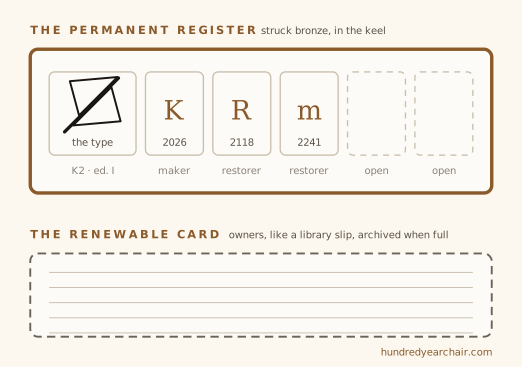
The scheme has three human marks and a fourth institutional one. The chair carries the register in a small bronze piece at the joint where the seat meets the back, the 80-degree apex, shaped from the chair's own triangle and cast with the type mark that says this is a Keel Chair to the standard. Its exact form is not yet fixed: a bracket, a sliding cover over a small cubby, or something else. The build in A Thousand-Year Chair decides it. Beside it the first maker strikes a personal cipher by hand. On the first chair that cipher is my ambigram, chisel strokes struck into bronze, the same figure that has been my gift to my family for forty years, now given to a stranger I will never meet. Beside that a place is left open. Every future maker who rebuilds the keel is invited to strike their own mark and their year, joining a line that runs back to the first hand. A separate, renewable card, the library book's date-stamp slip, records the owners, who run on a faster clock.
Both marks turn out to be inversions, and so does the chair. An ambigram is half a figure rotated a hundred and eighty degrees and joined to itself down a central line, which is exactly how the chair is built: two congruent triangles turned to face each other across a shared spine, the keel. The type mark, in its most recent drawing, reads the same turned upside down. I did not design the three to rhyme. I noticed only when I went to sign the one with the other.
The consequence is that retention becomes self-interested. The weakness of any heirloom mark is the question of why a stranger two centuries on would bother to preserve it. The answer here is that preserving it is how they enroll themselves. The restorer who rebuilds the keel in 2226 does the invisible structural work. The reward is a permanent, dated place in the genealogy beside the maker's own hand. Transferring the relic to the new keel is not a chore imposed on them. It is their initiation. They want the record to survive because it is how their own name survives, for a while, until it too dilutes into the line.
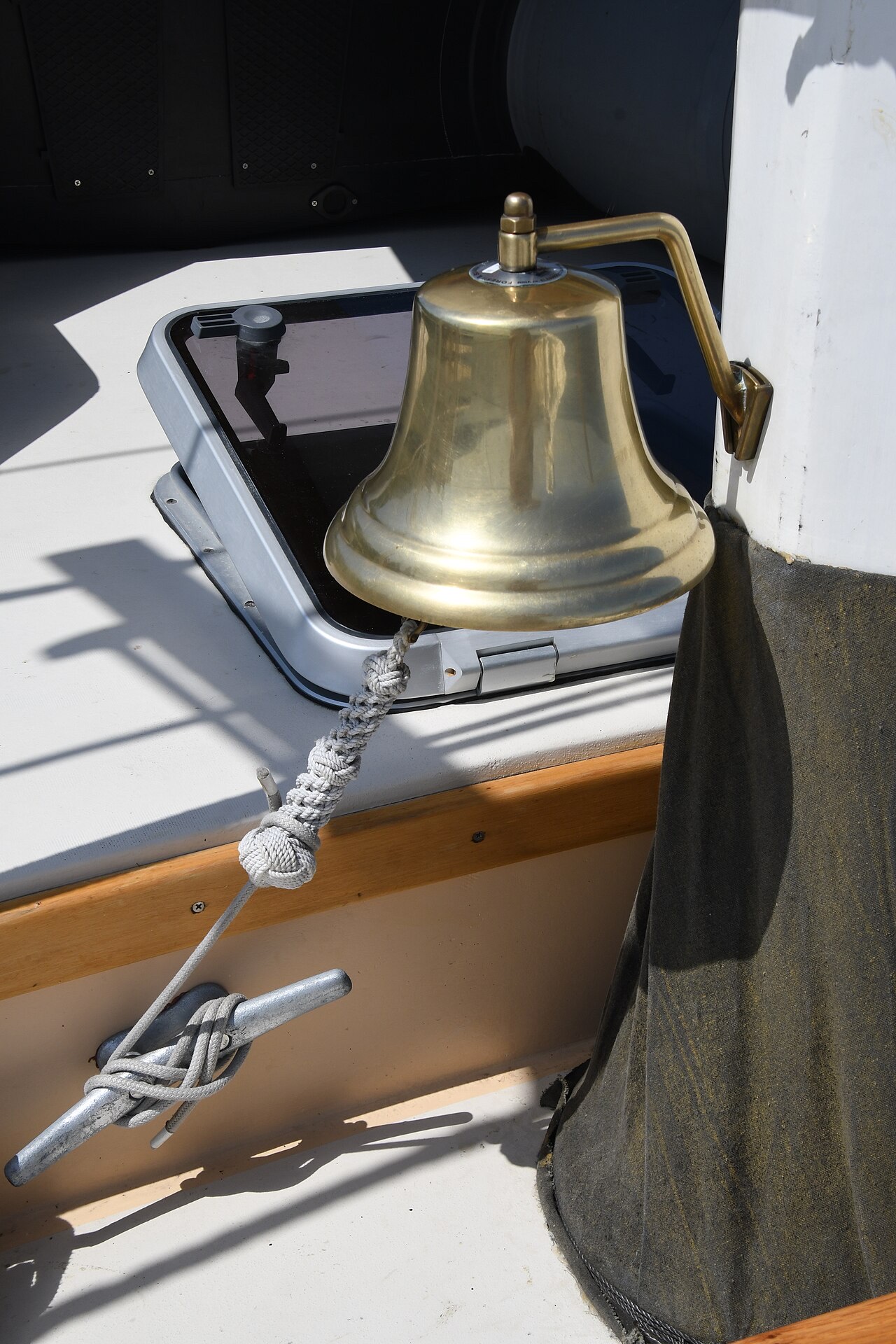
That bronze piece is the chair's ship's bell. When a US Navy ship is decommissioned, its bell is among the fittings taken off and kept. It may then be loaned to the next ship of the same name. The bell outlives the hull and carries the name across to another one. The register works the same way. Its metal is worth nothing to melt, so its only real value is being the chair's signature. It belongs to no single wooden part, so it survives every rebuild and passes to the next, the one element that outlives the keel itself. For a chair whose spine is called the keel, this is not a metaphor. It is the same practice, scaled to something you can lift with one hand.
Branding stamps a logo onto an object from outside. This mark does the reverse. It is the chair's own geometry, the two triangles and the keel, the figure that is the thing it marks, in the mason's sense; and beside it my kao, a name folded until it survives being turned upside down. A brand says trust the name behind this. This mark says something else: here is how this was made, here is how you could make it too, here is where you sign when you keep it going.
Every ambigram I ever made was a gift with someone else's name in it, a mark that was never mine to keep. Signing the chair is the same act at a longer range. You sign it not to be remembered. You sign it because signing it well is how you invite the strangers who will actually keep it to add themselves.
Checked against primary and institutional sources on 7 September 2026; six claims needed correction, one of them the author's own. PERSONAL, from KU's account of 22 August 2026: the ambigram on this page made 29 December 2009 in Park City, Utah; the design-half-and-rotate method; the branding biography, the Wharton teaching, and the marks Xootr, Belle-V, and MakerStock.
THE DOMAIN-NAME PAPER. Karan Girotra and Karl T. Ulrich, "Empirical Evidence for Domain Name Performance," Wharton working paper, SSRN 1714992, posted 25 November 2010. As of 7 September 2026 it has 871 downloads and 9,066 abstract views; the text cites the download count only. It is a working paper, not a peer-reviewed article, and the text says so.
SCOTT KIM. Inversions: A Catalog of Calligraphic Cartwheels, BYTE Books (a division of McGraw-Hill), 1981; a later W. H. Freeman edition exists, so 1981 pairs with BYTE Books and not with Freeman. The book covers mirror symmetries and figure-ground inversions as well as rotational ones, so the text no longer describes it as a catalogue only of the latter. Douglas Hofstadter's coinage of "ambigram" is attested but thinly; the safe citation is Hofstadter and Kim, Ambigrammia: Between Creation and Discovery, Yale University Press, 2024, which the text now points at instead of claiming which word is commoner.
CHARTRES. Twenty-eight distinct marks were recorded by the photographic campaign of May 2005 for the University of Pittsburgh's Images of Medieval Art and Architecture collection, which states plainly that these "do not include all marks present at the cathedral"; the text now says so. That page also calls the banker the officer who paid the mason, which is wrong and which the chapter had followed: the banker is the bench the mason works at (1911 Britannica, "Banker-Marks"; BAJR, Recording Masons' Marks, 2024). The per-stone payment account and the one-mark-for-life account are both contested, per James Wright and Jenny Alexander on the Lincoln and Exeter contrast; the text now reports the contest rather than the folklore.
TERRA SIGILLATA (the pressed-in clause in the mason passage). The Roman Samian potters stamped the mark into the clay before firing, so the mark is integral to the material; primary source R. Marichal, Les graffites de La Graufesenque, Gallia Supplement 47, 1988 [obtain before print]. The fuller terra-sigillata account (firing tallies, OF for officina) is held in the queue.
HALLMARKS. The separate-punch scheme (town, standard, maker, year, struck by different authorities) is confirmed against the Goldsmiths' Company Assay Office. The regnal chronology (leopard's head 1300, maker's mark 1363, date letter 1478) and the date letter's warden origin are held in the queue.
KAO. The Chinese origin is given across sources as either Southern Qi or Northern Qi and no scholarly citation could be reached, so the text refers to the Northern and Southern dynasties; the earliest Japanese example is a signature of 933. The plate is a placeholder pending an openly licensed image.
SHIP'S BELL. US Naval History and Heritage Command: the bell is among the artifacts removed and preserved at decommissioning and may be loaned to a later ship of the same name, which is what the text now claims; it had said the bell was the one fitting preserved, which the Command does not support.
THE REGISTER'S PHYSICAL FORM is not yet settled (bracket, a bronze sliding cover over a cubby, or another form); the text says so and defers the resolution to A Thousand-Year Chair. The type mark's rotational-inversion property is per KU's Keel Furniture branding folder, most recent version.
A chapter of The Hundred-Year Chair, drafted and refined in public. The same text lives in the book; the interactive tools and the fully-sourced technical notes live here. home · the book · the technical notes · hundredyearchair.com