The Hundred-Year Chair · a chapter
How Long Is a Hundred Years?
There is a gray rocking chair in my living room in Philadelphia. My father bought it broken in about 1961. It was old when he bought it. Call it somewhere north of eighty, probably near a hundred. Nobody has ever dated it and nobody ever will. Of the four things a person can sit on in that room, it is the one that gets used when there are people around. A rocker invites a body in a way an upholstered thing does not. This one tends to start a story.
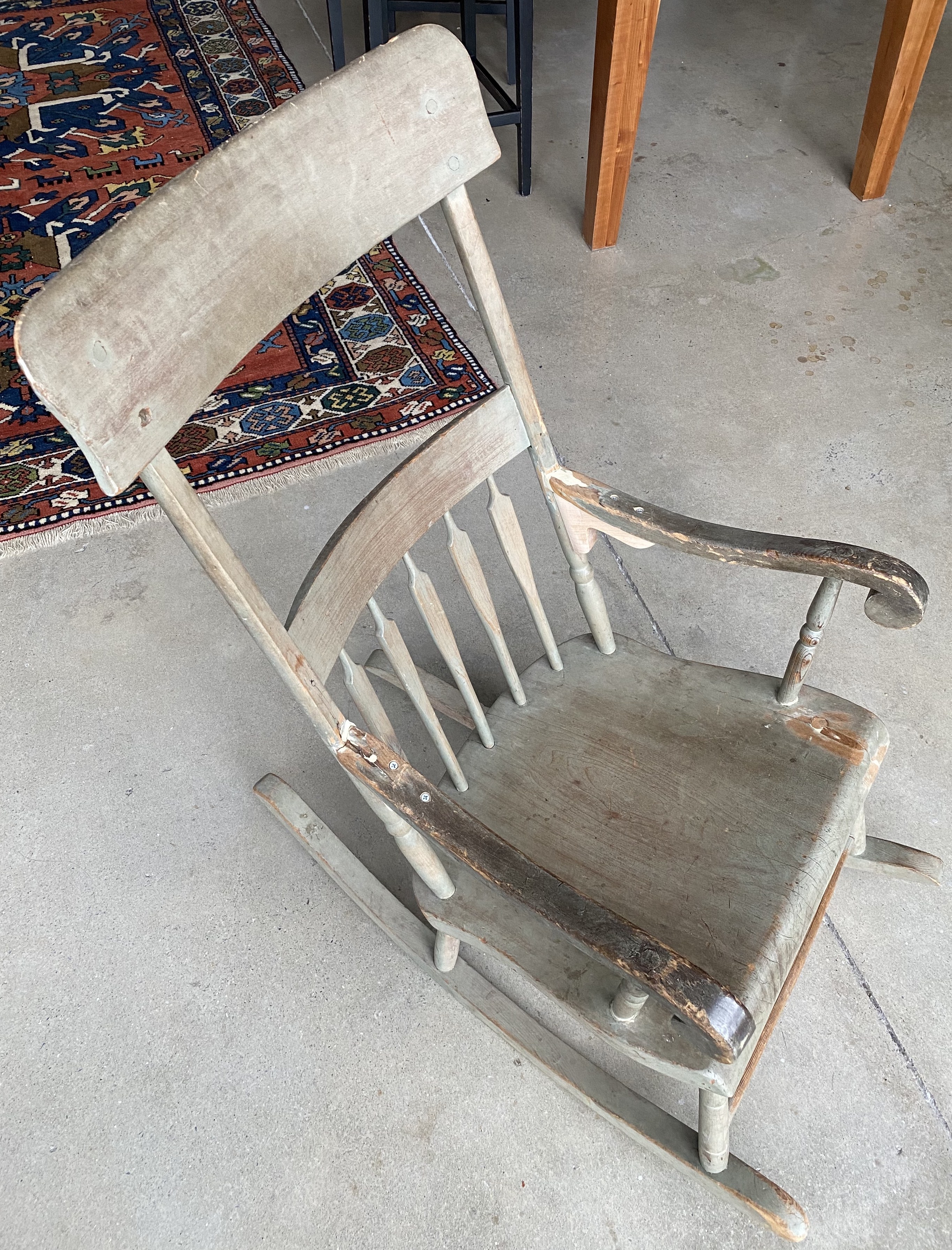
A few years ago my parents were downsizing. They did the sensible thing and asked which of their four children wanted what. I claimed the rocker. It was not, at that moment, in good order: one arm was dangling and the other was loose, because my father had, for the first time I could remember, left a repair unfinished. I did not claim the chair in spite of that. I claimed it partly because of it. The chair was the most vivid object I knew for my father's essential character. The unfinished repair was the last brushstroke.
Even as a boy I had mistrusted one joint, the spindly connection where the arm meets the rear stile of the back. It always felt uncertain under my hand, and the chair's own record backed the feeling: that joint had carried more of my father's interventions than any other part. So when the chair became mine I decided to make that one joint bulletproof. I conceived a small bracket. I chose a chunk of hard maple. I cut the shape first in balsa foam, a dense modeling board that sands like a hard cheese, and tuned its fit against the chair with a few passes of sandpaper. Then I reproduced the tuned shape in maple.
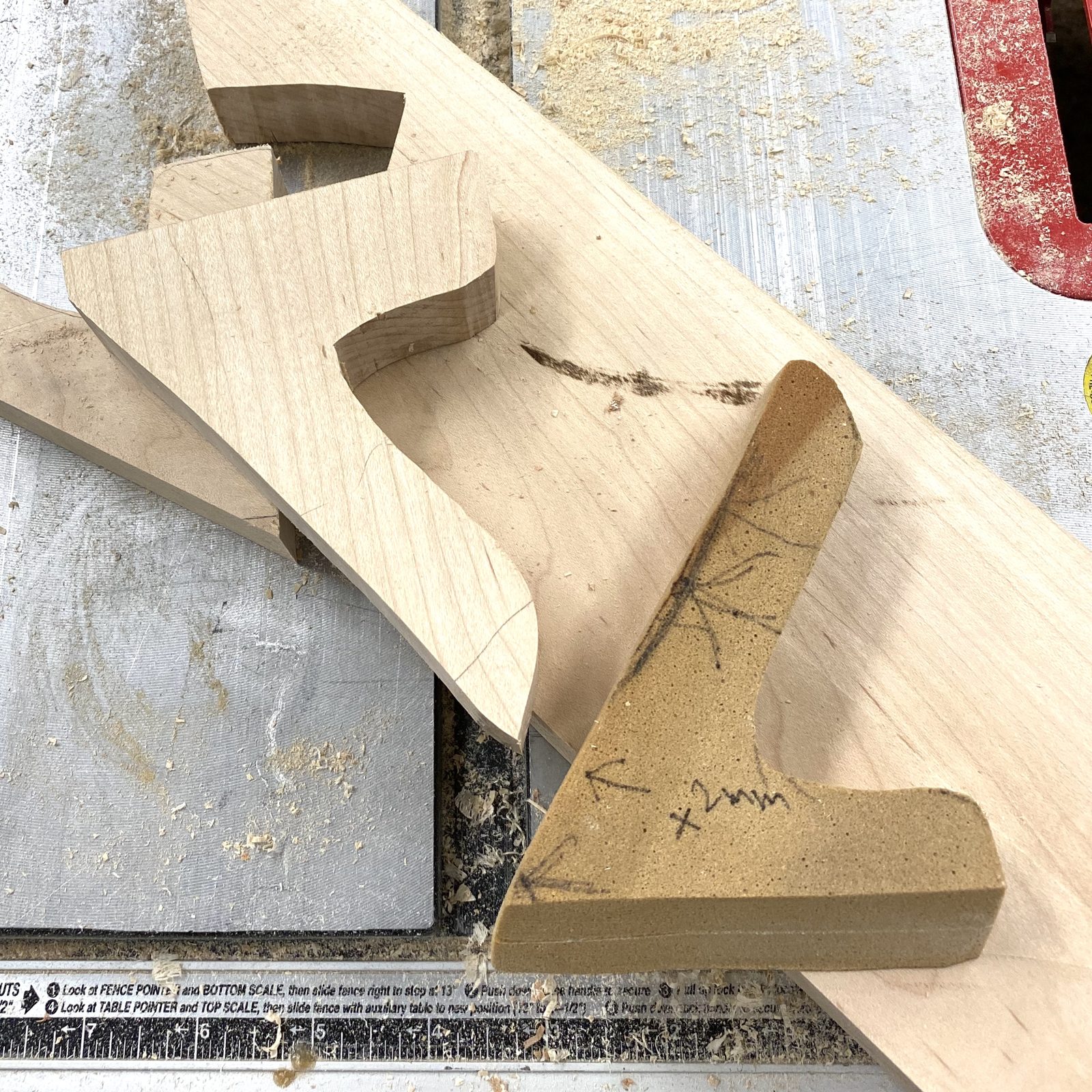
I picked a heavy wood screw with an honest black-oxide finish and left it showing. There was no reason to hide it, and sixty years of precedent not to.
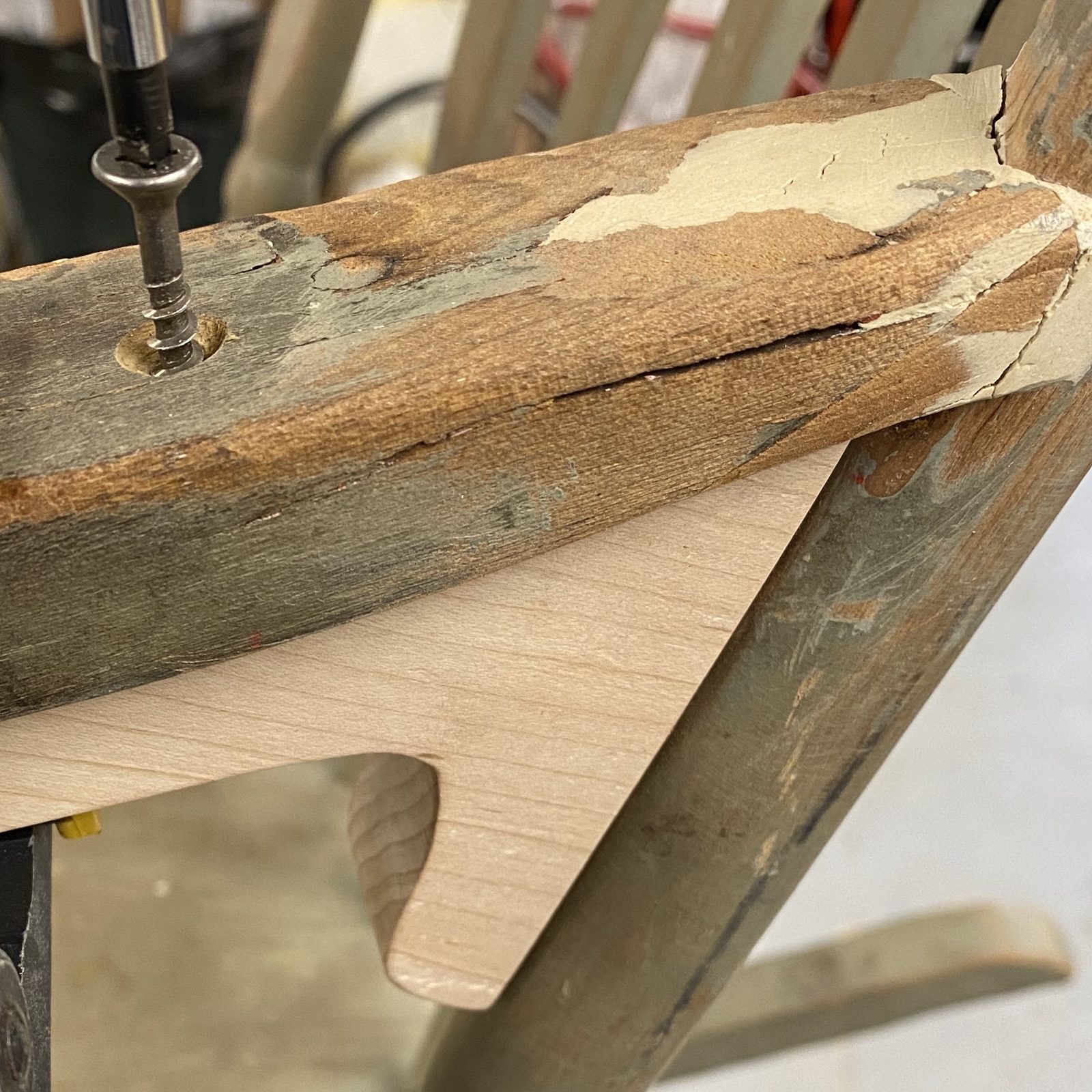
The chair I was working on was a core sample of my father's hand. Under the gray paint were earlier colors, ghosting through where the top coat had worn. There was a stratum of plastic wood. There was one very long drywall screw I could date to his late period the way an archaeologist dates a layer by its nails. I added my maple bracket to the sequence and left the older strata where they were. The strata were the point.
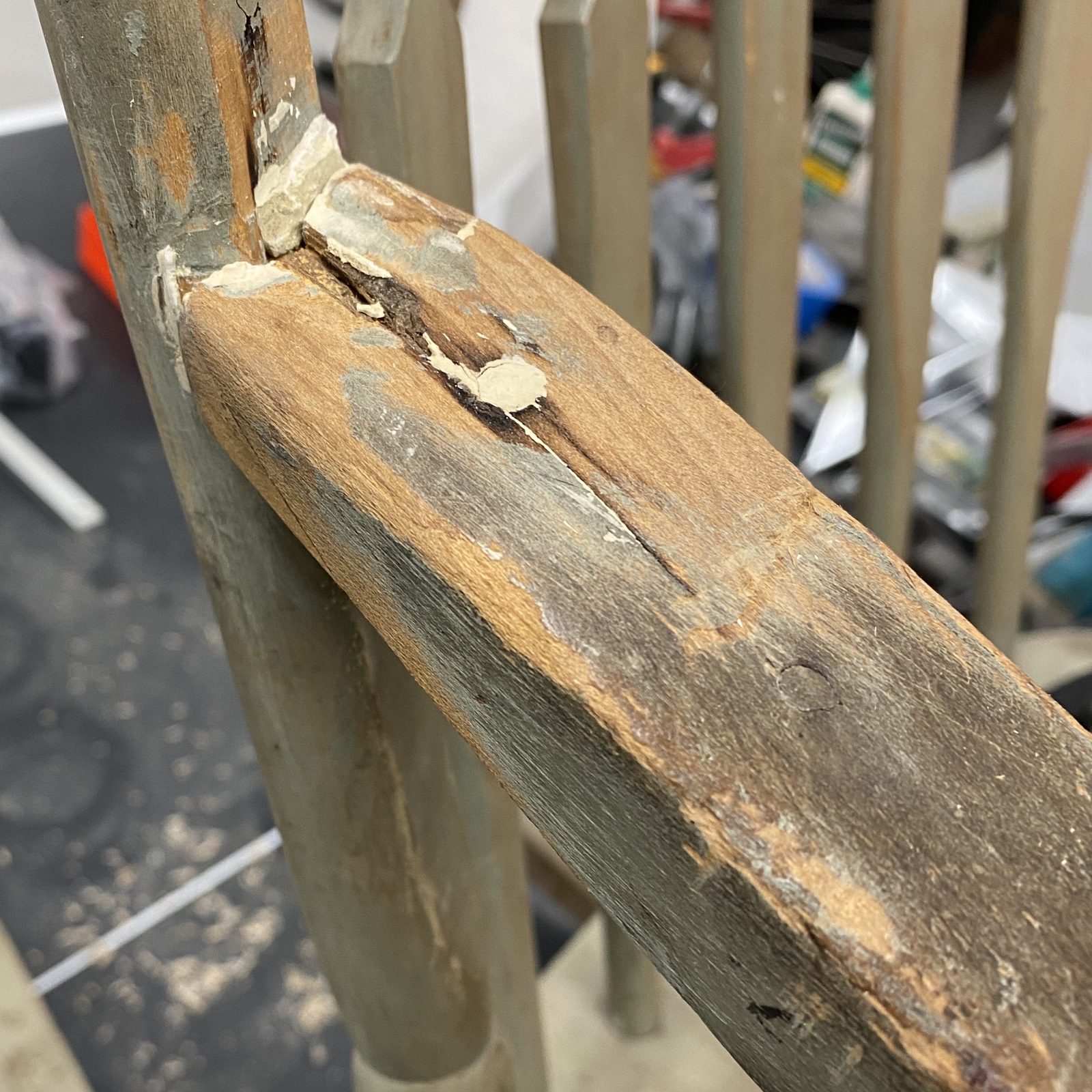
The whole thing took a Saturday afternoon in my shop and delivered the particular satisfaction of a small problem completely solved by dinner.
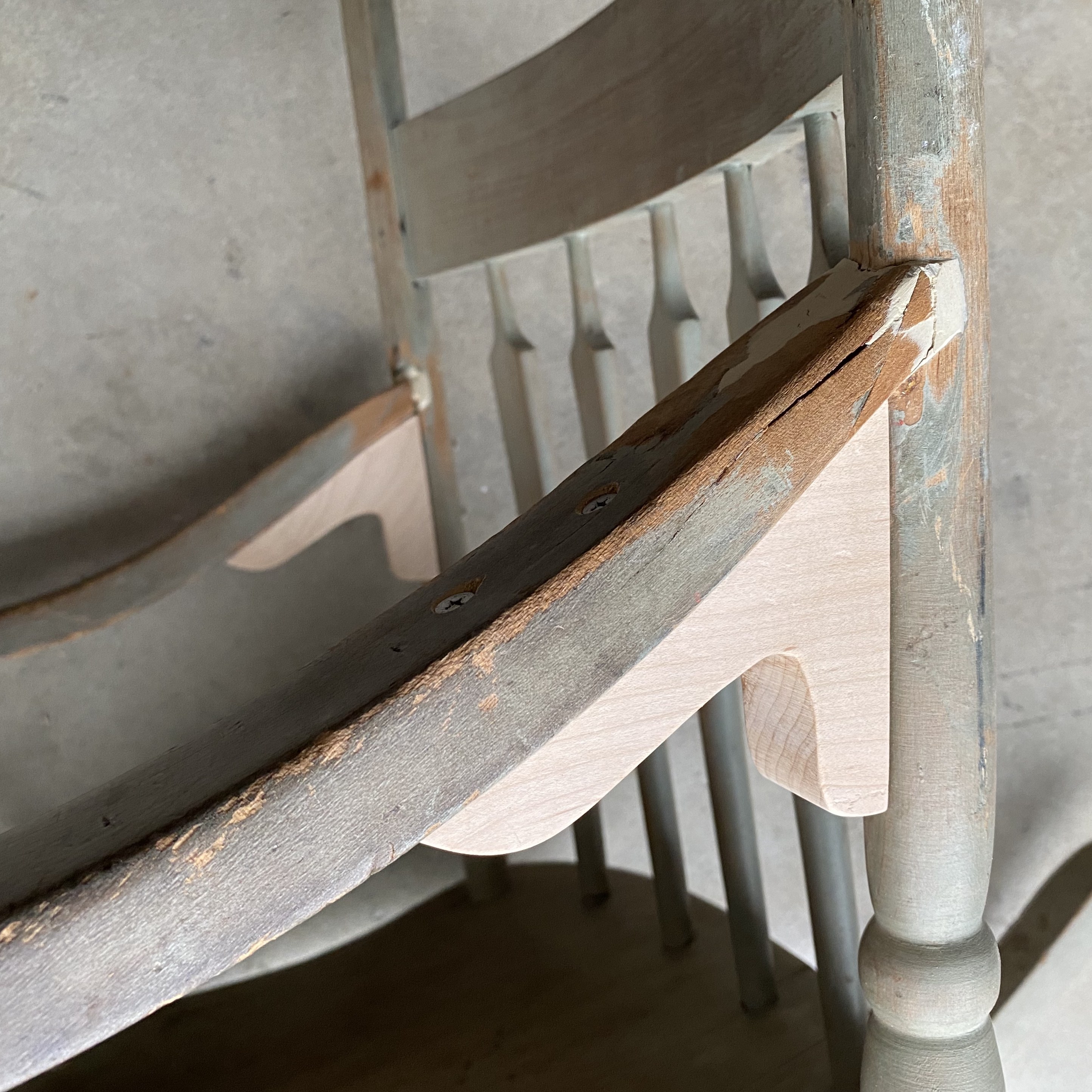
I knew my parents would want to see it, so I photographed every step and wrote the build up in an email. What came back is the truest thing I can tell you about where a chair's history actually lives. My father corrected some of my facts. My mother corrected my father. My father's friend John, who has his own place in this story, weighed in. A chair's provenance is not a document. It is a family arguing affectionately about a chair. The argument is the provenance.
My father, Gael D. Ulrich, grew up in Devils Slide, Utah, a cement company town folded into a canyon. He was a Yankee at heart, which in his case meant that he never threw anything away and that nothing pleased him more than returning a found object to use. In graduate school he made pocket money pulling washing machines off the curb, repairing them, and reselling them. He became a serious researcher on a narrow and genuinely hard subject, the formation of particles in flames. He did that front-edge work in a laboratory full of ancient instruments he had repurposed for it. He was a combustion engineer, and his first love, he would tell you, was burning things. He once said the only possession he wanted to carry into the afterlife was his South Bend lathe.
Here was a man whose profession was oxidation, the conversion of solid matter into heat and smoke and fine particles, and whose deepest private instinct was to keep. The gray rocker is what the second instinct looks like when it runs for sixty years. He died in 2023. The chair is still being kept. That is the reason I wanted to know, when the chair became mine, whether what I had was remarkable or ordinary.
I named this project The Hundred-Year Chair and thought I was being ambitious. Then I went looking for the survivors, and the survivors laughed at me.
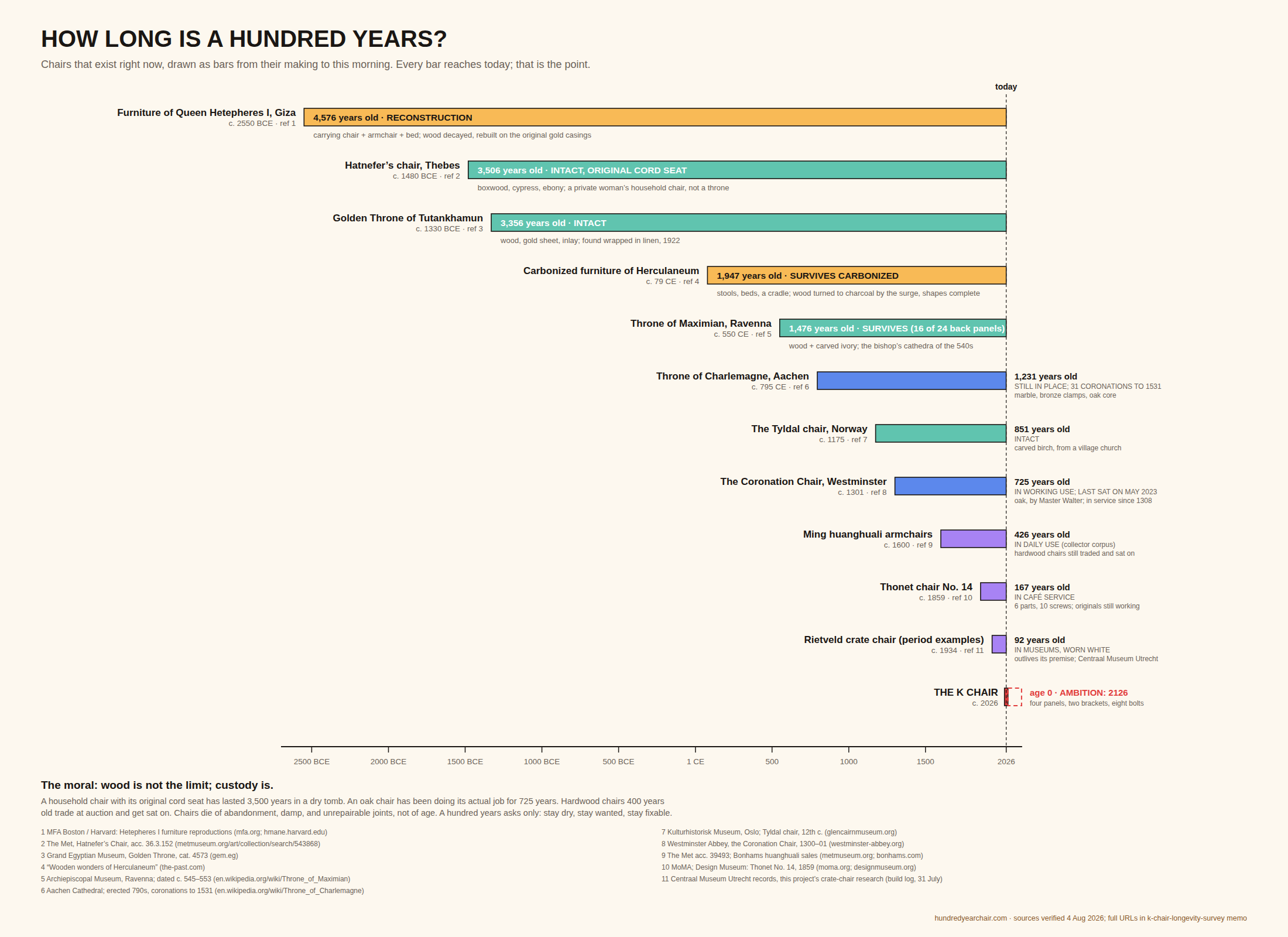
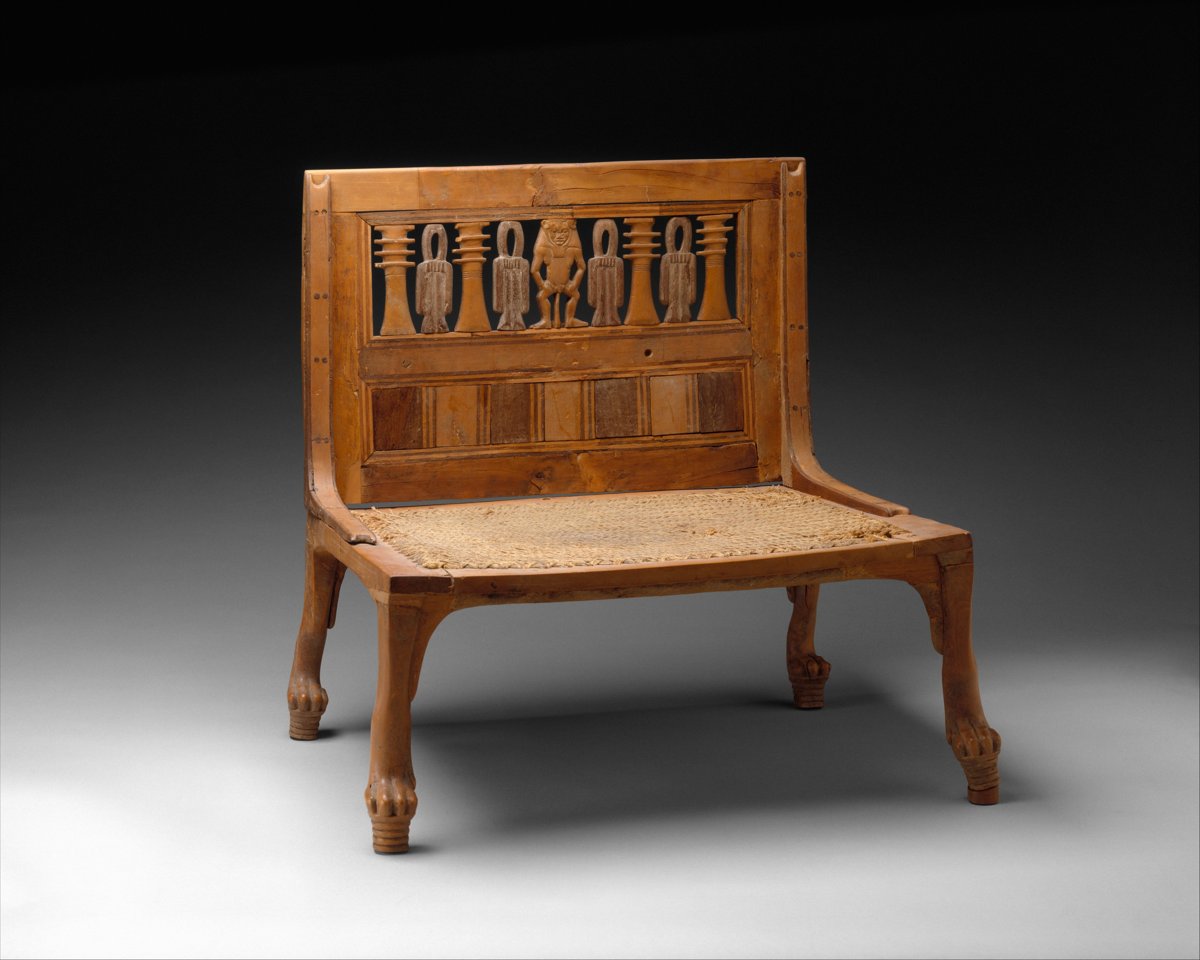
The star witness is not a throne. In 1936, excavators from the Metropolitan Museum found a chair sitting at the entrance of an undisturbed tomb in Thebes. It belonged to Hatnefer, a private woman, the mother of a court official. It is boxwood, cypress, and ebony, joined with mortises, tenons, and pegs, and its seat, a web of woven linen cord, is original. It was made around 1490 BCE. It is a household chair, the kind of object this project is about, and thirty-five times older than my name for it.
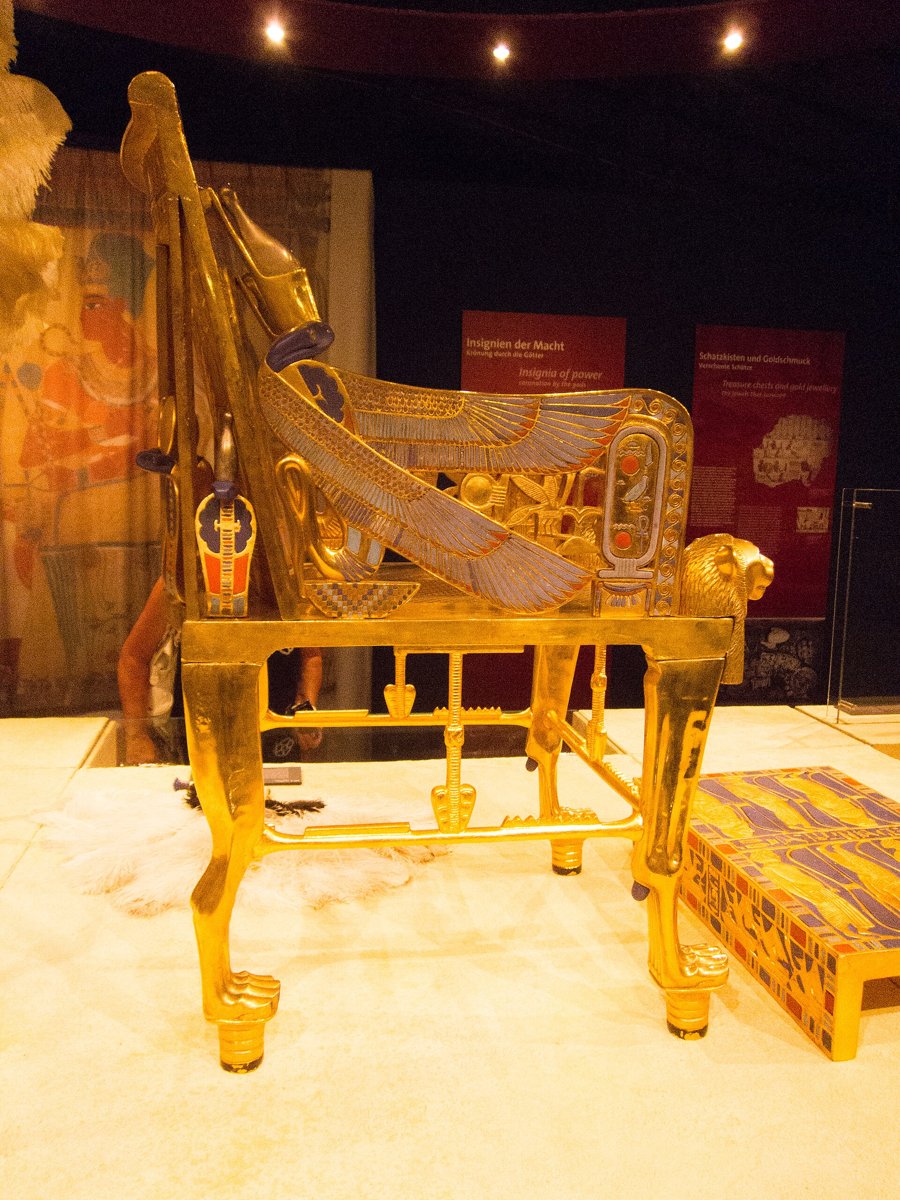
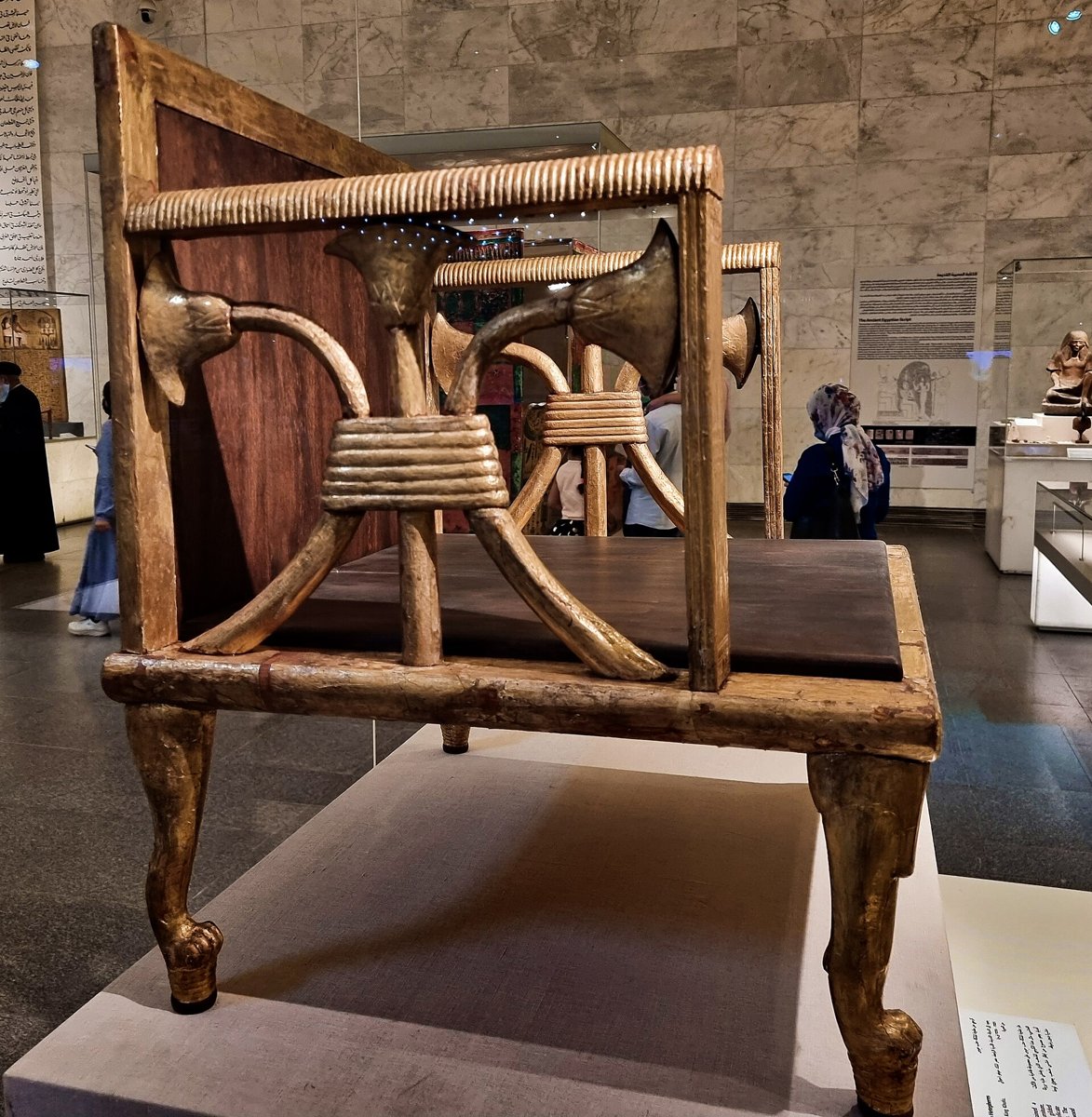
The thrones are witnesses too. They prove less than they appear to. Tutankhamun's golden throne has crossed three and a third millennia as wood under sheet gold, inlaid with glass, faience, silver and semi-precious stones. It was found wrapped in linen in the antechamber. That is how it was stored, not how it was made. Among the oldest furniture there is, the carrying chair and armchair of [Queen Hetepheres](https://hmane.harvard.edu/recreating-throne-of-egyptian- queen-hetepheres), mother of the builder of the Great Pyramid, survives only as a documented resurrection: the wood had decayed to dust, and the pieces were rebuilt with modern timber on their original gold casings. Thrones survive because everything around them is arranged to keep them. That is not a materials result but a custody one.
For ordinary seating the record is thinner and stranger. At Herculaneum in 79 CE the pyroclastic flow carbonized the town's wooden furniture, stools and beds and a cradle, preserving their shapes as charcoal. It is the rare window onto the everyday Roman chair. It survived by dying: the wood was destroyed as material and kept as form. My father would have appreciated that a surge of fire is what saved it.
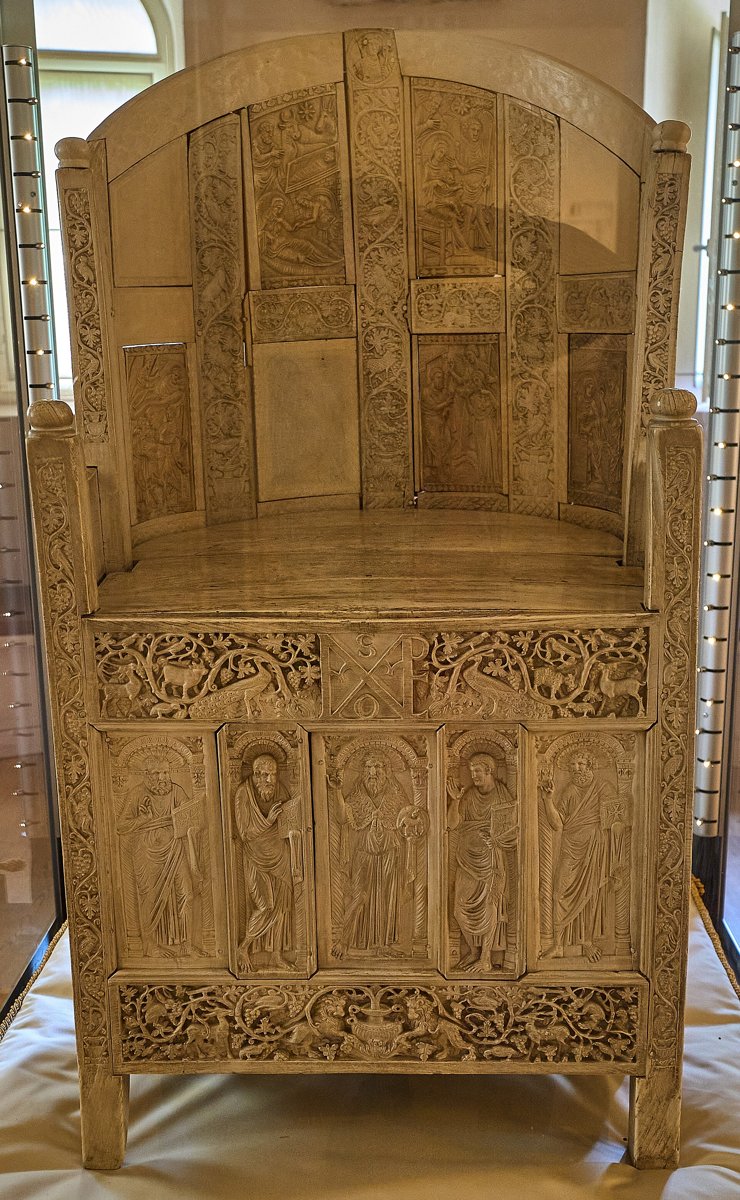
Then the run of working survivors begins. The throne of Maximian in Ravenna, a bishop's cathedra of carved ivory plaques on a wooden frame, was made during Maximian's episcopate, between 546 and 556. A good many of its back plaques are gone, and the sources disagree about how many there were to begin with.
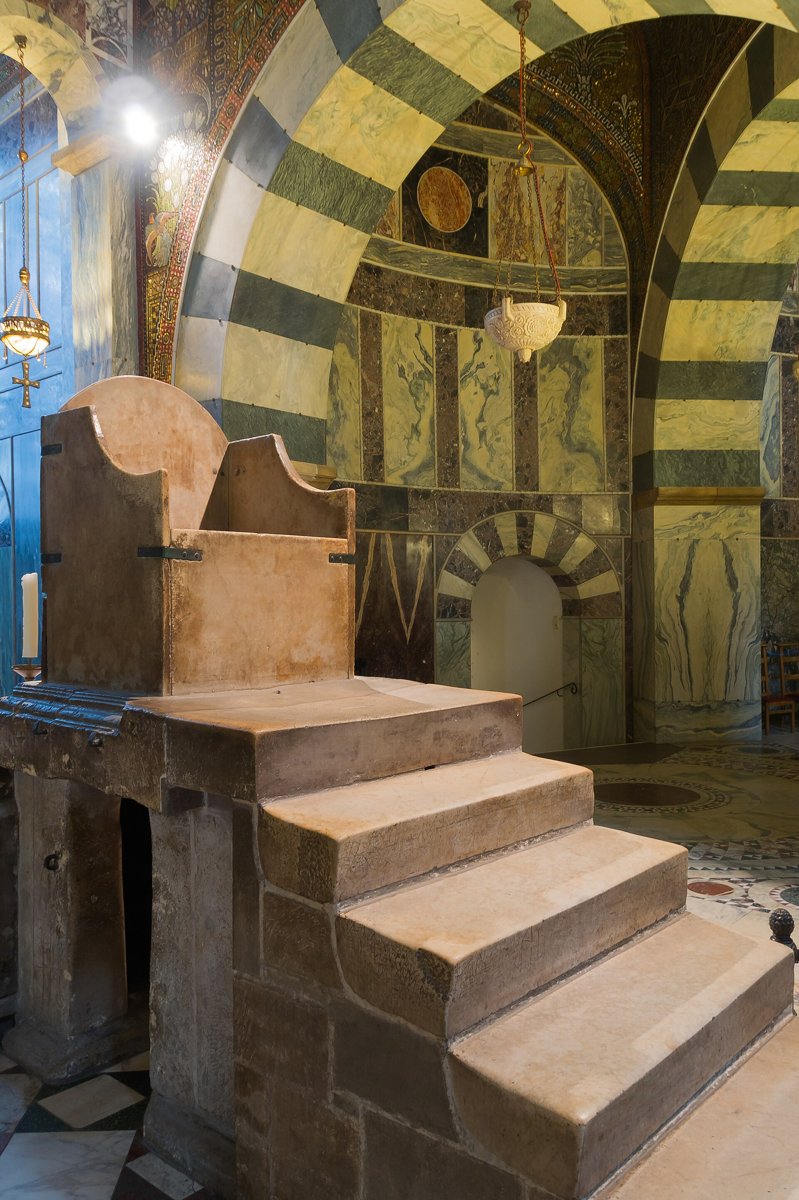
Charlemagne's throne at Aachen, four plain marble slabs held by bronze clamps over an oak core, has stood in the upper gallery of the Palatine Chapel since about 800, and thirty kings were crowned on it between 936 and 1531. It has survived every rebuilding of the chapel around it, though not unaltered: a late-medieval hand replaced the bottom of the rear slab with an oak board.
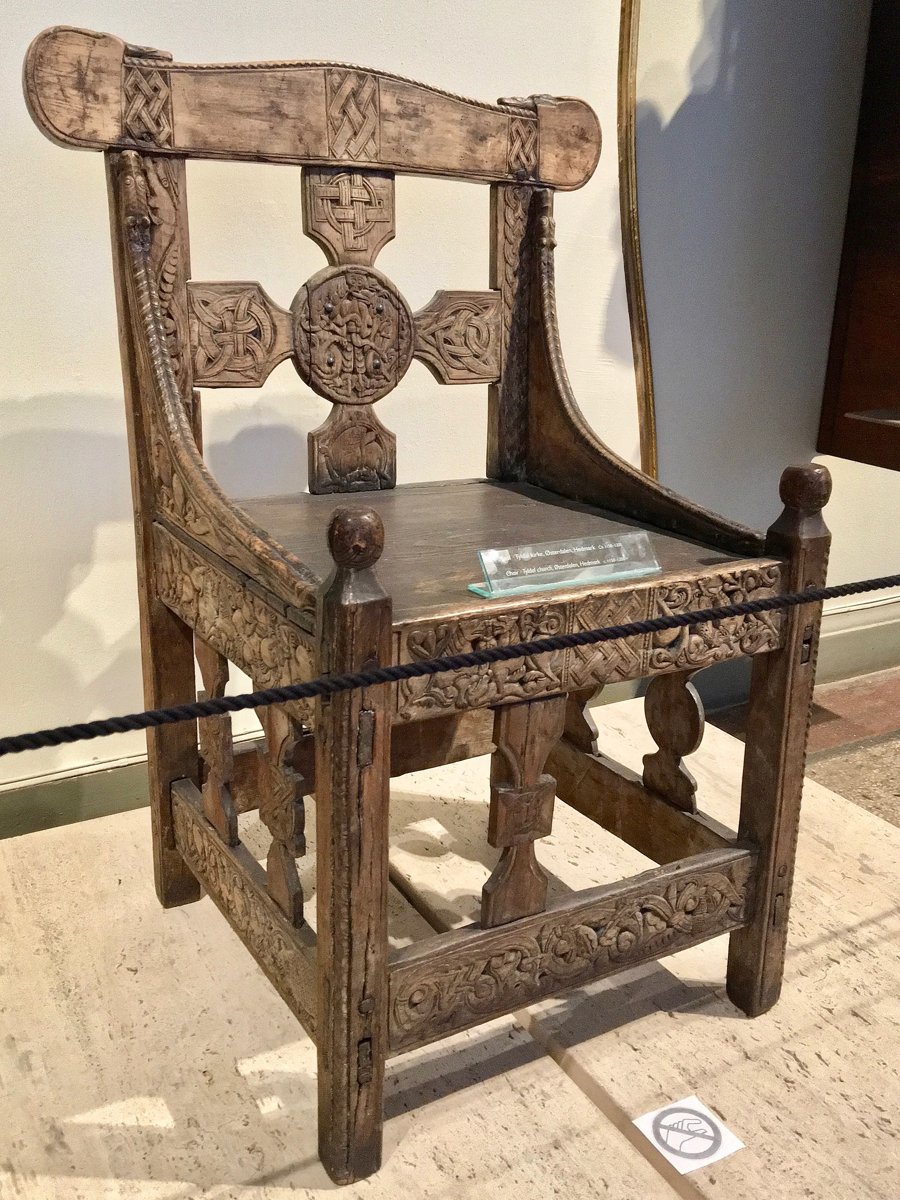
The Norwegian churches kept the middle ages dry for us: the [Tyldal chair](https://www.glencairnmuseum.org/newsletter/2018/4/9/glencairns-tyldal- chair-a-20th-century-revival-of-12th-century-norwegian-woodcarving), carved birch from a village church in Osterdalen, has stood since the second half of the twelfth century.
And in Westminster Abbey the [Coronation Chair](https://www.westminster- abbey.org/history/explore-our-history/the-coronation-chair), oak, made for Edward I in 1300 and 1301 and painted by Master Walter, has been in coronation service since 1308, though the Abbey itself says opinion divides on when it was first used for a crowning. Charles III sat on it on the sixth of May 2023. Seven hundred and twenty-five years old, and still employed.
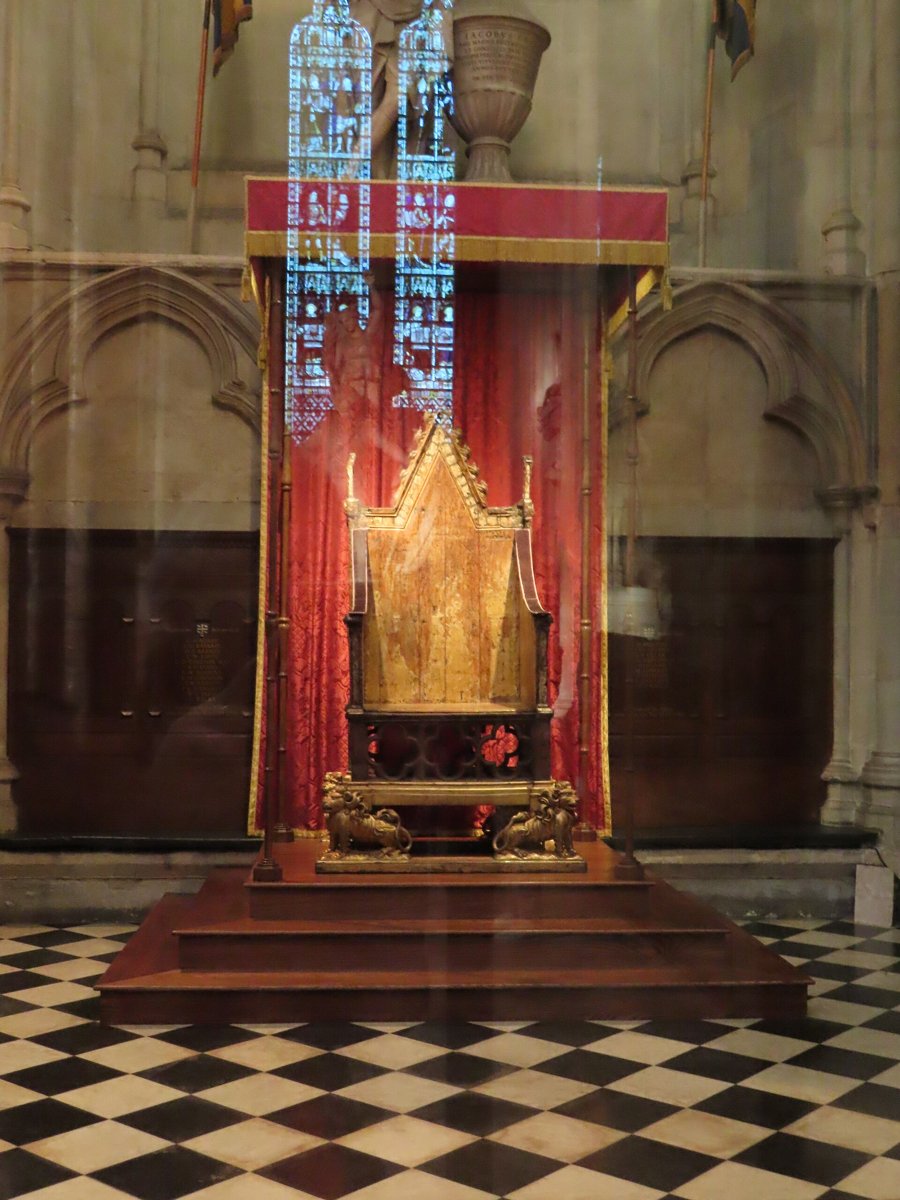
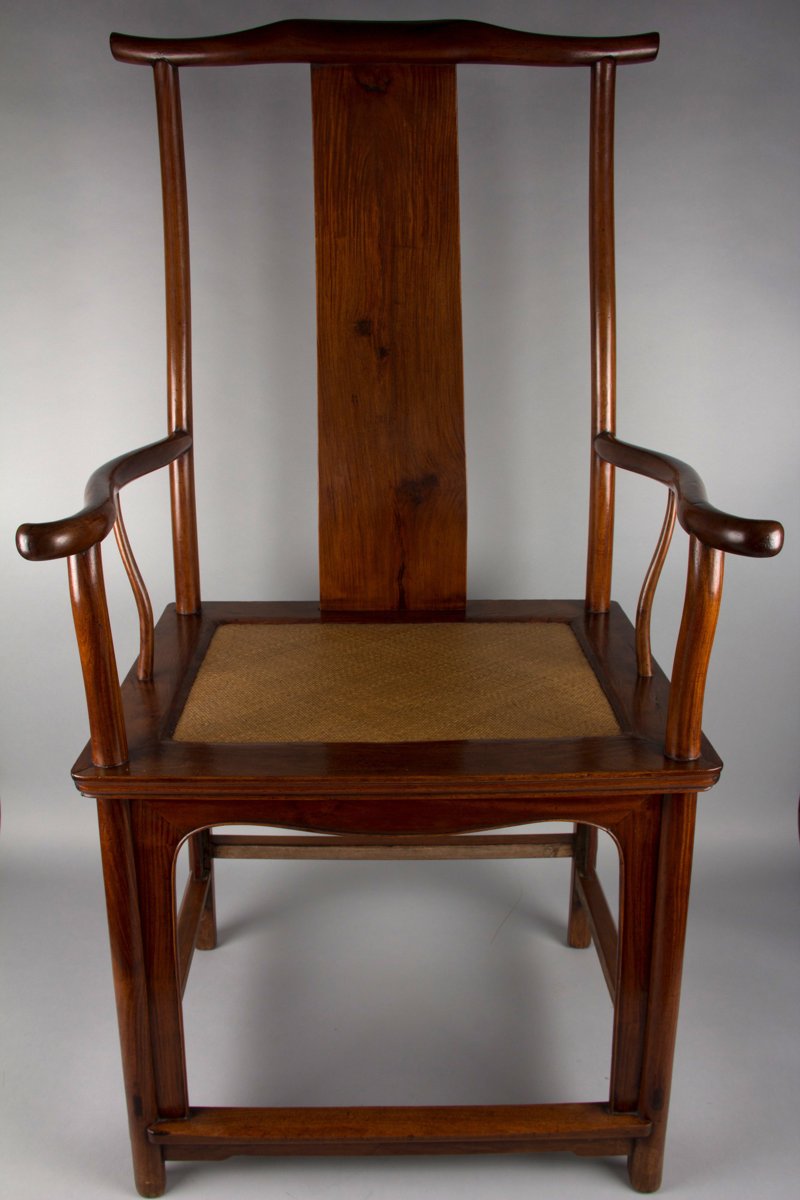
Below the ceremonial tier sits the most instructive rank of all: chairs that stayed in ordinary use. Ming hardwood chairs survive as a living corpus, the sixteenth- and seventeenth-century pieces still collected, traded, repaired, and sat in. A huanghuali official's hat armchair made just under two million dollars at Bonhams in March 2023, an imperial folding chair sixteen million at Sotheby's the autumn before. Then they go back into houses, [not vitrines](https://bonhams.shorthandstories.com/collecting-101-huanghuali-chinese- furniture/).
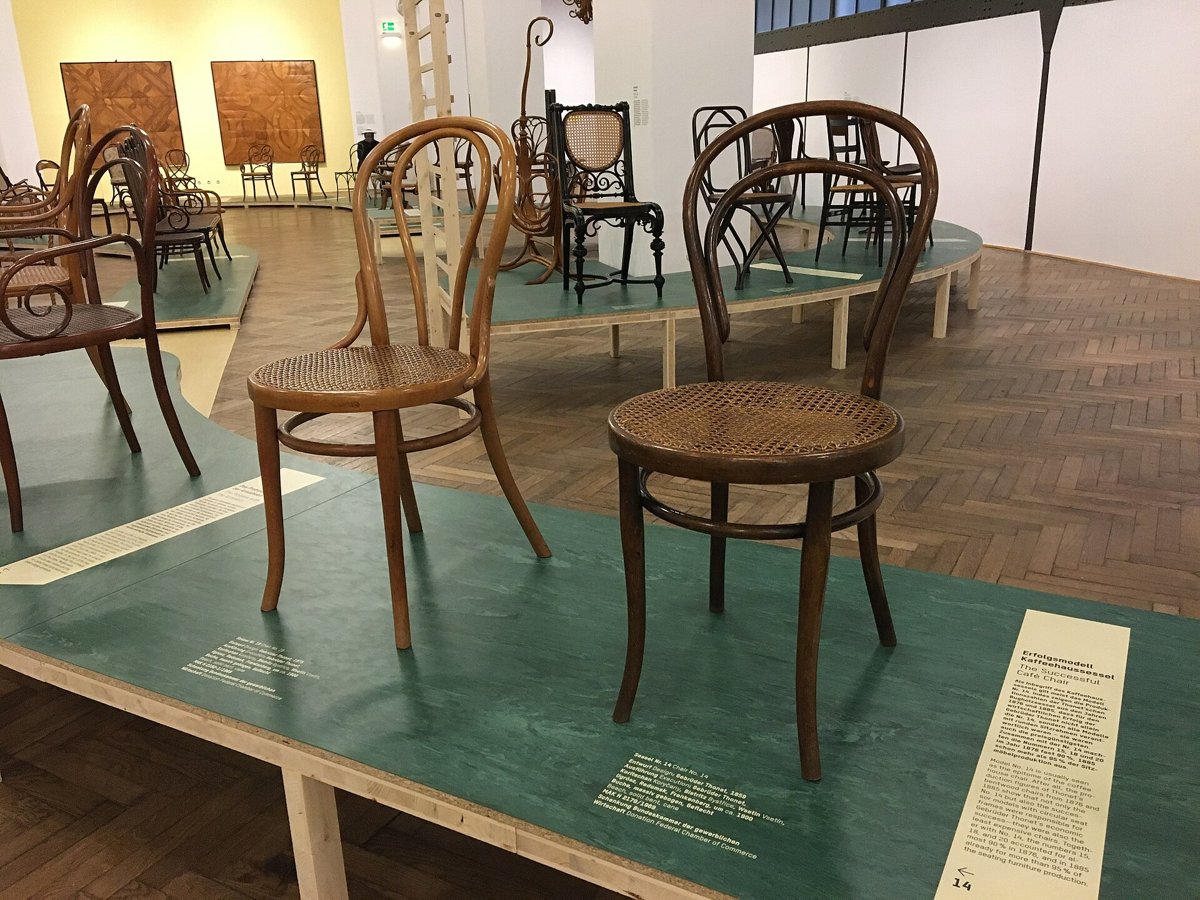
Thonet's chair No. 14 of 1859, in its original form six pieces of bent beech, ten screws and two nuts, had sold fifty million by 1930, and originals still do cafe work at 167.
Even my own totem, Rietveld's 1934 crate chair, the cheap emergency object built to be temporary, is in the Centraal Museum Utrecht at 92. The museum photograph shows off-white paint knocked off every edge and corner, bare pine underneath, rust bleeding from the screw heads: ninety-two years of being used rather than admired, which is one universe-lifetime for a chair that was never supposed to have one.
Something is wrong with that list. It took me a while to see it. Hatnefer's chair is one object that survived thirty-five centuries. Thonet's No. 14 is not. Almost every No. 14 ever made is gone. The number that matters about it is fifty million, not 167. The chairs in cafes today are not survivors; they are descendants.
I had been counting two different achievements in one column. One is the longevity of a particular object: these atoms, this seat cord, kept dry and wanted long enough. The other is the longevity of a pattern: a shape that keeps being rebuilt because people keep wanting it, with no individual specimen lasting or needing to.
The monobloc of the last chapter is the pure case of the second kind. No monobloc lasts and nobody minds. The form is fifty years old, exists in the billions, is made everywhere and is owned by no one. It will outlive every chair in this chapter and every chair I will ever build, as an idea in constant production. Set against Hatnefer's chair it is a different species of durability altogether.
Most of my witnesses are the first kind. A hundred years is a claim about an object. The other kind belongs to A Thousand-Year Chair?, where past a few centuries the atoms stop mattering and only the pattern is left. The K is after both at once. They are not the same problem: keeping an object is a matter of custody, keeping a pattern a matter of legibility.
Read the list of survivors against the far larger list of the disappeared and the pattern is not subtle. The dead chairs died of damp, of abandonment, and of joints that could not be repaired. Almost none died of old wood. Wood in a dry, stable, indoor life is effectively a permanent material at furniture scale. Hatnefer's seat is woven linen cord, still holding a sitter's weight thirty-five centuries on. The survivors all enjoyed one of three custody regimes: a sealed tomb (dry by accident), sacral status (dry by institution), or heirloom care (dry by love). My father's rocker is the third case in miniature, and the Ming chairs add the crucial commercial one: beauty recruits custodians, and a repair trade keeps recruiting them.
So the hundred-year problem is not a materials problem. It is a custody problem with a materials footnote.
The rocker teaches the same lesson, harder than any museum. It came with a control group. I have the story from both men in it. I know the chair's beginning because my father told me, by the fire in my parents' house, later in the same year I repaired it. (He was a combustion engineer; a fireplace was his natural habitat.) Around 1961, at a church white-elephant sale in Cambridge, Massachusetts, he and his friend John Romish both bid six dollars on a broken rocking chair. They flipped a coin; my father won. Decades later, John weighed in on my repair email with his own side of it. The winner and the loser agree.
John's chair is the control group. The one he lost he replaced with a proper antique, a Boston rocker he bought for sixty dollars, ten times the price. When he took it to a furniture repairer in Boston, the man refused to touch it, "fearing its real value would be threatened." Read the two custody paths side by side. The precious chair was frozen by its own value: unrepaired, preserved, held at arm's length. The worthless chair was repaired without hesitation for sixty years. Nothing about it demanded reverence. It is the one that lived a life. Preciousness is a custody hazard in both directions: it can get an object melted, looted, or peeled off a cave wall; it can also get one embalmed. The gray rocker survived on the only fuel that never runs out in a family: fondness plus the permission to keep fixing.
There were other chairs of Theseus in that house. A set of six Victorian oak chairs we called the Growly Chairs, each with a carved beast's face in the seat back, mouth open wide enough to hold a napkin or serve as a handle, was rebuilt by my father more times than anyone counted, and eventually given away as a set, still working, custody transferred whole. The face belonged to a recognizable genre: the green man and mask-back oak chairs of the decades around 1900, foliate guardian heads carved where the sitter's spine goes. Dealers still sell them as emblems of "renewal and protection." That is how they are wanted now, not how they were sold then [family photographs sought]. Furniture has worn guardian beasts since the lion legs of Egypt: paws below, faces behind, the chair as a creature that keeps you. The apple did not fall far from the chair.
Here the record gives design advice with unusual clarity, because the survivors sort by how they were held together.
The oldest tier is fastened with almost nothing. Hatnefer's chair is mortise, tenon, and peg; the cords are textile; Egyptian furniture used metal sparingly. Three and a half millennia and almost no fastener corrosion. There is almost no metal in the chair to corrode. The joints are wood-in-wood, and when they loosen they can be re-glued, re-wedged, re-lashed.
The middle tier chooses its metals well. Charlemagne's marble is held by bronze clamps, twelve hundred years old and doing their job; copper alloys passivate instead of rusting. Iron is the problem child and the archaeology says so. Buried or damp iron rusts, and rust takes up more room than the iron it came from, so the fastener grows inside the joint and splits the wood it was put there to hold. In oak the tannins attack the iron chemically, and the iron blackens the oak in return. Boatbuilders have a name for the result, nail sickness. A damp-country chair nailed with iron is a chair with a timed charge in every joint. The instinct that not many iron fasteners survived is right in exactly this regime: from antiquity, wood-in-wood joints survive by the thousand, iron fastenings mostly as stains and voids.
But the modern tier rehabilitates metal on one condition. Thonet's ten steel screws have been in service for 167 years, because the chair lives indoors and dry. A screw is also not a nail. It is removable, replaceable, re-tightenable. The fastener stopped being a permanent part and became a consumable. Consumables do not age; they get replaced. My father's late-period drywall screw and my own black-oxide bracket screw are the same idea, arrived at in a home shop rather than a factory: not permanence, but cheap replaceability, left in plain sight.
That is the fastener doctrine the triad chapter names under maintainable. The survivors are why I trust it: no glue, every connection reversible, threads that end in steel so a stripped bolt is a trip to the hardware store rather than a dead chair. The mechanism, why the preload leaks out of a bolted joint while a compression joint keeps its grip, is worked out in the technical note on why joints go slack. The survivors only settle the verdict: the fasteners that lasted were the ones that could be replaced.
The triad chapter set out what a chair must be to last. The survivors and the rocker are where I learned it. They add two things.
Custody is the design object. A chair lasts if someone keeps it. Stay dry, stay wanted, stay fixable; everything else is detail. That sounds like advice for owners. It is really a brief for the designer, whose task is to recruit a chain of custodians not yet born. Nothing on the survivor list lasted because it was well made. Each lasted because of the regime it fell into. Two of those three are accidents. Only heirloom care can be designed for, by making a chair somebody wants to keep.
Concentrate the irreplaceable. The triad chapter makes this a rule; Westminster makes it a fact. Seven centuries of regilding, new feet, and repair after repair, all of it worked around one oak carcass that nobody has ever replaced. What survives is the one part built so it never has to be replaced. A chair should carry as little of that as it can.
I wrote most of this chapter asking why some chairs reach old age, and then, on a walk at dusk, the question walked up and introduced itself. Within fifty meters of my own door I passed four chairs set out on the verge: a white stool and two blocky wooden chairs I found frankly hideous, and, at the end of the row, an orange one. A plain vernacular library chair, a slatted back and clean, balanced lines, painted orange somewhere along the way. My father made pocket money hauling washing machines off exactly this kind of curb. It seems I cannot walk past a good object left for dead either. I turned it over all the way to the park, decided I had to have it, started to worry someone would beat me to it, and came back for the prize.
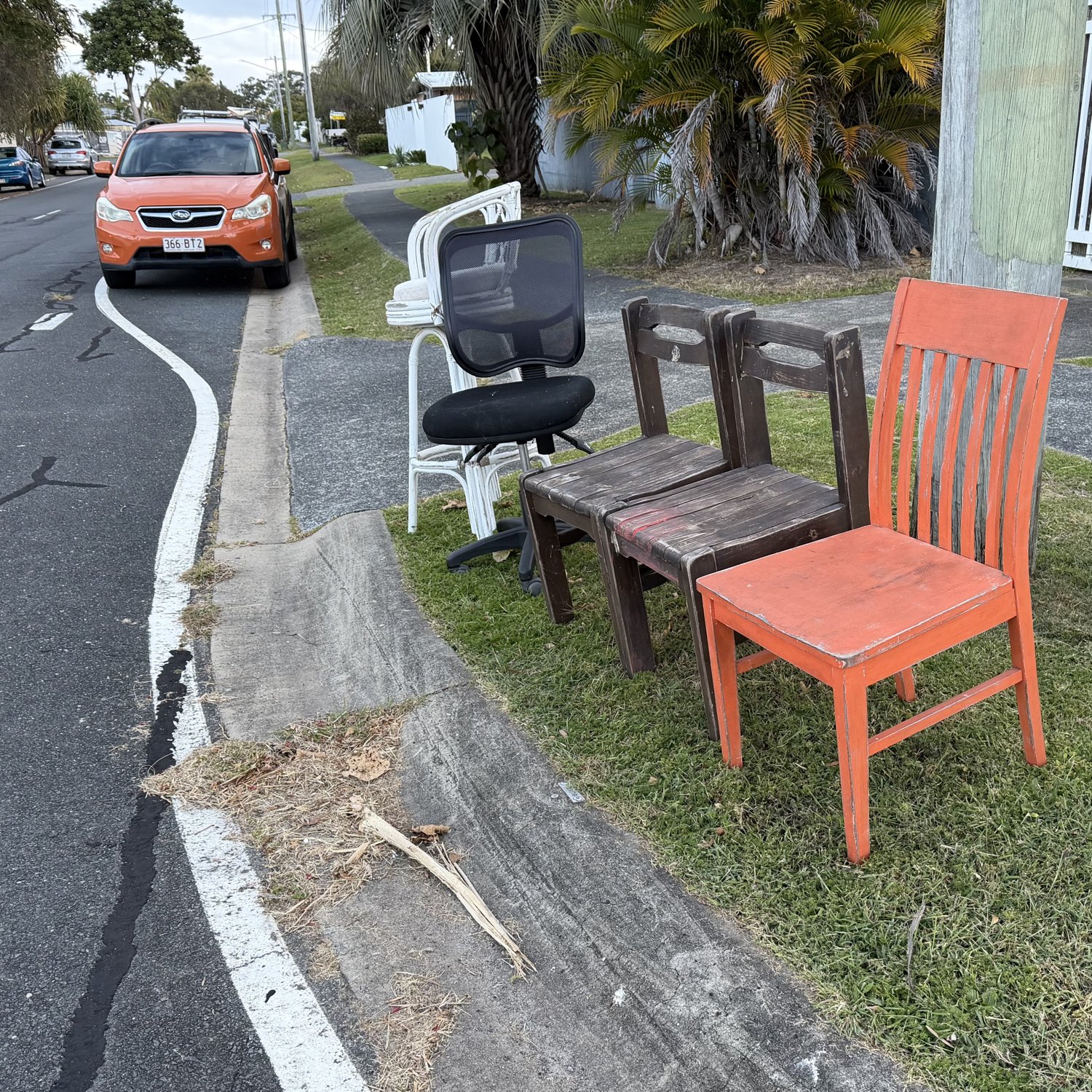
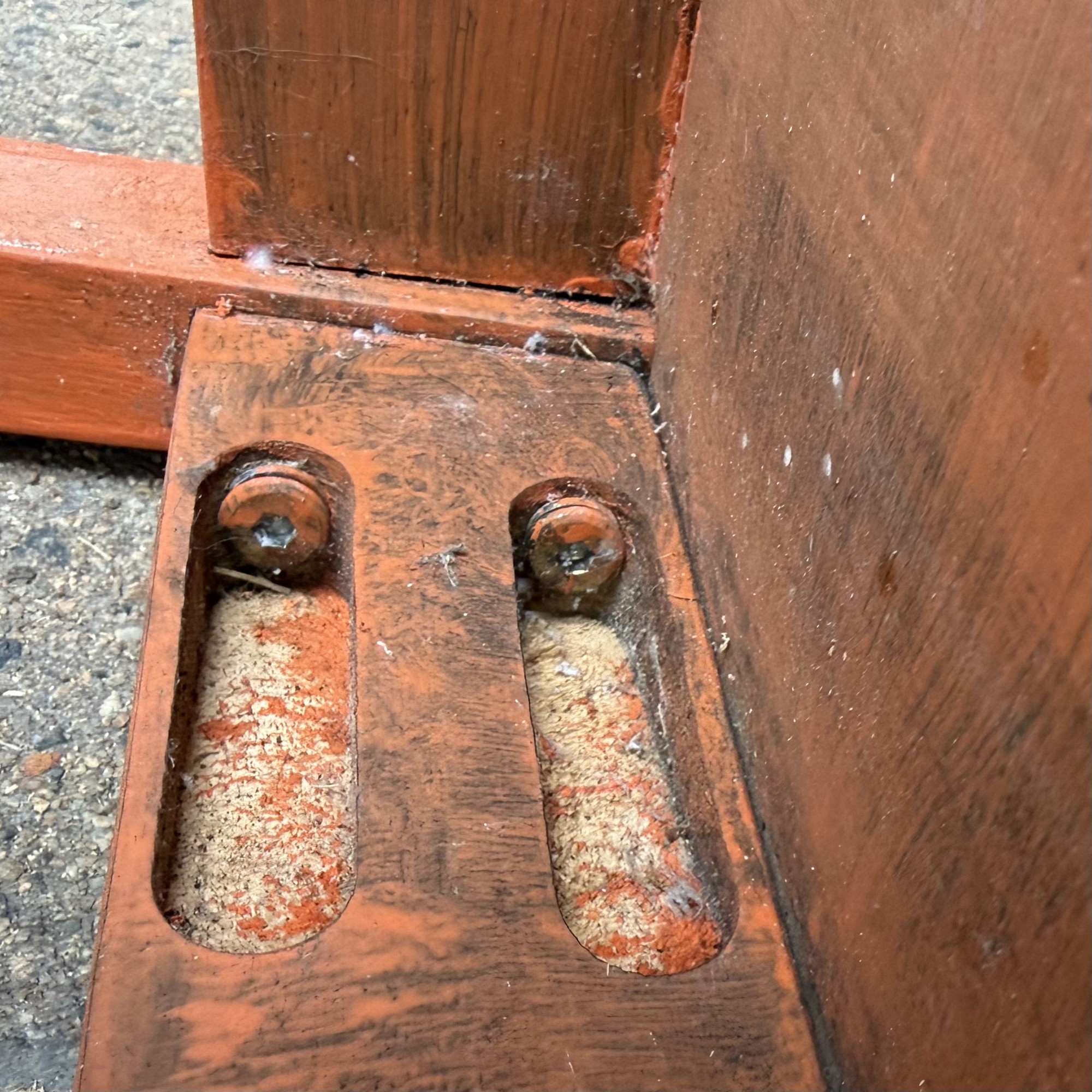
Up close it made my own argument for me. It is plenty legible: every joint screwed through a milled pocket, driven at an angle, the same move the K uses.
!Two elongated pockets milled side by side into a corner brace on the underside of the chair, each with a screw head seated in a raised boss at the upper end of its slot and the rest of the slot filled with pale dust. The pockets, 22 August 2026. A slot milled to take the screw at an angle, the same joint the K makes with a bracket. Whoever built this chair expected somebody to open it again. It has seen weather and wears at least two coats of paint. It is entirely maintainable. I can bring it back to full working order, and I will, out of professional interest. Which leaves the only question that was ever going to matter, the one both rules above quietly depend on: will the restored chair be lovable enough to earn its keep? My guess is no. Adoption into my house requires the consent of two chair parents, and I do not think it clears that bar. Legible and maintainable and quite possibly unloved. I can engineer everything about its second century except the one thing that decides whether it gets one. I come back to the orange chair, and to that question, in the coda.
A hundred years, against this record, is not a boast. Hatnefer's chair is thirty-five hundred years old and still holds its original seat cord. The Coronation Chair has been doing its job for more than seven centuries. All I am promising is the first one percent of what a wooden chair has already proven it can do, provided I do the two things the survivors teach: make a chair worth loving, and then engineer the custody, not just the chair.
My father died in 2023. The rocker is in my living room, with a sheepskin pad on the seat now, the one improvement I have allowed myself. It is sat in whenever there are people around. It still starts a story or two, this one among them. The chair is still being kept.
Every artifact claim in this chapter was checked against museum and institutional sources on 6 September 2026, independently of the project's own survey notes; five failed and are corrected in the text. Hatnefer's chair: The Metropolitan Museum, acc. 36.3.152, MMA excavations 1935 to 36, "The seat, made of linen cord, is original," dated ca. 1491 to 1473 BCE; Hatnefer was the mother of Senenmut, high official under Hatshepsut. Tutankhamun's golden throne: Grand Egyptian Museum, wood under chased sheet gold with glass, faience, silver and semi-precious inlay, found wrapped in linen in the antechamber. Hetepheres: Digital Giza (Harvard/MFA), the surviving pieces restored with modern wood on ancient gold, Manuelian in JARCE 53 (2017) calling the assemblage among the oldest from the ancient Mediterranean world rather than the oldest furniture. Herculaneum: Parco Archeologico di Ercolano and Current World Archaeology, carbonized rather than combusted for want of oxygen, the oak cradle from the House of Marcus Pilius Primigenius Granianus among the finds. Throne of Maximian: the Emilia-Romagna heritage catalogue dates it to Maximian's episcopate, 546 to 556, and gives seven surviving plaques of sixteen original on the back, where English Wikipedia gives sixteen of twenty-four; the text states neither count because the sources conflict. Throne of Charlemagne: Aachen Cathedral for the four marble slabs and bronze clamps and for thirty kings crowned between 936 and 1531, and for the late-medieval oak board replacing the bottom of the rear slab; the c. 800 date rests on radiocarbon of the oak substructure. Tyldal chair: Glencairn Museum and the St Thomas Guild, birch, Osterdalen, 1150 to 1200, now in Oslo [no museum catalogue number retrieved; write to the registrar before print]. Coronation Chair: Westminster Abbey, made 1300 to 1301 and painted by Master Walter, in coronation service since 1308 with the Abbey's own caveat that opinion divides on the first crowning, certainly from Henry IV in 1399; Charles III on 6 May 2023. Ming market: Bonhams New York, Mary and Cheney Cowles Collection, 20 March 2023, lot 81, huanghuali official's hat armchair, US$1,980,375 with fees; the imperial folding chair at US$16m is Sotheby's Hong Kong, October 2022. Thonet No. 14: the Design Museum, London, "six pieces of wood, ten screws and two nuts," fifty million sold by 1930. Rietveld crate chair: designed and made 1934, V&A; the Centraal Museum holds a Kratstoel, and the paint and the wear are visible in the museum photograph the project holds, filed as images/krat-museum-offwhite.jpg and used in The Neighborhood. No published record describes the condition, so the description here is read off the photograph and says so [confirm the holding institution when the image rights are cleared]. Green man chairs: the genre and the phrase "renewal and protection" are attested in present-day dealer listings, not in period marketing, and the text now says so.
The gray rocker, its 2020 repair, and my father's history are my own account of 21 August 2026, corroborated within the family; the 1961 origin is from my father directly, with John Romish concurring by email. The orange chair, rescued 20 August 2026 fifty meters from my door, is my own account; its repair is under way and its fate is reported in the coda. Rocker photographs January 2020, mine, GPS stripped; orange-chair photographs August 2026, mine.
A chapter of The Hundred-Year Chair, drafted and refined in public. The same text lives in the book; the interactive tools and the fully-sourced technical notes live here. home · the book · the technical notes · hundredyearchair.com