The family tree · an exhibit
The Lineage
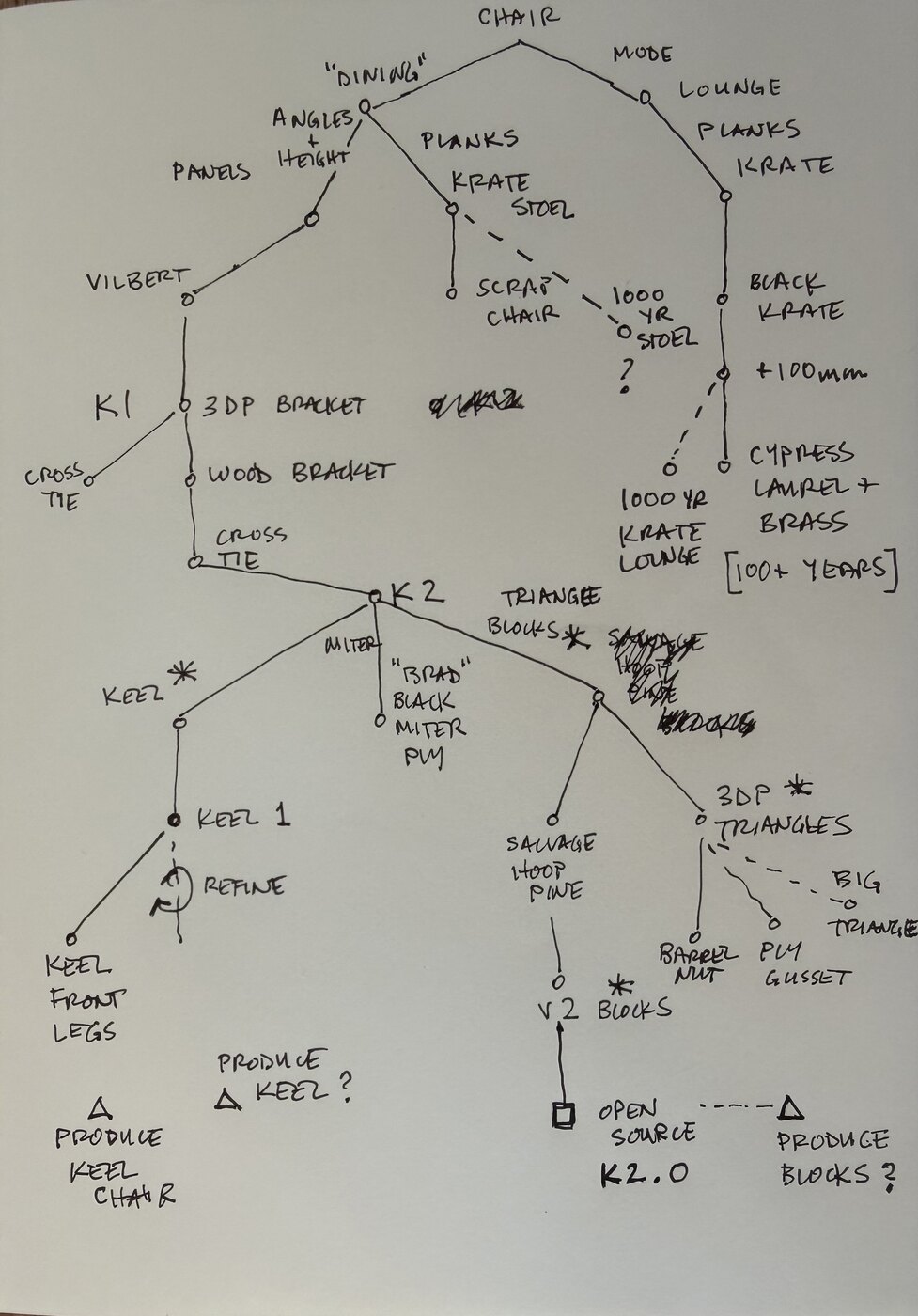
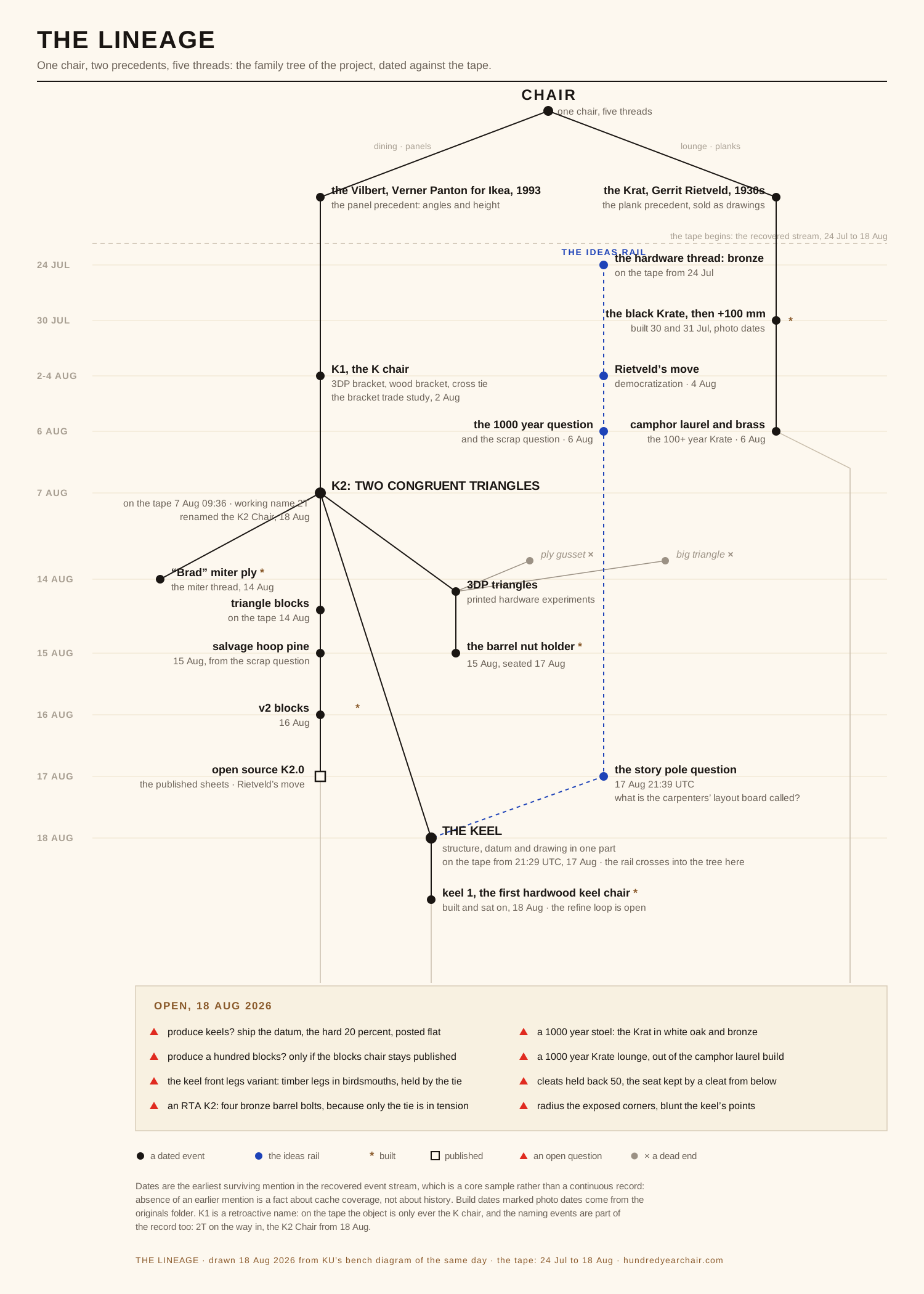
Most design histories are written after the fact, from memory, and memory flatters. This project keeps its tape: the working conversations between the designer and the AI co-worker are archived, timestamped to the minute, and they now reach back to 24 July. So the family tree below is a rare kind of document. It was drawn from life twice: once by hand at the bench, and once against the record.
How to read it
Two precedents stand at the top: Verner Panton's Vilbert, four panels and an attitude, and Gerrit Rietveld's Krat, planks sold as drawings anyone could cut. Every chair in this project descends from one or the other, and the project's five threads (scrap, longevity, process, bits and atoms, democratization) run through both lines. Solid lines are descent. The blue dashed line is different, and it is the reason this exhibit exists.
What the tape adds to the bench diagram
Three amendments, each of which only a record can make.
First, THE IDEAS RAIL. The bench diagram is a genealogy of artifacts, but the tape shows a second structure running beside the artifacts: ideas that belong to no one chair, crossing from thread to thread. Bronze enters on 24 July, before any chair it now serves. The thousand-year question arrives 6 August. And on 17 August at 21:39 UTC a question about carpenters' vocabulary (what is the layout board called?) crossed from the process thread into the artifact tree and became a part: the keel. That crossing is drawn as the one place the rail touches the tree, because it is the clearest recorded case of an insight becoming an object.
Second, RETROACTIVE NAMING. The name K1 appears nowhere on the tape; until the bench diagram was drawn, that object was only ever the K chair. Nothing is wrong with renaming ancestors, every history does it, but the exhibit dates the names separately from the things: 2T on the way in, the K2 Chair from 18 August, K1 conferred afterwards, in retrospect.
Third, DEAD ENDS. The bench diagram mostly shows survivors, and two of its nodes are scratched out. The typeset tree keeps the dead ends legible (the ply gusset, the big triangle) because the retractions taught as much as the survivals, and a lineage of survivors only is advertising, not history.
The honest caveat
The recovered stream is a core sample, not a continuous record: some days are dense, some absent, because the recovery depended on which pages of the client's cache survived. A date on this sheet is therefore a lower bound, the earliest surviving mention, and the absence of an earlier one is a fact about cache coverage rather than about history. The archive, its method, and its coverage table live with the transcripts; the capture is now automatic, daily, so the tree can only get more accurate from here.
The Lineage · drawn 18 Aug 2026 from the bench diagram of the same day, dated against the recovered event stream (24 Jul to 18 Aug 2026) · the technical notes · the verification ledger · by Karl T. Ulrich, with an AI co-worker · hundredyearchair.com