The Hundred-Year Chair · a chapter
Nailed It: The Keel
A truss diagram is built out of a part that does not exist. Every place two members meet in that diagram is a perfect pin joint: it passes load in any direction, holds nothing against rotation, and lives at a single point with no size. We can neither buy that part nor cut it; it exists in theory only. Making something that behaves enough like one, and putting it exactly where the drawing shows, took more work than getting to the two triangle concept in the first place.
How does a stranger put five pieces of wood together, twice, and get the same chair both times? That question, not the shape of the chair, is what closed out the search.
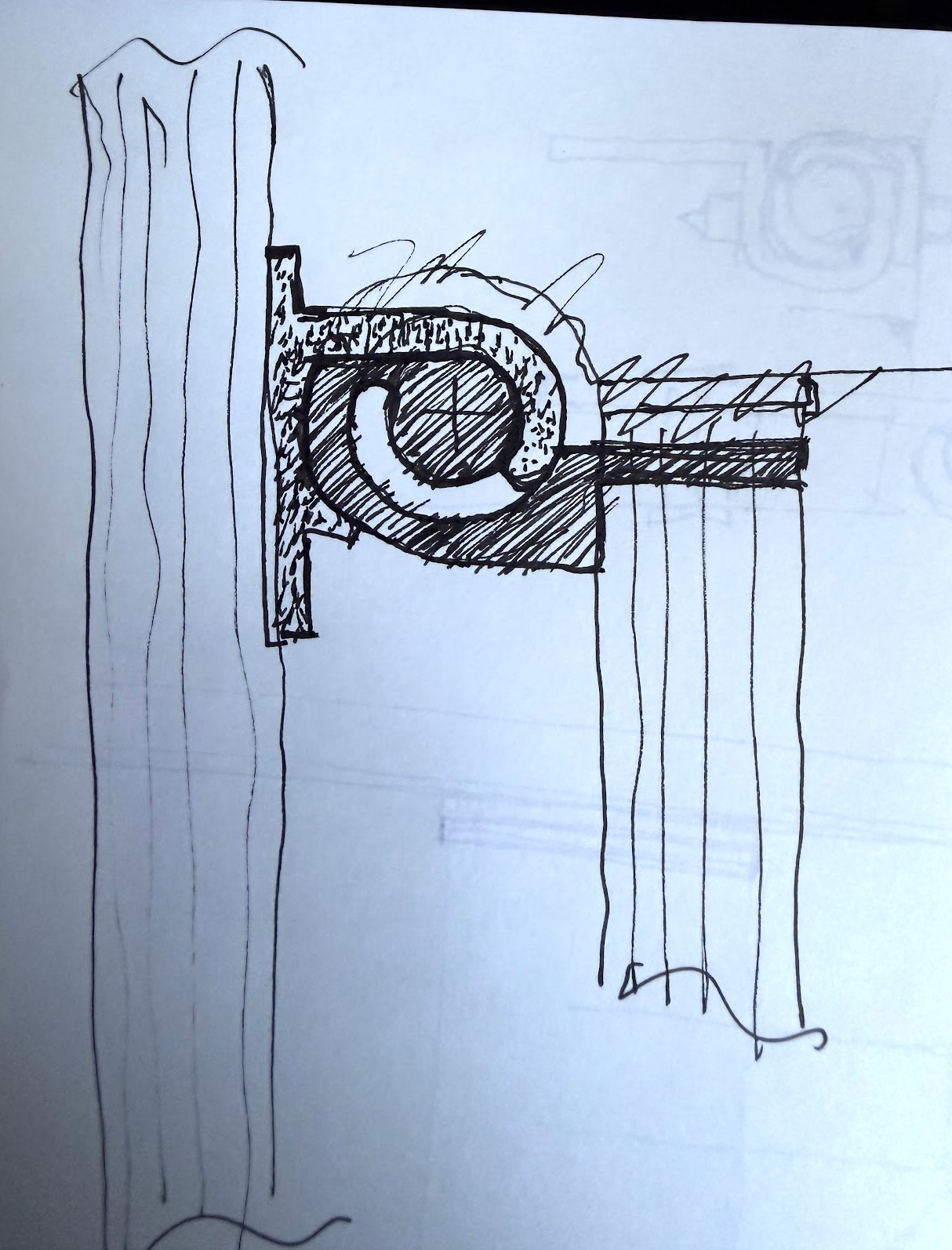
On the sixth of August I spent three and a half hours on a flight drawing a hinge. Not a hinge for its own sake. I wanted a joint with no angle built into it. Put a hole in each member, run a pin through, and two pieces of wood can meet at whatever angle the drawing asks. The distances between the holes fix the shape; the connector only holds the pin.
Nobody tells you this until you have built a few chairs. The hard part is not strength; almost any pile of sticks thick enough will hold a person. The hard part is that a chair is a set of angles, and every one of them has to be put somewhere. Something in the object has to know that the seat meets the back at a hundred degrees, and go on knowing it while a stranger with a chop saw assembles the thing in a shed. Locating the angles is the job.
Where can an angle live? The hardware can hold it, say in a steel angle bracket. The mating surfaces of the sticks can hold it, say in a miter or a mortise and tenon. Or two sticks are placed at an angle and fastened together through their faces with multiple fasteners and you hope for the best.
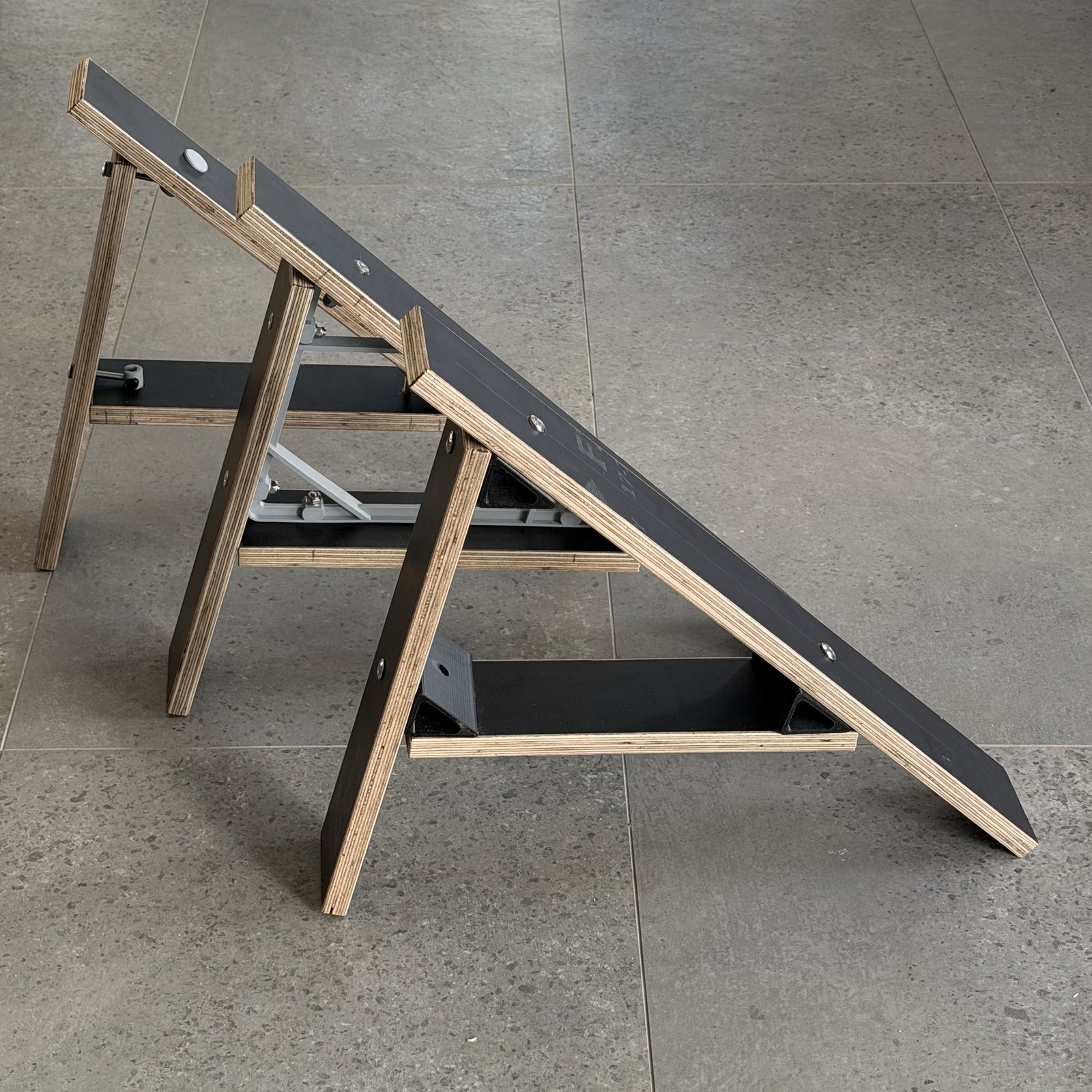
That afternoon the hardware won, on a doctrine I had held for weeks, that one part number should cover every geometry the model might emit. I went off to design the perfect bracket. I literally spent a week designing brackets, and I count more than 40 variants and at least six prototypes. I eventually created an elegant triangular bracket with angles at 40, 60, and 80 degrees, that could be used in three different orientations to support three corners of the triangles.
I totally missed a key insight. A bracket does not need to hold an angle in a truss. If the lengths of the sticks are right and the ends are located in the right locations, the angles are fully determined. Brackets need take no prying forces; they just need to locate the sticks. Let me say it again slightly differently. If the frame is triangulated, no joint in it has to resist being bent, because a triangle holds its own angles. The geometry determines the angles, not a bracket.
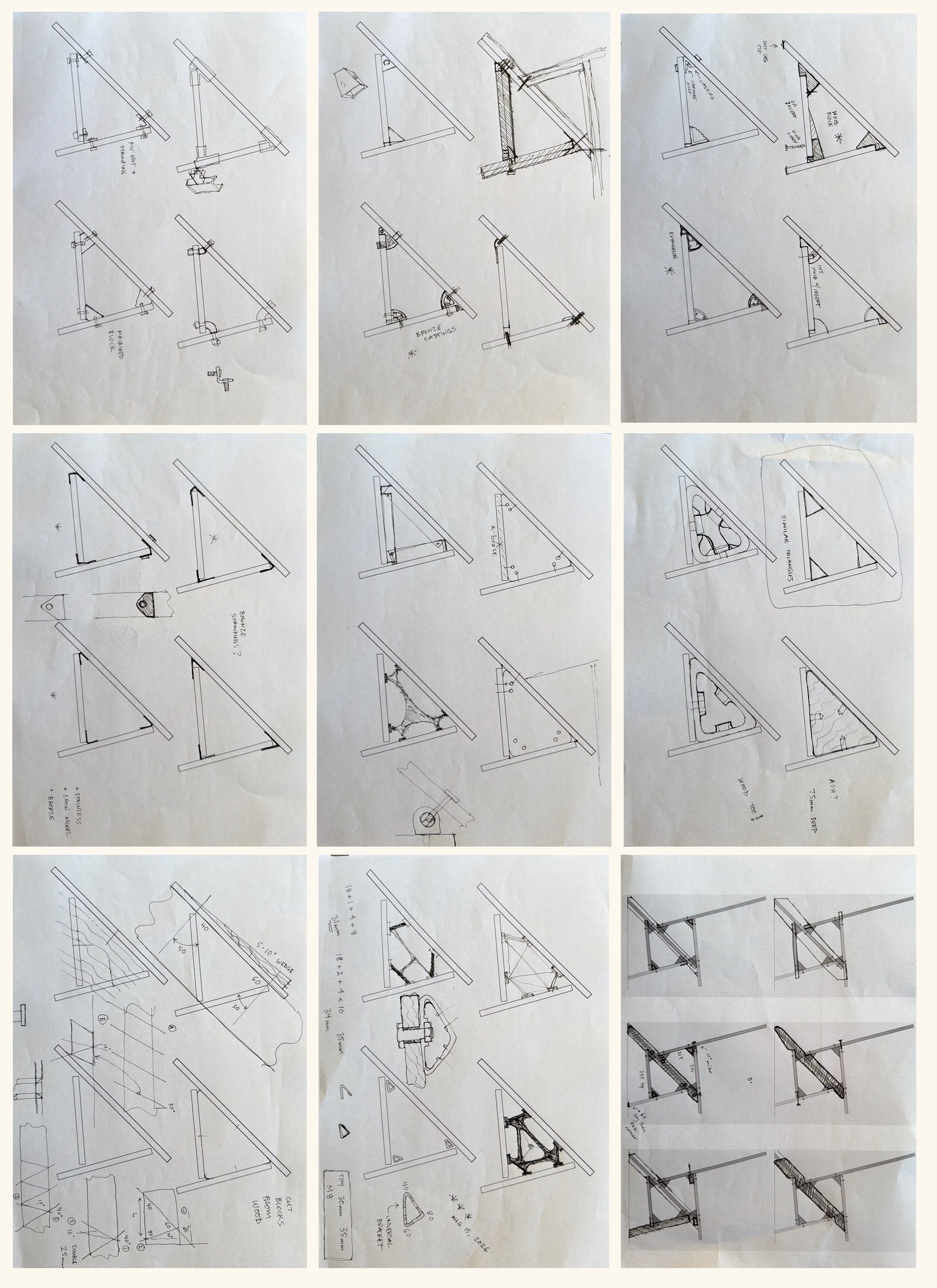
Wood blocks glued into the corners. Printed brackets in PETG that snapped when I tightened the bolts. Printed triangles in ABS that did not. A two-piece printed frame that was really an assembly jig pretending to be a part. A universal bracket, starred on a sheet dated the fifteenth of August, that would serve all three corner angles with one part number. What it produced was an inventory of answers to a question the frame had already closed. Once the bracket's job is only to mark a position, you no longer need a clever part at each corner.
In a long design effort and with a little luck there comes a moment when a thing you have circled for weeks holds still and looks back at you, finished. It does not announce itself. I had that moment on the eighteenth of August, looking at a schematic diagram of the two triangle chair.
What I was actually looking at was a diagonal with the little corner blocks stuck to it. I had drawn that arrangement a dozen times without seeing it. This time I saw that the blocks did not have to be blocks. Make the diagonal and everything on it one part, and every angle in the chair, every position, all the fussiness I had been trying to package into hardware, would live inside a single stick. That stick is a little rafter with some notches cut into it. The other four members would not have to know anything. They would just be the right length and be placed in the notches in the rafter. The chair's geometry would be fully defined.
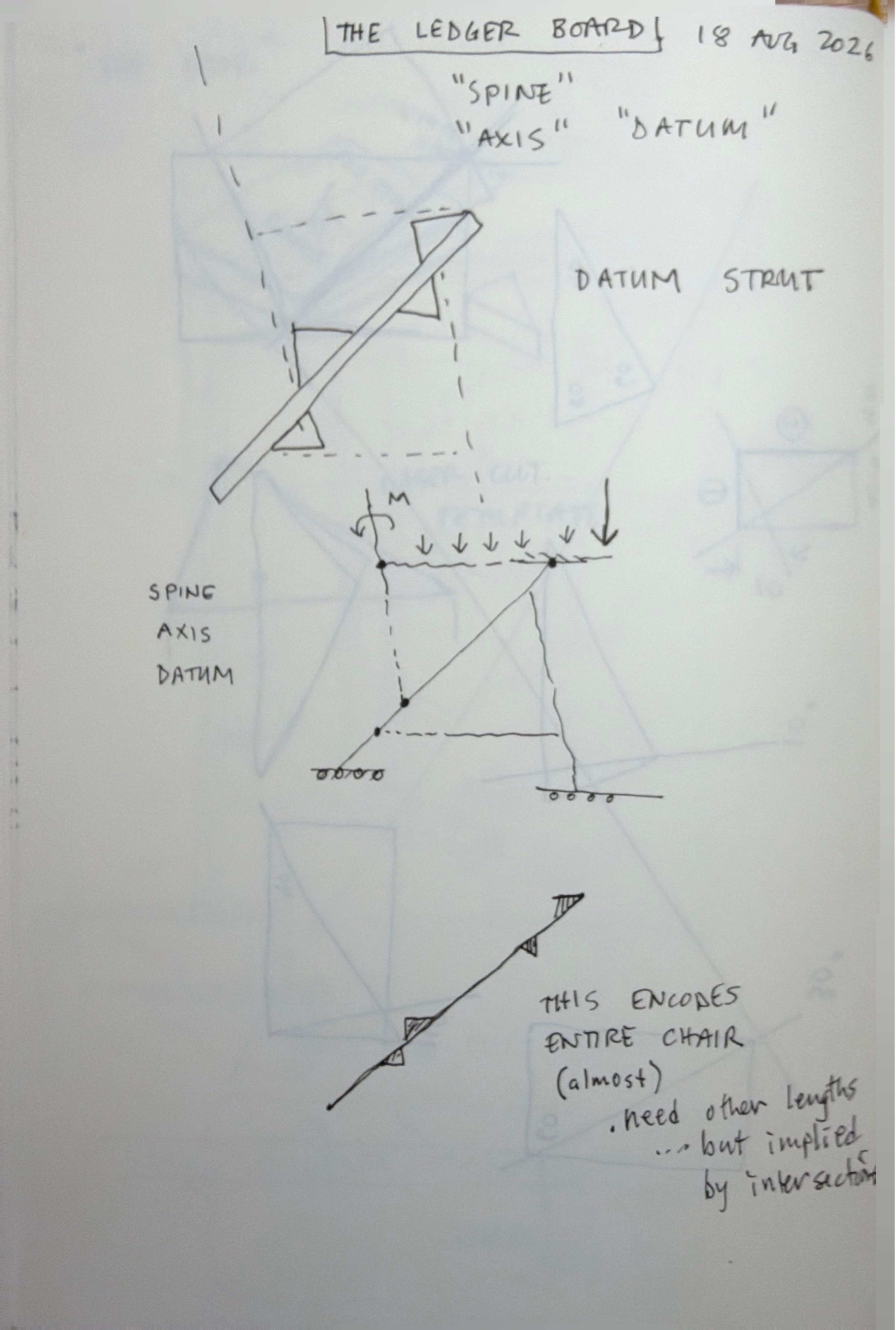
The name for this part I could think of was ledger board, and I asked the machine to help me remember the name for the stick carpenters use to lay out the height of windows and trim, a Story Pole. The margin of my notebook page hunts for a better word, SPINE, AXIS, DATUM, the one thing everything else is measured from. The word that fit came from boats. A boat's keel is laid first. The hull is lofted from it. It carries load for the life of the boat. Laid first, built from, loaded forever, all three at once. The word is not mine, as it happens. The machine offered it, and I adopted it.
Every station on the keel is struck from the same end of the same stick, the seat here, the front there, the back and the tie further along. Only the keel's own marks can carry error, and because they all come off one corner, nothing accumulates. The placement of the other four members is not measured at all. They are placed at the locations the keel defines.
The keel also mostly swallows the brackets. Each member drops into a notch cut into the keel, a triangular pocket whose walls seat against solid timber. Carpenters call that cut a birdsmouth; I call it a fish mouth. It is a keel not a rafter, after all. In the earlier chair, every acute joint needed a small wedge glued into the corner behind it. The fish mouth is that same wedge, subtracted from the keel instead of added to the corner. Three notches a side retire six of the chair's twelve blocks, replaced by a cut in a part I was making anyway. I wrote "mostly swallows" because the back and the seat still need to meet at an angle, and the front legs and the tie still need to meet at an angle. I eventually did design a little aluminum bracket for that job.
Two more properties fall out for free. Because every member but the tie works in compression, the load closes its own joints; sit down and the seat drives harder into its fish mouth. A notch is exactly the right shape for a joint that is pressed shut. And the chair has no handedness. The chair is a flat drawing carried across the room on a thickness. The second side is not a mirror of the first but the same profile slid over. Stack two boards, cut both keels in one pass, separate them. One cut made both, so they are identical, and identical sides square the chair.
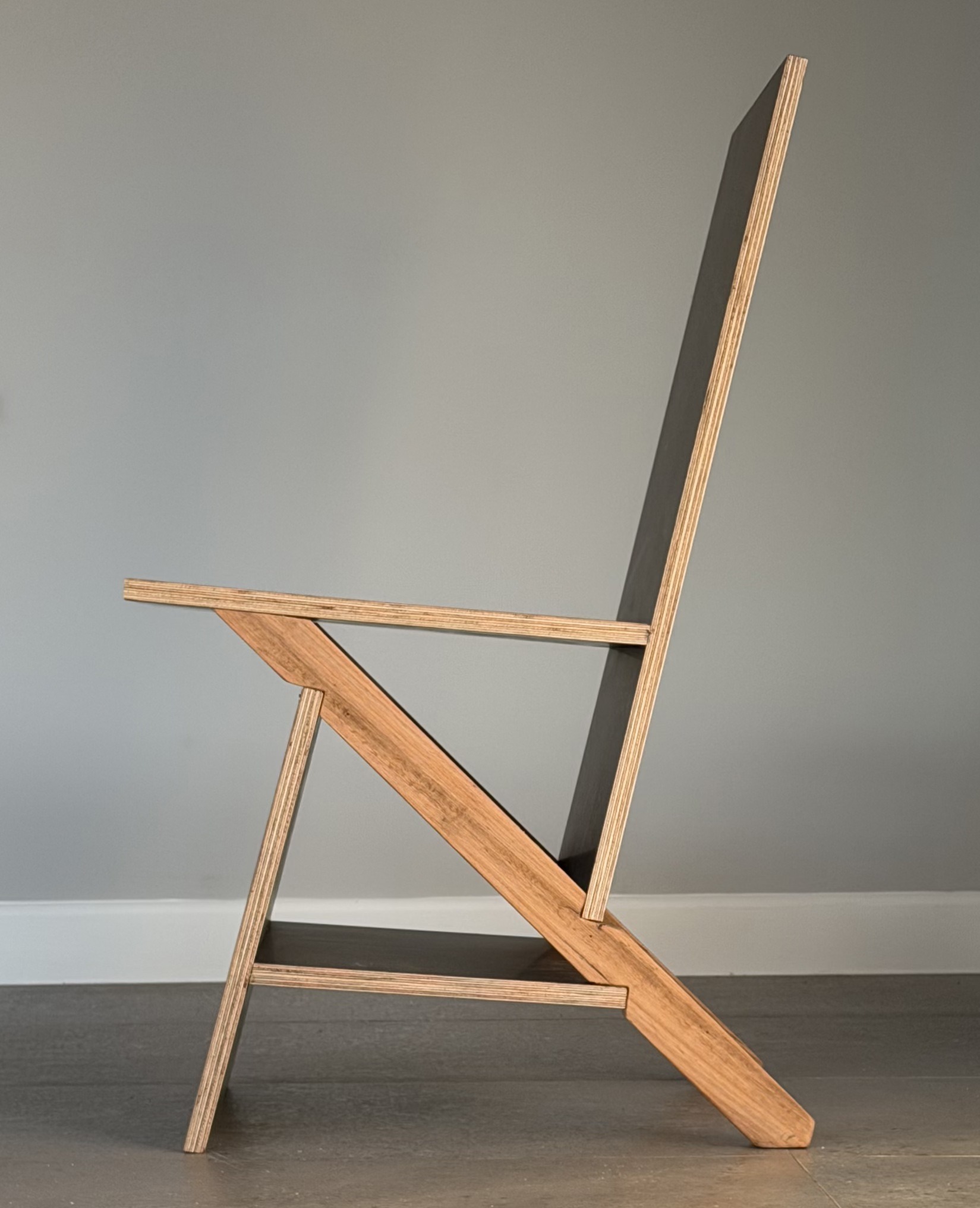
Put it together and the keel takes the whole precision budget. If the keel is right, the chair is right. Cut that one part on a machine, or cast it, or build a jig for it, and then cut the other four with a hand saw in a shed, and the chair geometry still comes out right.
The trades have half of this already in the story pole, a board a builder marks once and reads again and again along one axis. The keel does a story pole's job and then does the thing a story pole never does, which is stay. A story pole is consulted and thrown in the corner when the wall is up. The keel is consulted and then carries loads every time someone sits down.
I remember the words in my mind after building and assembling the first keel chair: nailed it. I had felt exactly that at the Vilbert, at the double triangle, at the one-triangle bracket. Every one of those was a false summit with a higher ridge behind it that I could not see. Nothing in the feeling tells you what kind of peak you're on.
I've finally got my chair. Two triangles, four numbers, one keel, and a person can sit in it and lean back hard. Now it just has to last, and lasting is not a property of wood. It is a property of people. That is the next act.
For sources, citations, and the technical notes behind this chapter, see hundredyearchair.com.
A chapter of The Hundred-Year Chair, drafted and refined in public. The same text lives in the book; the interactive tools and the fully-sourced technical notes live here. home · the book · the technical notes · hundredyearchair.com