The Hundred-Year Chair · back matter
Colophon
A colophon is the page at the back where a book confesses how it was made. In the early days of printing it carried the printer's name, the city and the date. Often it was the only place the human hands behind the object were visible at all. This book's making was strange enough that the confession needs a chapter. What follows is the machinery, the money, the voice, and one question I have not resolved. It is deliberately the weediest chapter in the book. It is also the only one that will keep changing after the print edition freezes. Its canonical copy lives on the website, where a colophon can stay current.
The stack
The book is the repo, and the repo is the book. Every chapter is a plain text file in a git repository on my laptop, with a remote on GitHub. The website is deployed from that repository by Vercel. The print edition is compiled from the same canonical chapters by Python code written by the machine. One source, three surfaces: web, newsletter, print. Nothing is pasted between them by hand, because anything pasted by hand forks, and forks rot. (Typesetting toolchain, epub path, and printer: to be decided, and recorded here when they are. The working assumption is print on demand for the trade copies. The special edition is hand assembled, with a jacket laser cut and engraved from 1.5 millimeter plywood.)
There is an ancestry here I did not plan but will claim. Donald Knuth built TeX on the insight that text is code, and books have been compiled ever since. This project runs the same insight pointed at furniture: the chair is code, a pattern from which any competent person can regenerate the object. The technical notes state the two philosophies side by side. TeX: the code is the text. Keel: the code is the chair. In both cases the artifact should be legible enough that the code could be reproduced from it, and in both cases, if only one survives, it will be the artifact. Paper and hardwood over repositories, every century so far.
Who wrote what
The writing was drafted by Anthropic's Claude, variously the Fable 5.0, Opus 5, and Opus 4.8 models, in high effort mode. Editing and critical review came mostly from ChatGPT 5.6, with occasional queries to Grok and Gemini, which are fast and essentially free. As of this printing I have not directly edited one word of the source text. Every change I wanted was made the way every change to the chair was made: I said it in conversation, and the machine revised the canonical file.
The division of labor is the same one the Centaur chapter documents at the saw. The arguments, the structure, the memories, the verdicts, and the taste are mine; the sentences, at first draft, are the machine's. I like writing, and I think I am still a better writer than the models. I am also about a hundred times slower. That ratio decides the workflow, not any judgment about quality. The economics are the chair's economics: the thinking got cheap, the taste did not.
The not-one-word claim needs a footnote. A middle layer sits between my mouth and the machine's draft. It is a file. The project keeps a scratch pad, a plain document in a folder called coordination, where I scribble: half-thoughts, lists, misremembered names, jokes I am trying out, paragraphs I would write if I were writing. The chemistry set, the Tracy Kidder worry, the falling-in-love memory, the Köl brief, all of them entered this book as scribbles there first. So the division of labor is finer than dictation. I write raw ore into the scratch pad; the machine quarries it, checks it against the record, connects dots I had not connected, and produces the prose; I react to the prose in conversation, which produces more scribbles. When I say I have not edited one word of the source text, that stands. But plenty of my words are in the book, arrived not by my editing the output but by the machine mining the input. The scratch pad is the strangest document this project owns. It is the one place I still write like a person alone, and it exists so that I never have to.
The voice problem
The writing the machine produces is good. It is also, to a reader who has seen much of it, recognizably machine writing. The prose can be vivid, structured and correct, and still get discounted the moment the reader detects its origin. I spent real effort on this problem, and the fairest way to show the work is to put a specimen on the table. Here is a paragraph as the machine first drafted it, for a technical note on why the chair's topology is fixed:
I want to be careful about one word here, because it is the hinge of the whole argument. When I say the topology is fixed, I do not mean it is a rule. I mean it is constitutive. There is a difference, and it matters. A rule is something you can break and still have the thing, only a worse version of it: run a red light and you have still driven a car, badly. Constitutive is not like that. The two-triangle topology is constitutive the way having four sides is constitutive of a square. If you change it, you have not broken a rule and made an inferior K2. You have made a different chair, which may be an excellent chair, and good luck to it. I have no authority to forbid you and no wish to. I am only telling you, honestly, that it will not be this one. This is the opposite of enforcement. It is a description of identity, and descriptions do not need a policeman. That is exactly why I trust the topology to last where I would not trust a rule to: no one has to guard a fact about what a thing is.
The argument is fine. The voice is the problem, and my notes from that morning record the diagnosis. The prefatory throat clearing, "I want to be careful," as if the reader suspected carelessness. "There is a difference, and it matters," when the words being spent are themselves the evidence that it matters. "Honestly," from a narrator whose honesty was not in question. And under the local tics, a cadence, a distinctive staccato of short declaratives landing one after another like proofs. Any one paragraph survives it. Three hundred pages of it is a tell.
The same paragraph as I would write it, drafted quickly in my notes, about ten percent shorter and to my ear far less tedious:
When I write that a typology is fixed, I do not mean it is rule. I mean it is constitutive, the essence of the category. A rule can be broken and the object of the rule can still belong to the class of things. The rule that dining chairs have four legs can be broken and the thing can still be a dining chair. Constitutive is different, like that squares have four sides with corners at 90 degrees. You can violate that characteristic and you still have a geometric shape; it's just not a square. The two-triangle topology is constitutive in that way. No one is forced to follow that topology, and there are plenty of fine chairs that don't embody two triangles. But, in that case, the chair is a different class of thing. It's just not a K2 chair, the thing we're hoping to characterize in order to ensure it works well. This is not enforcement, but rather a description of identity. The topology does not require enforcement. The designer can take it or leave it on its merits.
What happened next is the part worth recording. The diagnosis was compiled into law. The project's style guide, the standing instructions every writing session begins by reading, now contains a section headed Specific Prohibited Language, and its three rules are extracted directly from that one paragraph's autopsy: "honest" never as a prefatory phrase, since of course the author is honest; "careful" under the same rule; and a sentence may never end with "and it matters." The guide also bans the em dash outright, a punctuation habit I cannot stand and the machine cannot resist. The manuscript you have just read, this chapter included, was written under those rules, by the same machine that produced the specimen above. The specimen survives nowhere in the book except here, kept the way First Principles: Two Triangles keeps the design states that lost: as the population the survivor was selected from.
The linter
Prohibitions catch phrases. They cannot catch cadence. Cadence is the part that gives the game away. In September I read back a sentence that had passed every rule in the guide and still sounded wrong to me.
Which is why my actual objection to the monobloc is not environmental, and I want to state it with the accounting in plain view rather than hiding behind a fuzzy sustainability that the numbers do not support.
Nothing in that is prohibited. I could not name the fault either. The closest I got was that it pingponged: the second half of the sentence keeps turning back to comment on the first, so the subject stops being the monobloc and becomes my relationship to what I just said about the monobloc.
Naming a tic is most of the work of killing it. So we named them and built an instrument. A script now walks every chapter and counts nine, some per sentence and some per paragraph. Gloss is a statement followed by the author's appraisal of the statement in the same sentence. Kicker is a paragraph that closes on a maxim. Stage is throat clearing before the content arrives. Posture is a paragraph carrying more than one declaration of the author's own modesty. Bookkeeping is an editorial note to self that got printed as prose, which happened twice and reached the website both times. Tautology is a term defined with itself. Signpost is a sentence about this book rather than about its subject. Fragments hunts one specific figure, the "Not X, not Y. Z." construction. And swing is the pingpong, counted as the direction changes hung off a sentence's main clause. Across the finished book the median long sentence has one. Sixty sentences in twenty-five hundred have four or more. The sentence above has four, in thirty-seven words.
The swing counter was written last, after most of the book had been through a pass for the other eight. Running it cold over all twenty-seven chapters produced a result neither of us designed. Every chapter already edited scored between 0.0 and 3.3. Every chapter not yet edited scored between 4.3 and 9.4. The break falls between two adjacent chapters with nothing in the gap, and nobody had been hunting that particular tic on any of the earlier passes. The caveat is real. The same machine did the editing and later wrote the counter, so this is not an independent test. What it suggests is still worth having. The nine are not nine habits. They are one habit with nine symptoms, and pulling on any of them brings some of the others.
Two entries for the error ledger while I am here. The machine wrote the pingpong tic into a fresh paragraph about an hour after helping define the check for it. And once, told that a sentence had been flagged for swing, it split the sentence in two, which halved the per-sentence count and changed nothing whatever about the prose. That is why several of the checks now run on paragraphs. An instrument the writer can game is a thermometer held near a window.
The humanizing
Which brings me to the strangest entry in the ledger. The writing is good, but if it is detectably machine writing some readers will discount it unread, and a book is for readers. So I made a reverse move. My longtime editor Tim Gray is fast and good, and I wrote to him in August with an unusual request.
I used Claude to write everything. Iterative for sure, but I didn't directly edit one word of the source text. I think the writing is decent, but it's pretty obviously Claude. The book is in part an experiment in extreme AI co-work, so that's ok. But, I do want the book itself to read as human... Would you be willing to edit the book (30,000 words +/-?) if not with a red pencil, at least without an internet connection. It has to be 100 percent human.
Tim's reply, in full:
Hey Karl,
Sure, I'd love to help with this. Fascinating, as your stuff always is. And the chair, btw, looks great. I'm already wondering, with my v. amateurish carpentry skills (like whatever one step up from Lincoln Logs is) if I could build one.
Are you in Philly or on the West Coast these days?
Cheers, T
So the workflow acquired the step my notes call humanizing: I hired my longtime editor to edit this entire book with a yellow pad and a red pencil in an air-gapped room with no computer. That's all true, except the last 16 words. And notice what else is in his reply. Unprompted, a man who rates his carpentry one step up from Lincoln Logs wants to know if he could build the chair. That makes Tim the pattern's ideal beta prototyper as well as the prose's. The plan, which he has not yet agreed to and which is hereby sprung on him in print, is that he gets both jobs: the manuscript, and a pattern with a pile of scrap.
The question I have not resolved
A doctrine is buried in the workflow above, and I have not decided whether to keep it. In the chair project I never once hand-edited the machine's geometry. Every correction went through the conversation, including the ones where I was sure and right. The model stayed canonical, so the drawings, the cut lists and the pattern could all be regenerated from it without a fork. The technical notes make this an explicit discipline for CAD in the age of AI: the moment a human hand edits generated geometry directly, the artifact and its source diverge, and every future regeneration silently reverts the fix or, worse, half of it.
The manuscript has run under the same discipline. I have not touched the files. And now the book is about to be handed to a man with a red pencil whose entire assignment is to touch it, and I face the question of whether my own hand should follow his. The case for staying out is the repo case. The book claims to be reproducible from its record, and today it is. The day I edit directly, the canonical source becomes "the files, plus whatever Karl did." That is the state every legacy codebase and every undocumented building is in. The case for wading in is the chair itself. The as-built chair is not the model; it diverged at the saw wherever the wood argued, and nobody, least of all me, thinks the chair is worse for having been touched by hands. Perhaps prose is the same kind of atoms. Tim's pass is the sanctioned fork, downstream of the repo, on paper, disclosed here. Whether my pencil joins his is undecided as this edition goes to press. Whatever happens will be recorded in the web edition of this colophon.
Atoms
One statement belongs at the very end of the confession, unhedged. Readers rightly bemoan the slop the machines have loosed on the world's text, bits generated without care and shipped without reading. Whatever this book's prose owes to a machine, the objects in it owe nothing. There is no atom slop here: I built every design I claim to have built, with my own two hands, no assistants of any kind, and Claude was frankly useless at the table saw.
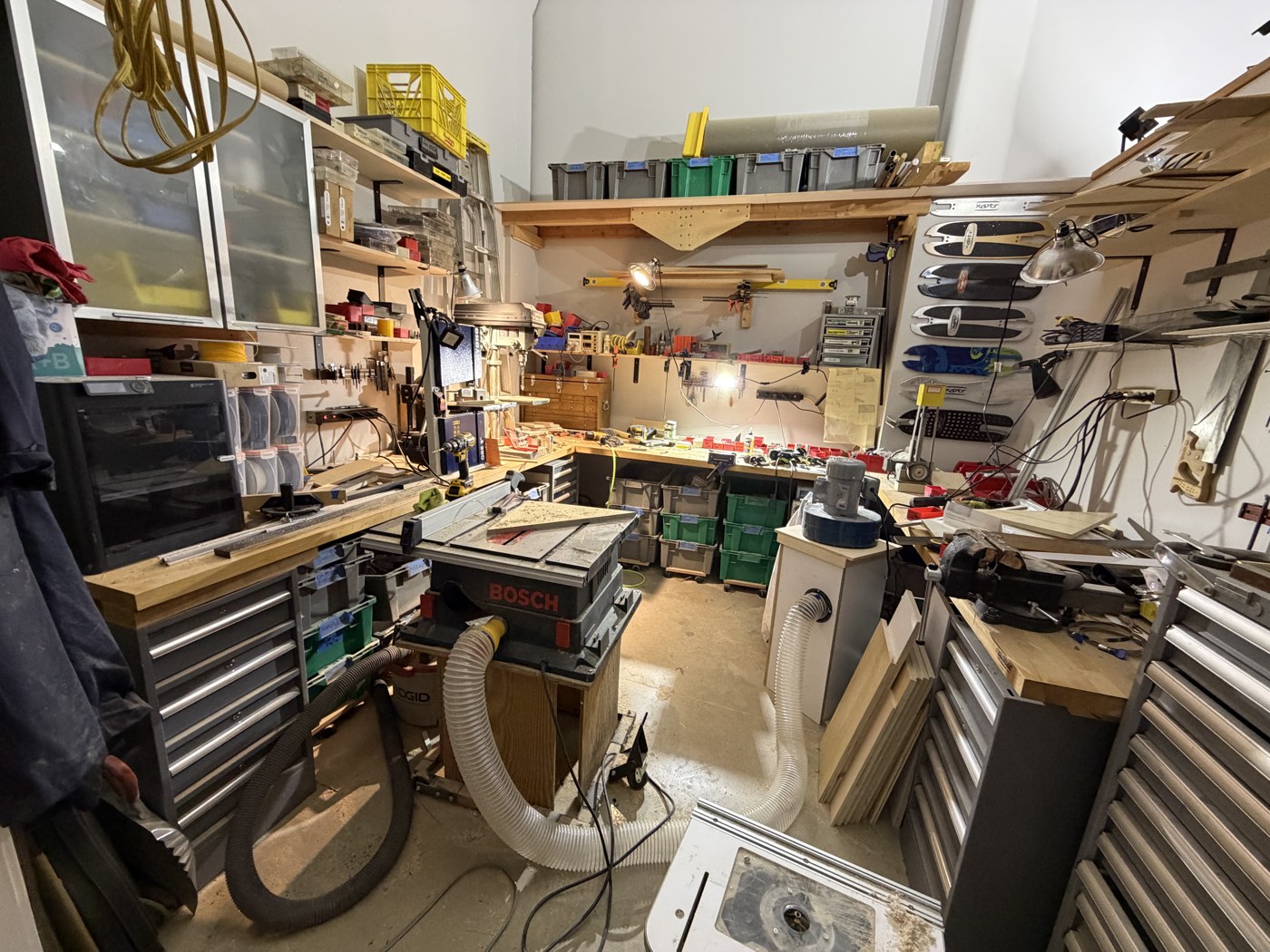
They came out of a hundred and twenty square feet: a second bedroom in a Philadelphia loft that was once the Acme Tea Warehouse. My best shop is at MakerStock's facility in Salt Lake City, and I have not stood in it in six months.
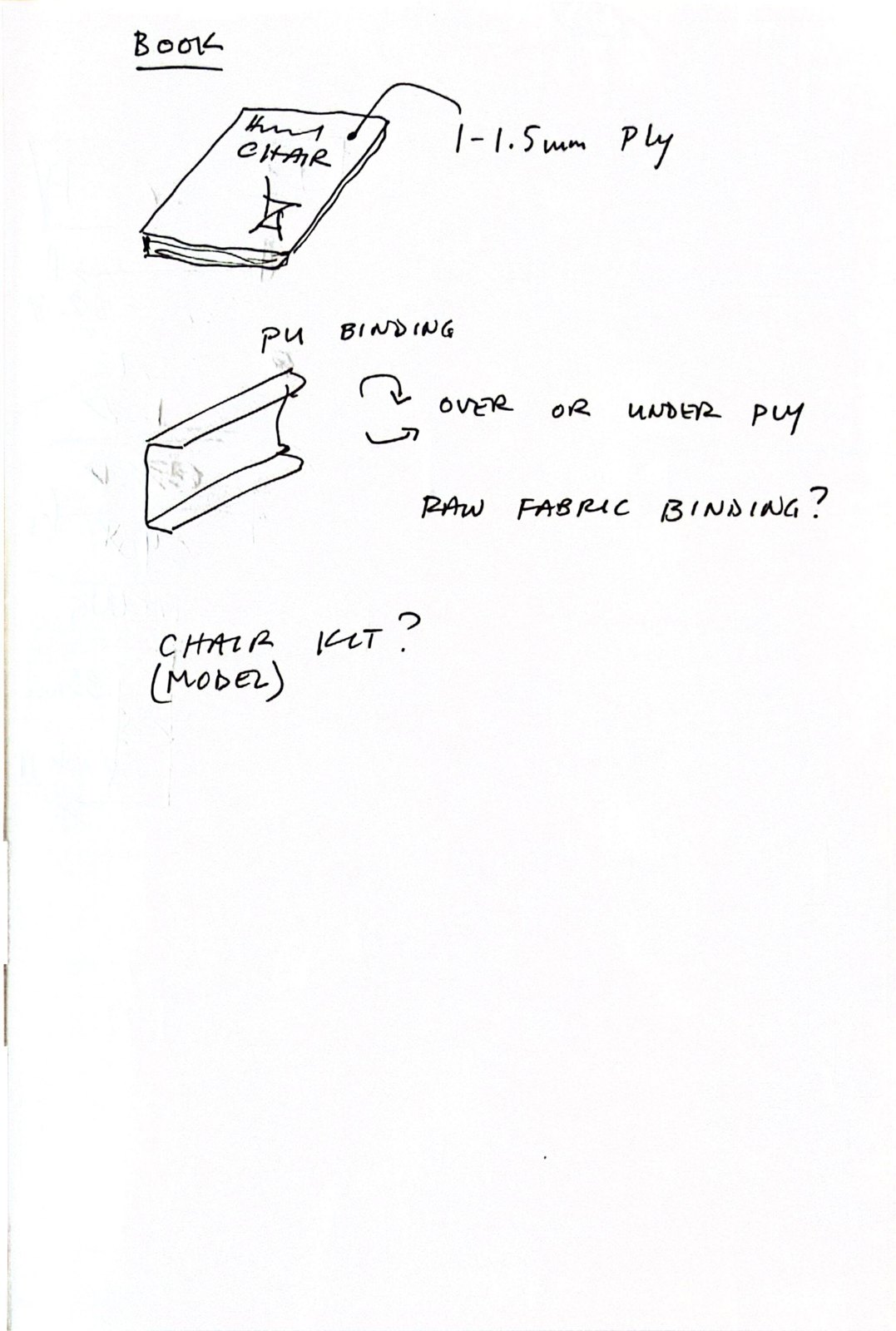
And if the plan in the notebook survives the printer's estimate, the book itself will carry a few atoms of its own. The page for it is dated to the last days of August: a cover of plywood a millimeter and a half thick, a PU binding run over or under the ply, raw fabric as the alternative, and a question I have not answered, whether a chair kit, a model of the thing, ships in the back.
The stack, the model list, and the workflow are from my own project notes (20 to 23 Aug 2026). The style-guide quotations verify against the guide itself. The specimen paragraph and my rewrite are quoted verbatim from my notes of 22 Aug. Tim Gray's reply is quoted with his permission pending; the last-16-words joke is quoted as made. The scratch-pad footnote is per the author, 23 Aug; its named examples verifiably originated as scribbles in the project record. The claim that I have not directly edited one word of the source text is re-verified at each release, and this page is where any change to that fact will be recorded.
A chapter of The Hundred-Year Chair, drafted and refined in public. The same text lives in the book; the interactive tools and the fully-sourced technical notes live here. home · the book · the technical notes · hundredyearchair.com