The Hundred-Year Chair · a chapter
Chaironomics
When I was fifty-two I decided I deserved grown-up furniture and bought a Herman Miller Eames lounge chair and ottoman from Design Within Reach, for what I remember as about three thousand dollars. Design Within Reach lists the certified article today at eight thousand seven hundred. Faithful reproductions, near enough indistinguishable, come out of Chinese showrooms for a few hundred. I love mine, and I know what the other several thousand dollars bought. Almost none of it was atoms. It was royalties, production location, distribution, and the pleasure of the certificate. The molded plywood and the die-cast aluminum were settled decades ago. What flexes is the price.
My second academic paper went after a claim everyone in design repeated and nobody had checked: that eighty percent of a product's manufacturing cost is set by its design. I called the method I used to check it product archaeology, and as far as I know I am still its only practitioner. Chase the eighty-percent number to its source and it dissolves into an informal survey at Ford. So Scott Pearson and I dug.
Consumer Reports had tested the automatic drip coffee makers and found they all brewed an indistinguishable cup, which let us hold function fixed. We tore every machine down to its parts and priced each part under one standard set of input costs. Price and cost turned out to be barely related. The Rowenta cost an estimated $5.92 to make and sold for $40.60. The Toastmaster cost more, $7.61, and sold for less than half as much.
The spread had to come from somewhere. We had ruled out the obvious places by construction: function was identical, and we had priced the materials the same on purpose. What was left was the design itself, the architecture of the assembly, the geometry of the parts, the number of times a hand had to touch the thing on the line. That spread ran to about half the average manufacturing cost in the sample. Design decisions had an outsized grip on cost, and so on profit, for the same cup of coffee.
Once you know design drives cost, you can watch the industry play it as a game, and the clearest player is IKEA. IKEA starts with the function it wants and the price the chair should sell for, and works backward through margin and freight to a manufacturing target. If IKEA were making the Keel Chair they would probably call it the Köl, fix the price at eighty-nine dollars, and hand the designers a brief: give us the Köl at a manufacturing cost of twenty-three dollars, FOB Linyi. That discipline gives the world painted MDF and flat packs and M6 bolts. I am not sneering. Hitting twenty-three dollars without the chair looking like it cost twenty-three dollars is real skill. I will confess that during this project's naming spree I registered the domain. If IKEA ever wants the Köl it is waiting, and my price is not ten dollars and eighty-eight cents.
The Eames chair in my living room plays the opposite game. There the design is fixed, sacred even. Everything else flexes: where it is made, who holds the license, which channel sells it, what story comes in the box. Same geometry, same materials, several times the price of the replica. The coffee makers, IKEA, and the Eames are three ways of playing the same game. Each fixes one thing and lets the rest move. What none of them questions is that a chair is a product made to be sold. The whole game is the distance between what it costs to make and what a buyer will pay. My chair is not made to be sold.
The cheapest usable chair in the world is a settled fact. You have sat in it. It is the white plastic stacking chair at every rented tent and taco stand, injection-molded from polypropylene in a single cycle that runs, by the accounts I can find, around seventy seconds. The industry calls it a monobloc. Out drops a whole chair, warm, ready to stack.
In my course I cost a molded part with a formula short enough for a napkin: mass times material price, plus the machine-and-operator rate divided by parts per hour, plus tooling divided by mold life. Run a chair through it. Two kilograms of pellets at two dollars a kilogram is four dollars. A hundred-dollar-an-hour machine turning out sixty chairs an hour adds a dollar and sixty-seven cents. A quarter-million-dollar mold over a million pulls adds twenty-five cents. Direct cost, just under six dollars.
The proportions surprised me the first time. In the monobloc, materials are two-thirds of the direct cost. Plastic is not dear. Everything else has been driven so close to zero that the pellets are what is left.
Slide away from that one object and labor floods back. A wooden chair is a dozen pieces that have to be cut, shaped, fitted, sanded, and finished. Every one of those verbs is a person's time. I have built enough chairs to feel it in my own hands. When I add up where the hours go, the wood is a minor line. A rough rule of the trade puts a made object at about a third material and two-thirds labor, and slides further toward a quarter material as the work gets more custom. For a chair built one at a time, material can be well under a fifth of the total. The rest is the shaping and the fitting and the finishing, which is time, which is wages.
So the two ends of the spectrum say opposite things and agree on the point. At the monobloc's end the labor is gone and material is most of a very small cost. At the craft end labor dominates and material trails far behind. The constant is that material is cheap either way, a few dollars up or down, while everything else moves by orders of magnitude. We tend to think a better chair is made of better stuff, its cost tracking the nobility of the material. It does not. Cost tracks human time wherever human time is in the process.
The sharpest proof is a chair I think of as the nice monobloc. Mario Bellini's chair for Heller is one molded piece of fiberglass-reinforced polypropylene, the same process as the parking-lot chair and not quite twice the material. Design Within Reach sells it for about three hundred dollars a chair. Seven dollars of resin, fifty times the price. The difference is Bellini's name, the proportions he drew, and the store it stands in.
The second cost hiding in plain sight is freight. A chair is an awkward thing to move because it is mostly empty space. You are shipping a volume of air with some sticks around its edge, and past a point freight is charged by the space a thing occupies rather than its weight. A container holds only so many cubic meters, and an assembled chair spends most of its cubic meters holding nothing.
This explains an astonishing amount of the furniture you own. It is why the monobloc stacks: a stack is one floor footprint carrying two dozen chairs. Stacking is a freight strategy wearing the clothes of a convenience feature. It is why so much furniture arrives flat for you to assemble. A knocked-down chair ships as a slab of dense material instead of a box of air, and the company has quietly handed you the assembly labor, the expensive ingredient, to do for free at your kitchen table.
The numbers are not subtle. When IKEA reworked one office chair to pack tighter, the count per container went from 2,750 to 6,900. They more than doubled the chairs by chasing out empty space. The flat pack is older than IKEA, too. Gerrit Rietveld built his Crate furniture in 1934 from the cheap pine planks that other goods were shipped in, and sold the pieces as kits the buyer screwed together at home. Move the atoms densely and let the customer supply the hands. It is one of the oldest tricks in the trade.
My chair plays none of those games. It is built not to be sold cheaply but to be repaired for a century. That inverts the logic. A factory designs the hands out of a chair because the hands are what it pays for. A chair meant to last needs the reverse: a repair small and legible enough that an hour or two of work, by whoever or whatever does it, is enough. Designing as if that labor were free would only invite complexity, the enemy of repair. Building for the simple version costs me more than a factory chair, for a payoff I will not live to collect.
Not every choice for a long life costs money. Many of the moves that buy a century cost nothing today: a legible joint takes no more wood than an obscure one, striking every critical cut from a single datum is no dearer than measuring badly, a finish that renews in place is the same brushful now. Those I took wherever I found them. The rest are real trade-offs, paid now for a benefit that lands after me: the labor kept in a person's hands, the freight that will not stack, the materials chosen for a stranger in a century rather than the lowest bid this quarter.
The ledger runs twice. At the end of August I priced the chair as a factory would, a hundred and ninety-nine dollars complete. A week later I priced the scrap-pile build. The page opens on a line I had never written about any product: Material $0, then a few dollars of fasteners and carton and an hour of labor. Same price for both. In the second, every dollar that is not a screw is time.
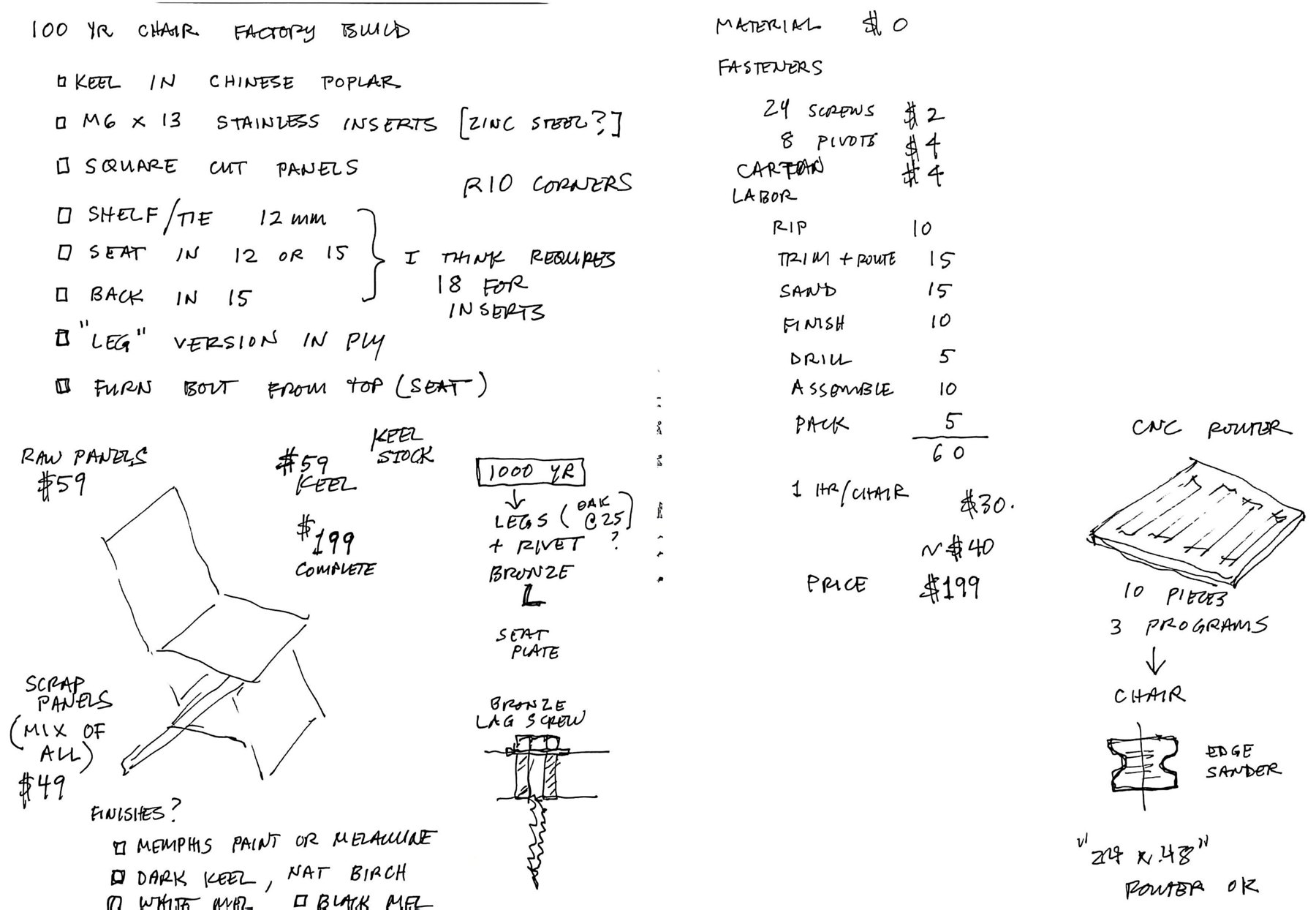
Once I saw that labor is nearly the whole cost, that a chair is mostly shipping air, and that the future's repair has to stay small, the shape of the thing was half decided before I cut a board. I have priced it in dollars and in Saturdays. The one cost I have not is the planet's. That deserves an instrument rather than a paragraph. It gets one in the next chapter.
For sources, citations, and the technical notes behind this chapter, see hundredyearchair.com.
The paper is Karl T. Ulrich and Scott Pearson, "Assessing the Importance of Design Through Product Archaeology," Management Science 44(3), March 1998, 352 to 369, DOI 10.1287/mnsc.44.3.352. Its motivation is the claim that eighty percent of manufacturing cost is set by design, traced by the authors to an informal Ford survey. Consumer Reports (1991) is the control establishing equivalent brew. The Rowenta at $5.92 cost against $40.60 price and the Toastmaster at $7.61 against $18.70, and the roughly fifty-percent spread attributed to differences in development capability, are the paper's own figures.
The Eames purchase, about $3,000 at fifty-two, is my recollection; Design Within Reach and the Herman Miller store list the Eames Lounge Chair and Ottoman at $8,700, checked 6 September 2026. The reproduction figure has no independent source: sellers quote $400 to $800, which is why the text says a few hundred. The Köl brief ($89 retail, $23 FOB Linyi) is a hypothetical stated as one; koelchair.com was registered by the author, per the project record of 21 August.
The monobloc: injection-molded polypropylene, a cycle "around seventy seconds" per Domus and Zuckerman (both of whom write "extruded," which is wrong for a monobloc). The napkin cost model (mass times bulk price, plus rate over throughput, plus tooling over mold life) is from the author's course materials and yields just under six dollars. Bellini: Mario Bellini for Heller, 1998, one piece of fiberglass-reinforced polypropylene, his eighth Compasso d'Oro in 2001; Design Within Reach sells it only as a set of two at $625, so $312.50 a chair, at 7.5 lb (3.4 kg), about seven dollars of resin at roughly $2 per kg. The trade rule of thumb on labor-to-material shares is the author's professional account and his own bench experience.
Freight: the container figures are the Wall Street Journal, Trefor Moss, 25 April 2023, "How IKEA Chopped, Hollowed Out and Flattened Its Furniture to Cut Costs": 6,900 FLINTAN office chairs per container, up from 2,750. Rietveld's Kratmeubelen: designed 1934 from pine packing-crate planks, sold as a buyer-assembled kit through Metz & Co from 1935, per Het Nieuwe Instituut and the V&A. The parcel-freight arithmetic for the folding chair lives in notes/tn-parcel-freight-06Sep2026.md and is told in the chapter So Similar, Yet So Different.
The two ledgers: Notebook 2 Part A p. 16 (between entries dated 31 August and 1 September) and p. 37 (between entries dated 4 and 5 September), transcribed from the scans; the labor minutes and prices are the author's estimates rather than measured times. The four-hundred-dollar figure for machine thinking, referred to in passing elsewhere, is from the chapter The Centaur.
A chapter of The Hundred-Year Chair, drafted and refined in public. The same text lives in the book; the interactive tools and the fully-sourced technical notes live here. home · the book · the technical notes · hundredyearchair.com