Part I · Making a chair
The Chair Moved
On the evening of August 5, 2026, at our home in Queensland, my wife Wendy sat down in the chair I had built that afternoon. She leaned forward, and a rear leg slid half an inch across the tile.
It was a pale plywood chair, with a broad, flat seat and back above narrow legs that slanted away from each other. The edges showed the layers of wood. There was no upholstery to obscure the construction, and not much construction to obscure: pieces cut from a sheet, screws, and wooden brackets holding the pieces at their angles. I had been working toward something a person could assemble from a kit, and this version had gone together quickly. When I looked at it, I could see the parts I had made and the problems I had solved.
The brackets had occupied much of the preceding days. I had first printed them in plastic, then worked out how to make them in wood. One, cut from reclaimed timber, had received particular attention. It fitted precisely, and I was already imagining other woods I might use, interesting little pieces that could give otherwise ordinary plywood some character. Before anyone had spent an evening sitting in the chair, I was thinking about what might go into the box with it.
Wendy said she was not sure it would hold her. I spent the evening telling her, and myself, that it was fine. The seat flexed visibly, however, and her ordinary movement forward was enough to send a foot sliding. She had no reason to take an interest in how well the brackets fitted. She wanted to know whether she could sit without worrying about the chair beneath her.
I had recorded my pleasure in the construction earlier that day: "Made the brackets quite carefully and they fit up perfectly." By that night the report had become less cheerful: "the seat flexes obviously. The rear leg is sliding 1/2-1 inch. Interestingly it slides on carpet too." I could not attribute the whole problem to the tile. A different floor had not stopped the movement, and reassurance had not made Wendy comfortable.
Over six weeks I would build twenty-one full-size chairs. The one that moved under Wendy's fifty-four kilograms was only the fourth. To understand how I got there, I need to go back to the first, and to the chair in Paris that made me want to build one.
In May 2019, late one afternoon, I came around a corner in the Bon Marché, the department store on the Left Bank in Paris, into a display of furniture by Piet Hein Eek. I knew his work from photographs but had never stood next to it. Here were chairs, a bench, and a table made from mismatched pieces of old painted timber, the boards laid side by side with their seams showing. I photographed the furniture and the placard identifying it.
The wood had not been made uniform before it became furniture. One board carried a different color from its neighbor; another showed bare grain. I could follow the edges of the pieces and see where they met. Even the slotted flathead screws were in plain sight. There was plenty for a person who likes making things to look at, without taking anything apart or turning it upside down.
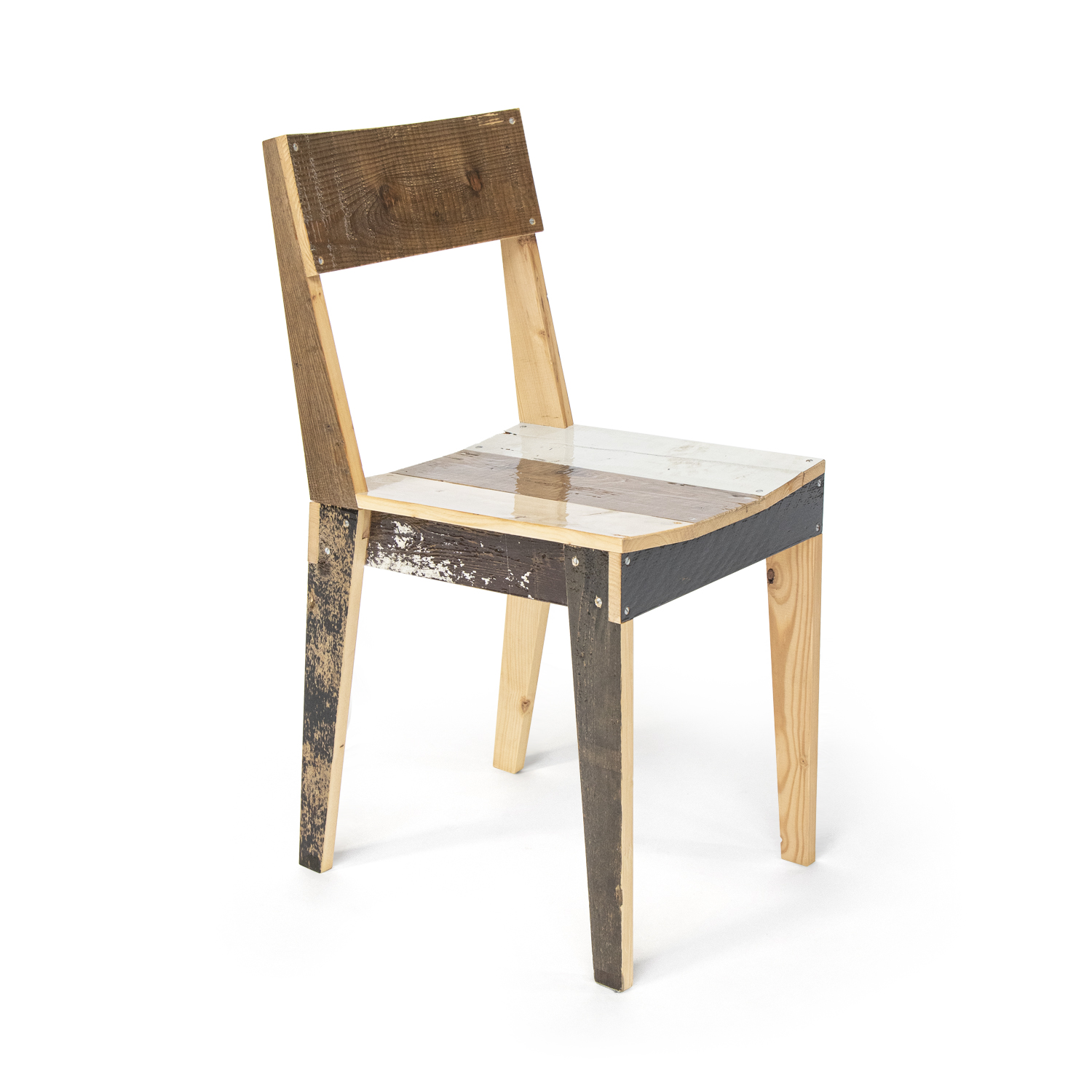
What appealed to me was how little the material had to be disguised. These were pieces I could imagine recognizing in a salvage pile, assembled into furniture I wanted. The attraction did not depend on hiding the joints or making every board match. Nor did exposing those things excuse a clumsy result. Eek had chosen and arranged the pieces, and I liked what he had made of them.
I could understand enough of the construction to begin imagining an attempt of my own. There would still be decisions about which boards went together, how wide to make them, and where to put the screws. But I would not need to commission a mold or acquire a factory before I could try. I filed the photographs among many other things I had seen and wanted to make, with the thought that someday I might design something with these qualities.
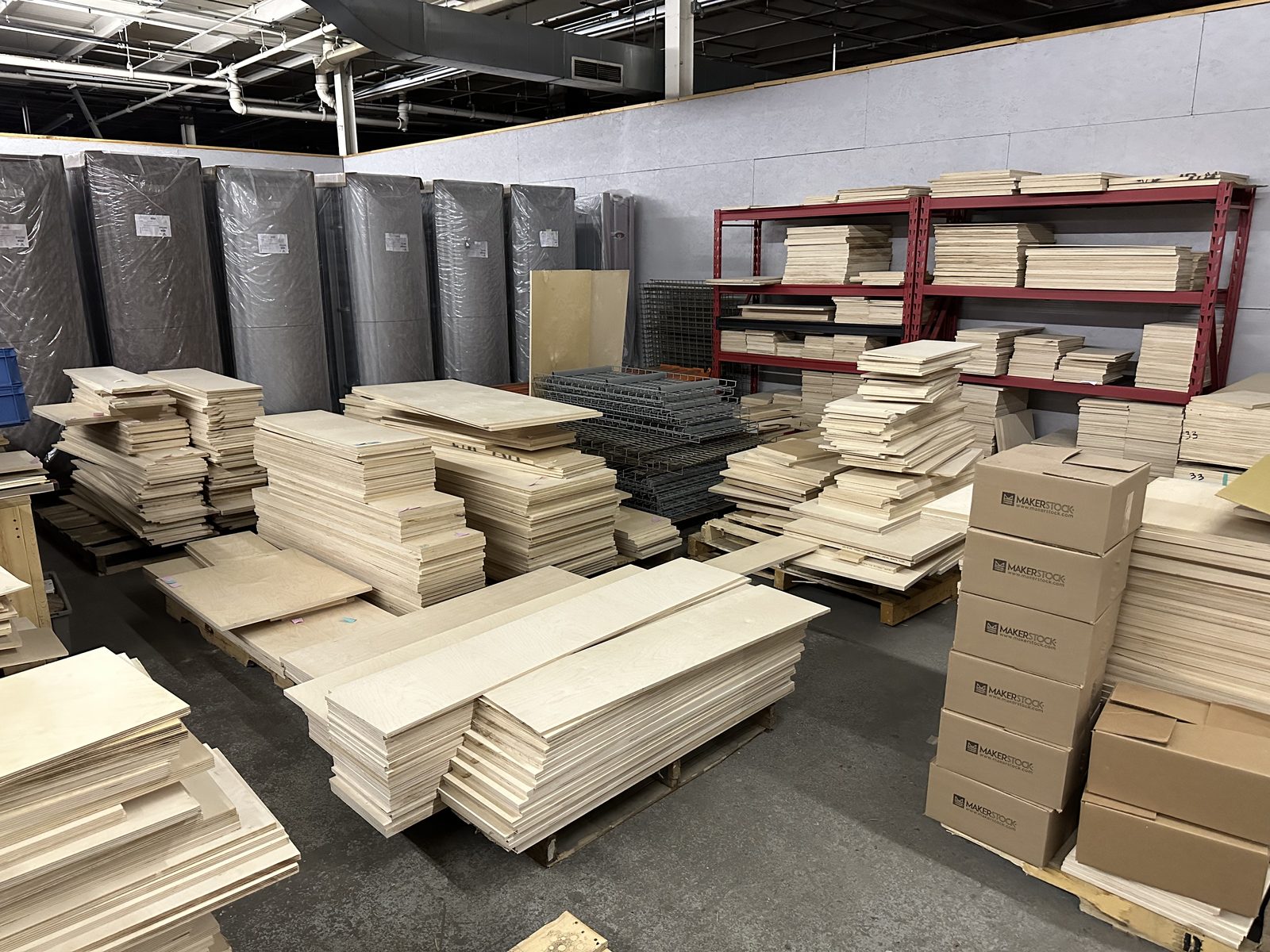
Someday took seven years. During the pandemic, while staying at a ranch in Napa wine country, I did make two small tables and a chair from wine-barrel staves. The French oak was fabulous and the chair was not. I had found another supply of interesting wood without yet making a chair I particularly liked.
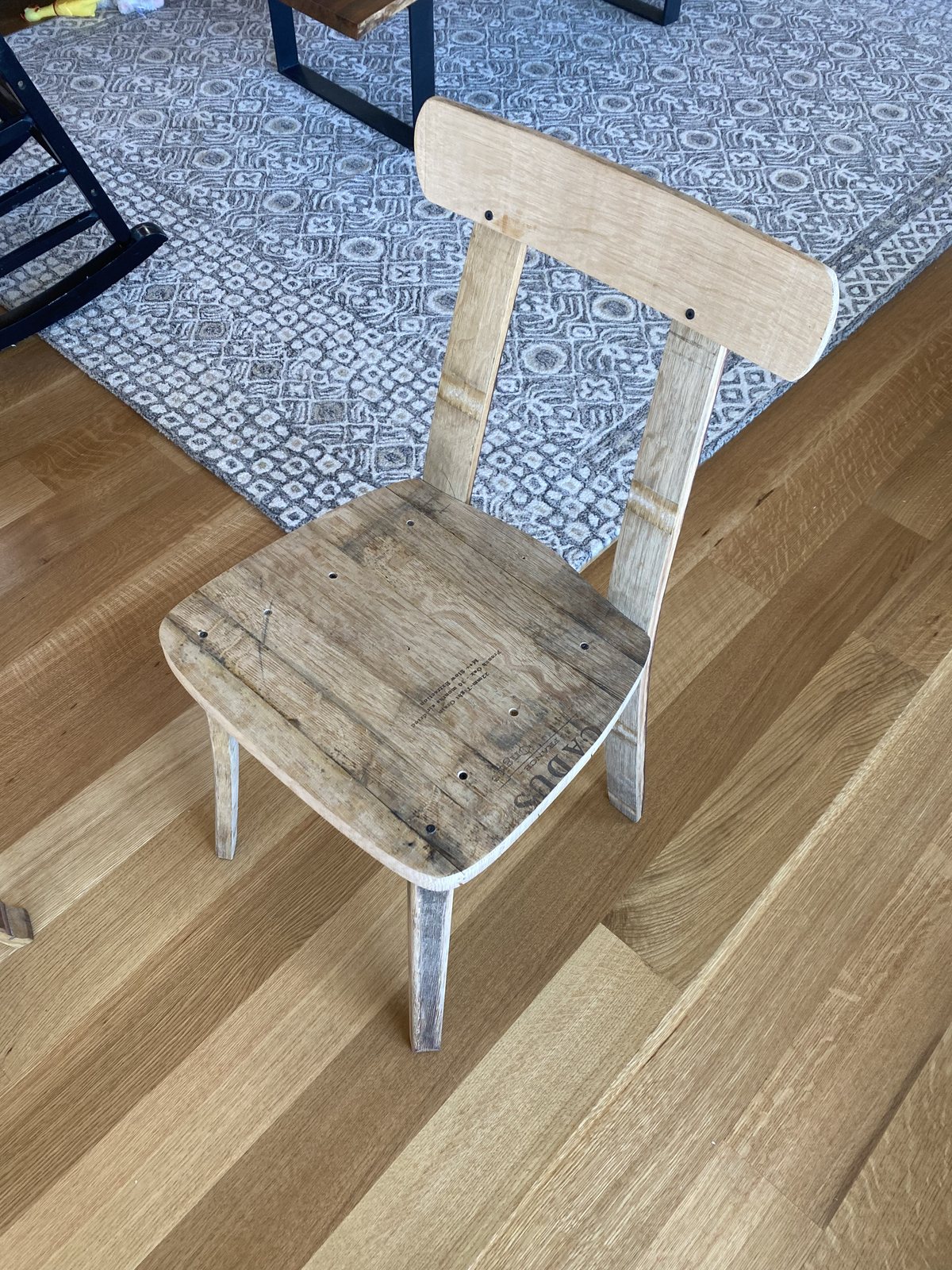
By 2026 I had a more persistent source of material. MakerStock, a business I co-founded, supplies panels and sheet goods to people who build things, cut to the sizes they need. Cutting a large sheet into smaller rectangles leaves offcuts. A customer gets the piece ordered, while we get another strip too narrow for our usual stock sizes. Much of this material is good plywood. There is nothing wrong with it except its dimensions.
At the warehouse, the pieces accumulate on pallets and shelving. We have tried giving them away, but the pile refills. We have tried selling them cheaply by the pound, and they dribble out a few pieces at a time. In a program we call "Cut the Scrap," we even put free pieces into shipments when there is room in the carton. We cannot bear to throw the material away, but merely finding a different way to give it away has not kept up with the saw.
What could I design that actually preferred narrow stock? A strip that was awkward inventory might already be close to the width of a chair leg or a piece of its back. Instead of starting with a large sheet and calculating how to get all the pieces out of it, I could start with the pieces we had. Eek's furniture had made that possibility attractive to me. The warehouse gave me a reason to pursue it.
I had settled on a chair before investigating whether it was the best use of the scrap. I liked chairs, and I liked making things. I describe myself to my students as process driven: I get satisfaction from the work itself, particularly from becoming competent at something new. Getting a small task right can be enough. The useful reasons for this project were real, but they were not the whole explanation for wanting to spend an afternoon on it.
A chair suited the way I wanted to work. I could draw something in the morning, make it in the afternoon, and sit in it that evening. Much of my ordinary work produces papers, plans, or decisions whose effects I may not see for years. In the shop I could smell the sawdust and point to an object when I stopped. There would be no need to convene a meeting to find out whether my wife liked sitting in it.
That July I was at our home in Queensland, fourteen time zones away from my university in Philadelphia. Most of the people who needed things from me were in the United States, asleep or finishing their day while I began mine. I usually worked from about five in the morning until noon, with few interruptions, then spent the afternoon making things or repairing the house. There was time for a walk on the beach before dinner. Tough life.
On Friday, July 24, I finished a statistics paper and sent it to two colleagues for comment. By midday I had opened a new conversation with an AI assistant and begun describing a chair. I was already using these systems for academic work; now I wanted help with a project I could take into the shop. I could ask for research, discuss dimensions, and get a computer model without doing all of the intervening drawing and coding myself.
My first message proposed beautiful mosaics made from otherwise wasted material. Then I began specifying how they would be built. I wanted ordinary stock thicknesses and a single type of screw we already sold. The pieces should be rectangular, cut by ripping strips from a panel and crosscutting them to length. "Hopefully we don't need complex profiles, faceted edges, or bent features," I wrote. I wanted someone with a saw to be able to make the parts, without first learning to bend wood or fitting a collection of elaborate joints.
Those restrictions made the project manageable, but they were preferences, not requirements imposed by the scrap. I had seen furniture I admired, identified material I wanted to use, and selected a convenient way to work it. I had not yet drawn a chair, sat in one of my own making for this project, or included anything about longevity in the brief.
I did ask the machine to research examples. It returned a catalog of chairs made from boards and scraps, with images and descriptions. Among them were Eek's work, Enzo Mari's Sedia 1, Gerrit Rietveld's crate chair, and Donald Judd's Chair 84. The catalog was ready before lunch on the first day. I barely opened it. I was in action mode and apparently not in the mood for a study of the past.
The questions I pursued instead concerned the person who would sit in my chair. How far should the seat tilt? How much should the back lean? Would a flat seat be comfortable, or would I need a cushion? I asked about other people's experience of sitting in Eek's chairs, then asked three questions in succession about padding. A cushion offered a tempting way to accommodate the body's curved surfaces while leaving my wooden parts flat.
By the next morning I had asked for a side-view drawing showing just the seat and back at their proposed angles. I settled on a seat tilted back five degrees and an angle of a hundred degrees between seat and back. This gave me something to build around: two surfaces positioned for a person, with the space beneath them still to be filled. These were starting dimensions for a dining chair, not an answer to how every chair ought to support a body.
On Monday I went to my favorite salvage place. There was hoop pine wall paneling, about four inches wide, carrying layers of paint that included a particularly funky lavender. There were also pieces of black film-faced plywood, eighteen millimeters thick, for five dollars each. I bought some of both. The painted boards had the irregularity I liked in Eek's furniture; the plywood offered a quick way to try a structure without worrying about the individual character of every piece.
The following morning, July 28, I was at my desk before four. My academic work and the chair project were now proceeding in parallel. I was asking the machine about research priorities and where to submit a paper, while sketching chair designs between queries. At one point it delivered a revised draft of a skiing paper and, four seconds later, the geometry of the chair's parts. I had found a way to interrupt my own uninterrupted workday.
Over the next couple of hours I adjusted the computer model. I wanted the front edges to align, enough overlap where pieces met, and less material where I thought a piece could be shorter. A change that improved one junction could leave the next one awkward. The back and rear leg were particularly troublesome. I asked for a rotation, then for the rear leg to be shortened. As the drawing changed, I was judging both whether the pieces could be attached and whether I liked how they looked together.
The resulting design had two side frames, each assembled from five flat pieces with screws through the overlaps. The seat and back spanned the frames. Narrow strips did most of the structural work, while broader pieces supported the sitter. I had not eliminated the need for wide stock, but I had arrived at something that used quite a bit of the narrow material I was trying to find a home for.
Looking at the rendering, before I had built the chair, I wrote:
"This is a clean and efficient chair that doesn't look bad. Indeed it's hard to imagine a chair that is more efficient and that would make better use of materials. How can this exact design not be the default vernacular chair design?"
The efficiency gets a superlative and the looks get a double negative. At the time, though, I was sufficiently pleased to wonder why everybody was not already building it. The pieces were straightforward, the material was cheap, and I could get started with the saw I had. A physical chair would let me check what the rendering could only suggest.
By late morning I was cutting the black plywood. In one photograph from the shop, four strips lie on the bench beside a tape measure and pencil. About an hour later, the two side frames are screwed together. The black faces and pale cut edges make the overlapping pieces easy to distinguish. There is no complicated joint to conceal: one piece crosses another, and the screws go through the flat faces. With the seat and back attached, the drawing had become something I could sit on.
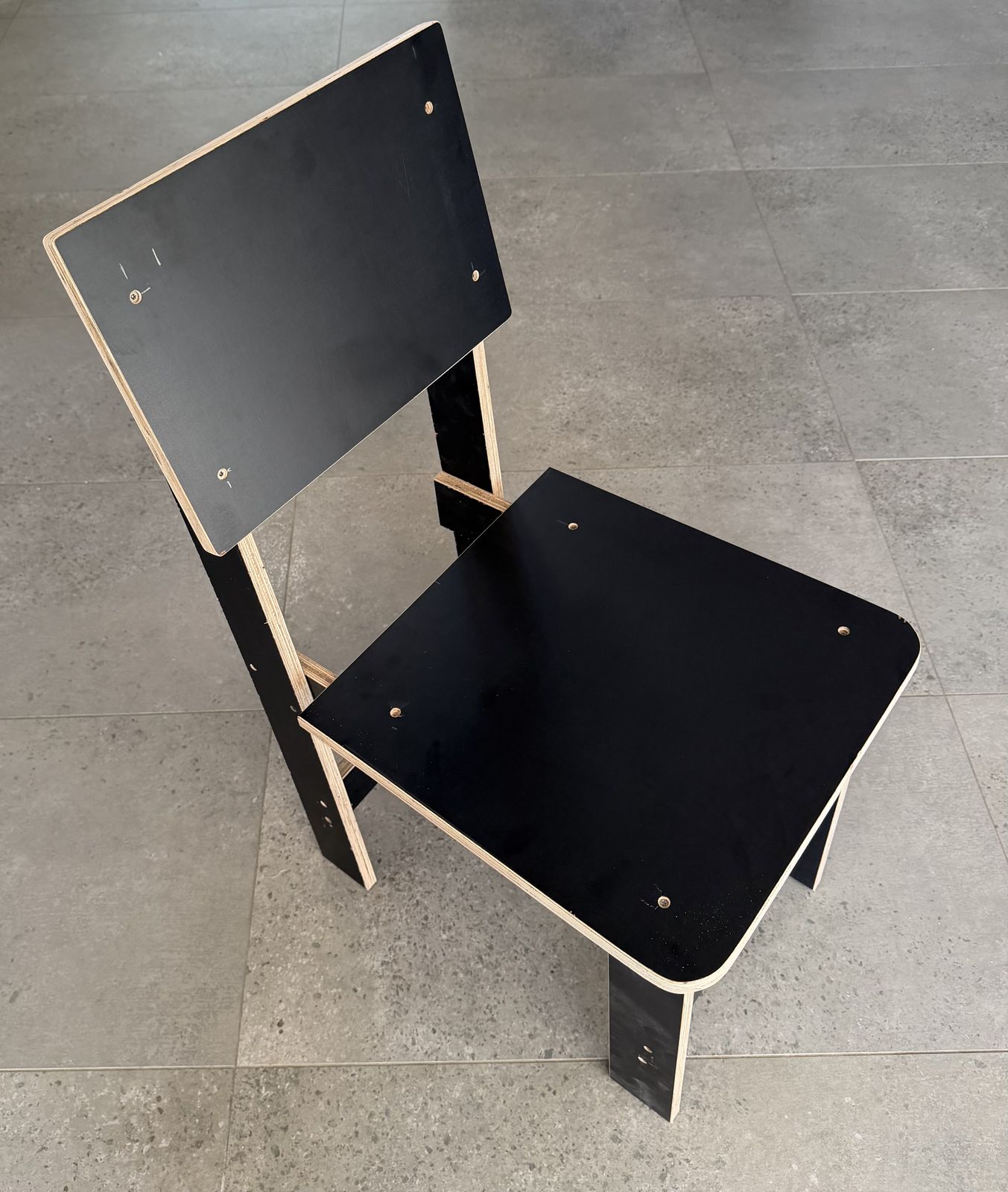
I was back at the keyboard that afternoon, having gone from adjusting the design to building it in the space of a working day. The chair stood up, held a person, and used inexpensive material with little waste. Those were the things I had asked of it, and I defended it as efficient and functional. I meant it.
I photograph pretty much everything I make and send it to my children. I photographed this chair too, but I did not send the pictures. The photograph stayed on my phone.
Notes
- "evening of August 5, 2026": Author's account of Wendy's trial and his same-evening design report, preserved in The Verdict of the Builds, an earlier manuscript chapter. The movement concerns the author's prototype, not the original Vilbert. The description of the chair also draws on the author's photograph of the stave chair, August 5, 2026.
- "Made the brackets quite carefully": Author's August 5, 2026 project notes, quoted in the earlier manuscript chapter The Search. The quoted night report is preserved in The Verdict of the Builds. These quotations are carried from the manuscript; transcript locations remain to be checked.
- "twenty-one full-size chairs": Author's account and clarification in the October 3, 2026 editorial exchange. The count excludes scale models. The first four full-size builds were the original scrapwood chair, the Rietveld replica, the plastic-bracket chair, and the wood-bracket chair Wendy tried. The author confirmed Wendy's weight as 54 kilograms.
- "In May 2019": Author's photographs and recollection of the Bon Marché visit, dated May 27, 2019 in his photographic record. The observations describe the scrap-wood furniture he encountered, not every piece Eek makes.
- "Oak chair in scrapwood": Piet Hein Eek, Oak chair in scrapwood, studio product page, https://pietheineek.nl/en/product/oak-chair-in-scrapwood, consulted October 3, 2026. The studio identifies the model and its scrap-wood construction. The product photograph illustrates the design; it is not a photograph of the Paris encounter. Publication permission and the individual photographer's credit remain to be confirmed.
- "ranch in Napa wine country": Author's account of the pandemic stay and wine-barrel furniture. The photograph is from the author's project archive.
- "MakerStock, a business I co-founded": Author's account as co-founder of the material supply, offcut practices, and Cut the Scrap program during this project.
- "caskets belonging to a company": Author's identification of the gray objects in the warehouse photograph and account of the shared warehouse space, supplied in the October 3, 2026 editorial exchange.
- "process driven": Author's own distinction, used with his students and described in his September 30, 2026 editorial account. It describes his sources of satisfaction, not a validated classification of people.
- "fourteen time zones away": The July 2026 clock difference between Queensland and Philadelphia was fourteen hours: Queensland used UTC+10 and Philadelphia UTC-4. Checked for July 24, 2026 using the Australia/Brisbane and America/New_York entries in the system time-zone database. The phrase refers to the author's university, not to all his collaborators.
- "On Friday, July 24": Author's account in the earlier manuscript chapter The Chair I Met in Paris of sending the statistics paper to colleagues and beginning the project on July 24, 2026. The founding brief, its quotation, and the catalog delivery are preserved in the earlier chapter The Search. The listed chairs describe the contents of that working catalog, not independently verified historical attributions.
- "seat tilted back five degrees": Author's selected initial dining-chair geometry, recorded in the July 2026 design work and the project drawing touchstone-01-envelope. These are design choices, not universal ergonomic recommendations.
- "hoop pine wall paneling": Author's account of the July 27, 2026 salvage purchase in the earlier chapter The Search. That account gives approximate paneling dimensions of 20 by 100 millimeters, lavender among the paint layers, and five dollars per piece of black film-faced plywood. The currency of the price remains to be confirmed.
- "four seconds later": The September 14, 2026 chronology audit retained with The Search records an AI response on the skiing paper at 07:11:32 and chair-parts geometry at 07:11:36, Queensland time, July 28. The interval comes from that earlier audit; it was not independently re-established for this revision.
- "Over the next couple of hours": Author's July 28, 2026 design conversation as excerpted in the earlier chapter The Search, including requests to align the front edge, adjust overlaps, rotate the rear leg, and shorten it. The construction is shown in the author's first-chair photograph.
- "This is a clean and efficient": Author's July 28, 2026 assessment, carried from the earlier manuscript. The retained chronology audit places it at 08:50:14, after the computer geometry was finalized and before the physical build. The original transcript location remains to be checked.
- "four strips lie on the bench": Author's photographic record, as documented in the retained September 14 chronology audit: IMG_2113 at 11:41:36 and IMG_2115 and IMG_2117 at 12:43:51 and 12:43:59, Queensland time, July 28, 2026. These establish progress, not an exact completion time. The finished-chair photograph reproduced here is a later view of that build.
- "I did not send the pictures": Author's recollection of his response to the first chair.
A chapter of The Hundred-Year Chair, drafted and refined in public. The same text lives in the book; the interactive tools and the fully-sourced technical notes live here. home · the book · the technical notes · hundredyearchair.com