The Hundred-Year Chair · a chapter
The Centaur
For twenty years I had a technique for getting the best design work out of the best designer I ever worked with. I would design the part myself, a bracket, a strut, declare it done, and send him the computer model. He would look at it, recognize immediately that it was not good enough, and then do it right. I never told him the bracket was bait, though I suspect he knew. It was the most productive dishonesty of my career, and I could get away with it because the designer was my brother.
Nathan, four years younger, lived large. He discovered the Titanic. He raced Porsches professionally. He played Division I basketball. He modeled in New York for the Wilhelmina agency. He died piloting his own plane, in a crash in the Bermuda triangle. (When I say he discovered the Titanic I exaggerate slightly. Nathan was a research scientist at Woods Hole and worked in the lab of Robert Ballard, whose team discovered the Titanic. The rest I am not exaggerating.) For more than twenty years he was my business partner, and we designed a lot of things together: a commercial robot end effector called the Penn Hand, the Xootr scooter, the Voloci electric motorbike, a lightweight electric mobility scooter. He was my original co-worker in design, and he was a much better designer than I am. The bait worked because of our dynamic. I am a bit manic and completion oriented. Nathan took a one-hour lunch break every day that included a bowl of ice cream and a science fiction novel, and I sometimes had a hard time getting him to focus and deliver. His taste exceeded his urgency, so I learned to manage the gap.
This chapter is about my second design partnership, and the fastest way to say what is strange about it is that the management problem arrives inverted. The machine delivers instantly, at six in the morning, without a lunch break in its life. What needs my audit is the taste. With Nathan I faked completion to summon his standards. With the machine I supply the standards, and it fakes nothing. It declares its own bracket done and believes it. Twenty years of managing a brilliant collaborator's gaps turns out to transfer. Only the gaps have moved. What does not transfer is everything else. The machine will never take the hour for ice cream and science fiction. That hour was not overhead. It was where Nathan's taste came from.
My son Nate, whose text began this book, is named for him.
The depth of the new arrangement can be measured by a thing I did in the third week of this project that I never once did in twenty years with Nathan: I stopped checking the arithmetic.
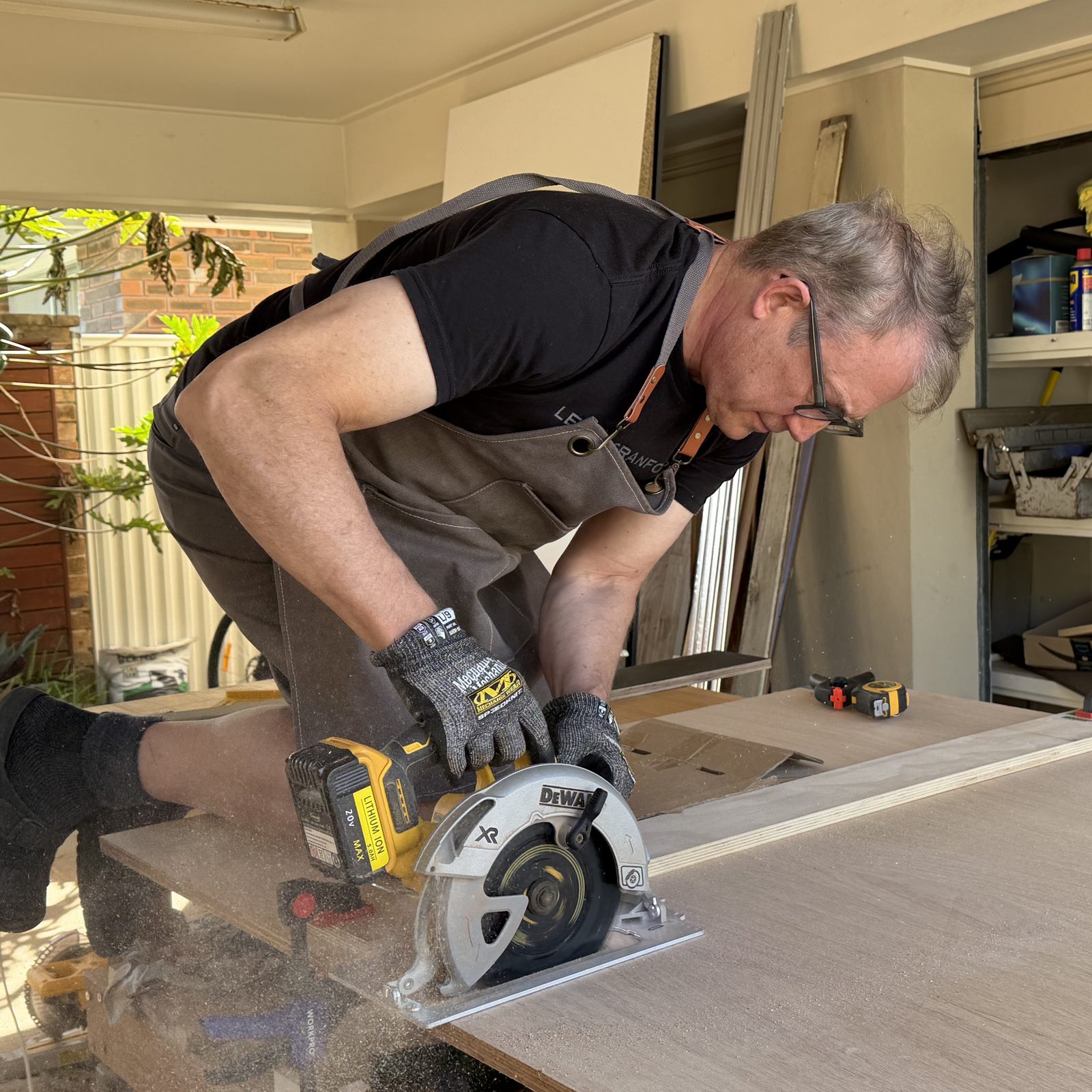
It happened at a saw, so I can be exact. The chair's geometry, by then, lived in a model the machine maintained: two congruent triangles, sides of 219, 295, and 335 millimeters, every angle one of three values. When it came time to build, the machine derived the cut list from the model, under a doctrine we had set together: "Let's get in the habit of rounding cut list dimensions to nearest 1mm... no one can measure 0.1mm on a 500mm length, with a tape measure." I printed the list, carried it to the shop, set the fence, and cut. I did not check the dimensions. I did not redraw the triangles or re-derive a single length, which is a thing I would have done without thinking a week earlier, the way you double a stranger's figures. The wood was salvage and the blade was real, and I cut a colleague's numbers on trust.
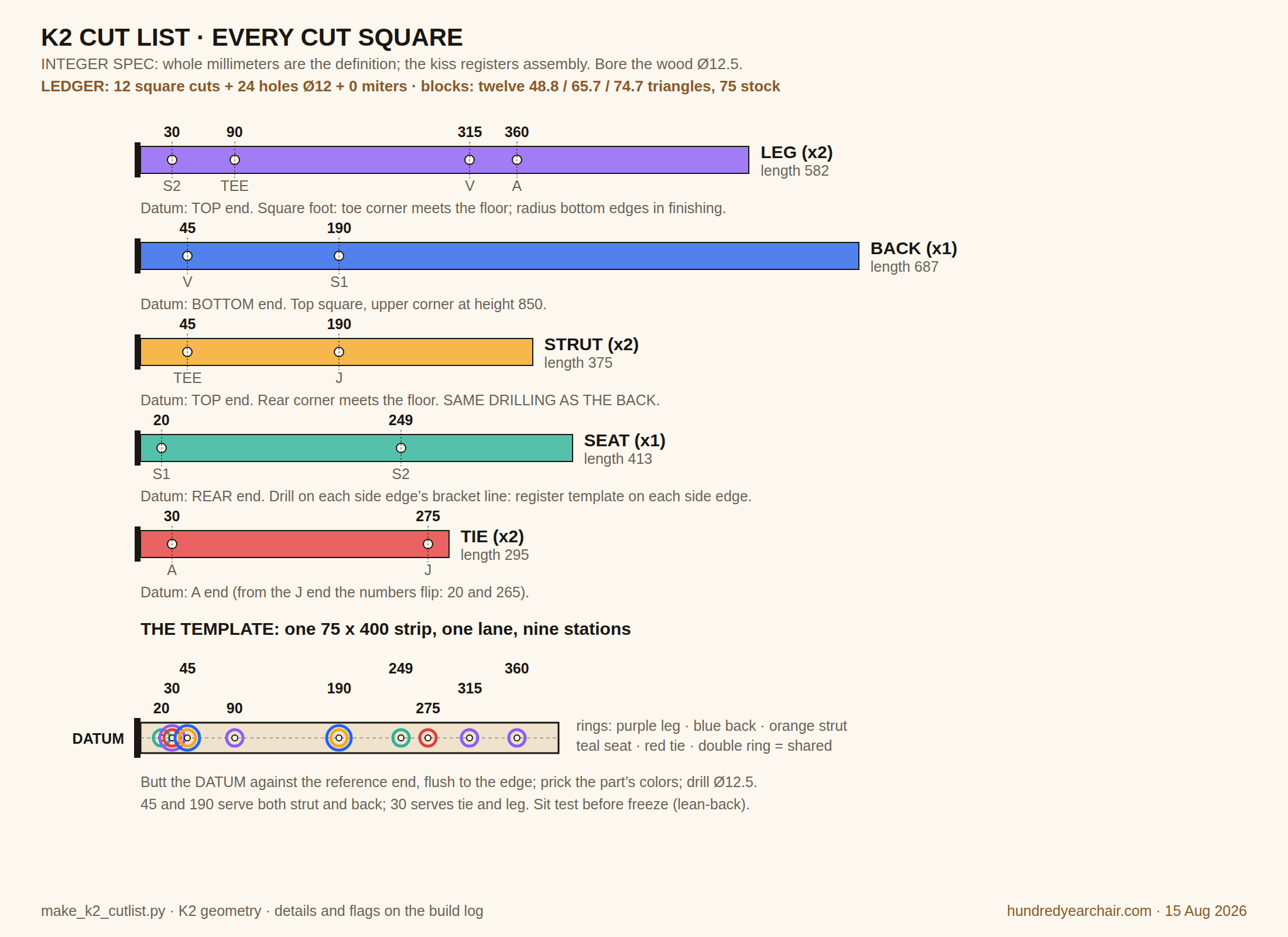
Trust between a designer and a machine is not granted. It is accumulated, error by caught error. This project's tape recorded the whole ledger: what the machine did, what I did, what each of us got wrong, and who caught whom. I know of no other design project where that ledger exists.
The arrangement
The working geometry of the collaboration was simple and strange. I was in a shop on the Gold Coast, in Queensland, with a saw, a drill, a printer for brackets, and a scrap pile. The machine was in a data center I will never see, on another continent for all I know. Between us ran a conversation: 3,000 or so turns of it over twenty-nine days, drawings traveling one way, photographs and corrections traveling the other. I did the designing and the building. The machine did the drawing, the arithmetic, the research, and the remembering. Neither of us could have produced this chair alone in a month, and only one of us likes the smell of sawdust.
The tape lets me say what each party actually contributed, measured rather than felt. On the machine's side of the ledger: finite element analysis on demand, at the speed of asking; CAD by prompt; a research sweep of a century of precedent chairs in minutes; and structural optimization runs, of which one took nineteen minutes and would have anchored a doctoral thesis when I was in graduate school. I noticed myself irritated at the nineteen minutes. On my side: the touchstone record of this act shows nearly every architectural move on the tape originating in my words. The parallel leg, the twin triangles, the trestle, the truss, the double triangle, the congruent solve, the keel: each arrived as a sentence of mine, and the machine drew and analyzed to keep up. Both halves are on the record, and together they rule out the two easy stories, the one where the machine is a tool and the one where it is the designer. Neither survives the ledger. The working name for what is left comes from computer chess, where teams of a human and a machine beat both humans and machines on their own for a while. They were called centaurs.
Tweaking beat solving
We used the machine on the structure in two quite different ways, and only one of them worked.
One was to solve. Hand over the loads, the sitter's volume, the floor and a budget of material, and ask what should be there. Those runs are real, and one of them took nineteen minutes, which would have anchored a doctoral thesis when I was in graduate school. What they returned is in the chapter First Principles: instructive about what structure wants in general, and never once this chair. The reason is not that the machine is weak at it. A solve needs the whole question stated before it starts, and I did not know the whole question. Half of what settled this chair, that the tie must not lie on the floor, that a joint should come apart with a hex key, that one person has to assemble it alone in a shed, never reached an objective function and mostly could not have.
The other way was a loop. I would move a member and say so in a sentence. The machine would analyze what that did and hand back numbers and a picture. I would look at the picture, dislike something about it, and move another member. Turns of a few minutes each, dozens of them. Seven architectures went past in an hour and fifty-one minutes on the evening of the fifth of August, and the chair came out of that, not out of any run.
What my eye was doing in the loop is the part I was slow to see. Every turn, I was checking whether the thing on the screen could be built, could be taken apart, would slide under a table, and looked like a chair. None of those is a load case. The machine could not have checked one of them and did not need to, because I was checking all four every few minutes and saying so in words it could act on.
Then the polishing, by hand, at the end. Make the back and the front parallel. Make the seat and the tie parallel. Look at the angles that fall out of that, see they are within a whisker of 40, 60 and 80, and round them. None of it came from analysis, and all of it is what makes the chair an object rather than a truss that works.
So the ranking, honestly. The optimization was the most impressive thing in the record and the least useful. The loop was unglamorous and it is where the chair came from. If there is anything here for someone else pointing one of these at a design problem, it is that the machine's speed pays off in how many turns you can take, not in how big a question you can hand over in one go.
The error ledger
What makes a colleague a colleague is not competence; it is that you know the shape of their mistakes. Nathan taught me that. The tape holds the mistakes of both parties and I have kept the best of them. The method here was never machine-checks-human or human-checks-machine. It was two differently shaped error detectors auditing each other.
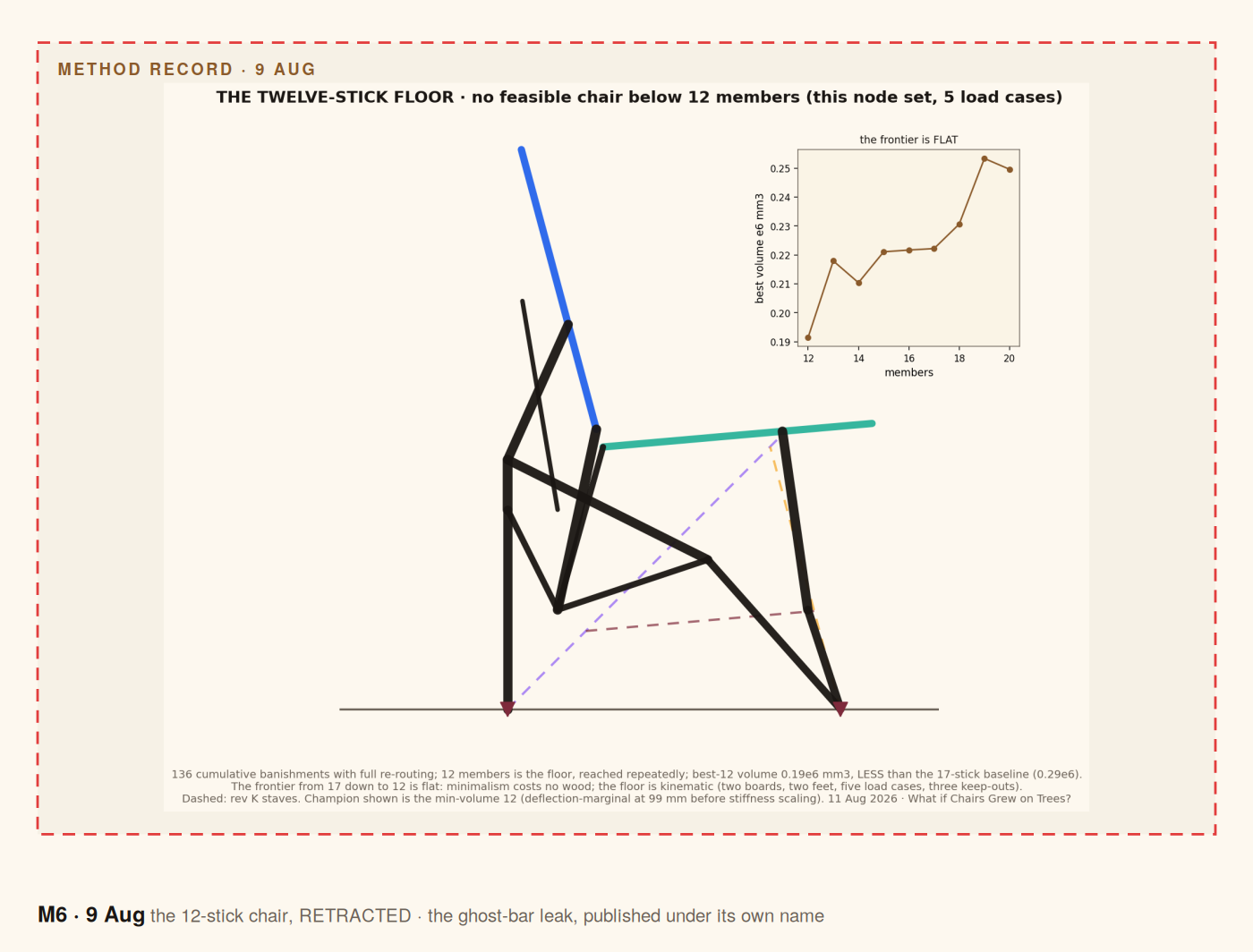
The machine's misses, on the record. It confused up and down in reaction forces more than once, a strange blind spot in something that can integrate a stiffness matrix. It once celebrated a twelve-stick minimal chair that was standing on ghost members, numerical scaffolding its own feasibility check had leaned on. The retraction is published in this book where the result would have been, and the exhibit below is the retracted object itself. And once, in a mass comparison, it laid the chair's staves down flat. Every plank in the model was bending on the wrong axis, a factor of eighteen in stiffness. The whole comparison was wrong by that factor. I caught it at half past six in the morning, reading numbers that felt off:
"I'm confused. The 'planks' are all out of plane, so don't appear in this analysis. They are 18mm in the business direction, right?"
They were. The corrected analysis reversed the conclusion, and the corrected moral, that a flat stave is an out-of-plane instrument, is the caveat that closes the audit in the chapter First Principles. The shape of the catch is the part worth seeing. It was not a recomputation, which I could not have done faster than the machine. It was a plausibility instinct trained by forty years of handling wood, applied to a number that smelled wrong at dawn.
Two more of the machine's, from the Philadelphia weeks. They are different in kind. On the twenty-ninth of August it handed me a bracket with two of its four bolt holes missing. The part looked right and the drawing looked right, and I caught it only because I was turning a live three-dimensional view and counted: "I see only two holes in the model. Are the others there?" They were not. The cutting cylinder had been built on a plane whose normal pointed away from the solid, so the operation meant to remove material removed none and handed back the body unchanged. Nothing failed. Nothing warned. The part was valid, and wrong. That is the most dangerous class of machine error. It produces a plausible object rather than an error message, and the only defense is to inspect the thing itself rather than the intention behind it. The next revision counts its own holes and refuses to proceed without four. It was checked by reading the exported file back rather than by trusting the script that wrote it. A chamfer I had asked for one minute earlier is what produced the count.
Two days later the machine told me a stainless strip would fail at 105 newtons, quoting first yield at the material's specification minimum as though yield were failure. I put a piece of twelve by one and a half millimeter stainless in a vise, loaded it, and sent back four words: "and yet it turns." It shrugged off 105 newtons and showed nothing. The correction is the useful part. For a ductile steel that hardens as it works, first yield is not an observable event. The permanent set at that load is measured in microns. The honest ladder runs from 105 newtons at first yield to about 457 at a plastic hinge in strain-hardened material. A vise beat a materials specification.
One entry belongs on the machine's side as a win. It started with a question of mine. On the thirteenth of August I asked whether the Vilbert might have a hidden gusset inside its pinwheel, because the chair had no business standing up without one. The bench model had already said so from statics alone: a four-panel cell of that geometry needs an internal member. Neither of us had seen one in a photograph. Then a dealer describing an example in hand listed the parts as four colored panels "plus 2 grey panels, which all come together centrally." The prediction came before the evidence. The statics were the machine's and the question was mine, which is the arrangement in one line.
My misses, on the same record. I reasoned the moment on a front leg backward and built it that way, and the chair told me: "Doh...one real error. I was thinking about moments on front leg backwards." I spent a week calling a Panton a Judd, in writing, to my own son (an earlier chapter). I mis-specified boundary conditions the machine then faithfully optimized against. That is the pairing to understand. The machine's errors were mostly errors of execution inside a frame; mine were mostly errors of the frame itself, and each kind is nearly invisible to the party that makes it. That is why the arrangement works, and it has nothing to do with speed.
Two ways to get the same number
One exchange in the record is not an error at all, and it says more about how the two of us think than any of them. On the morning of the twenty-fifth of August I wanted to know what the joint at the seat-to-back apex actually carries when somebody hauls back on the top of the chair. I did it in my head, on the walk to the shop: the pull acts on a lever 687 millimeters long, the apex resists on one 219 long, so the apex sees about three times the pull. 687 over 219 is 3.14.
The machine ran the frame. Its answer began with the seat as a two-force member, pinned at both ends and carrying nothing in between. Whatever crosses the apex therefore acts along the seat, and the back is a plain lever pinned at the 60 degree corner. Take moments about that corner and the pull's arm is 687 times the cosine of 15 degrees, or 663, while the apex's arm is 219 times the sine of 80 degrees, or 215. The load across the apex is 3.08 times the pull. The two angles trim my head figure by two percent, because the cosine of 15 and the sine of 80 all but cancel.
Two percent. My crude ratio and the full solve landed on the same number, and mine is the one a builder can carry around. What I wrote at the time is the reason this episode is in the chapter: "We came at this problem pretty differently. When constrained by human cognition and time, I had a pretty simple heuristic that got the answer within the margin of error. The machine just lets the full analysis rip, sometimes with wonky assumptions and implications." The machine's reply put my version at the head of its own memo and demoted its solver to a cross-check, with a rule attached: reduce to the smallest free body that answers the question and take moments by hand, then use the solver to check that rather than to replace it.
I have taught that rule for thirty years. It took a machine with unlimited patience for algebra to make me notice that I still use it. The scarcity it was invented for is my own attention, and that has not gone anywhere.
What the thinking cost
Now the economics, which I can report from my own bank statement. What the machine changed was not creativity. It was the carrying cost of a design hypothesis. In 1990 the question "what if the front leg ran parallel to the back?" cost a drawing board afternoon; in this project it cost minutes, and the collapse restructured the work. Seven architectures in one evening. A precedent survey over breakfast. A cut list on demand. The whole design, concept to built hardwood chair, in twenty-six days of part-time work.
What the thinking cost to produce, I do not know. Nobody outside the companies that run these models does. I put that first because the number I can report is a price, not a cost. The difference matters to anyone planning work on the strength of it.
The price: my subscription is two hundred dollars a month, and in August the project pushed me about two hundred dollars into additional usage. Call it four hundred dollars for the design month, nearly all of it the chair. For comparison, the materials in the brad-nailed prototype came to about twenty dollars, the Krat replica's plywood cost ten Australian dollars, and my own labor, at any defensible professional rate, passes both numbers put together inside the first morning. The thinking was the cheapest input in the project by an order of magnitude. That sentence has never been true of any designed object I have worked on in forty years.
Marked as the conjecture it is: I cannot imagine that running frontier models against my chair problem for a month actually nets out to four hundred dollars. Whether the gap is scale economics or investor subsidy is beyond this book's evidence. I raise it because a designer planning a business on cheap thinking should plan for the possibility that the thinking is on sale.
The live retraction
I had a sentence drafted for this chapter. It said: "AI is still not very good at conceptual design of physical goods." I believed it, on the evidence of this project. Across twenty-nine days the machine proposed brilliant analysis and almost no unprompted architecture, and the inventions on the tape are mine. Then, while this chapter sat in draft, I ran the experiment I should have run first. I gave a frontier model the MakerStock brief cold, no context, no coaching: scrap plywood, panels 500 by 600 and 200 by 1200, ten dining chair concepts, black on white. From my notes, written within the hour:
"wow. I can't believe I didn't do this first. Had been about to write that AI not yet very good as conceptual physical design. This would have been an A+ on the concept generation assignment in any of my sections of product design through Fall 2022. Interesting echos of Ollie, Zig-zag."
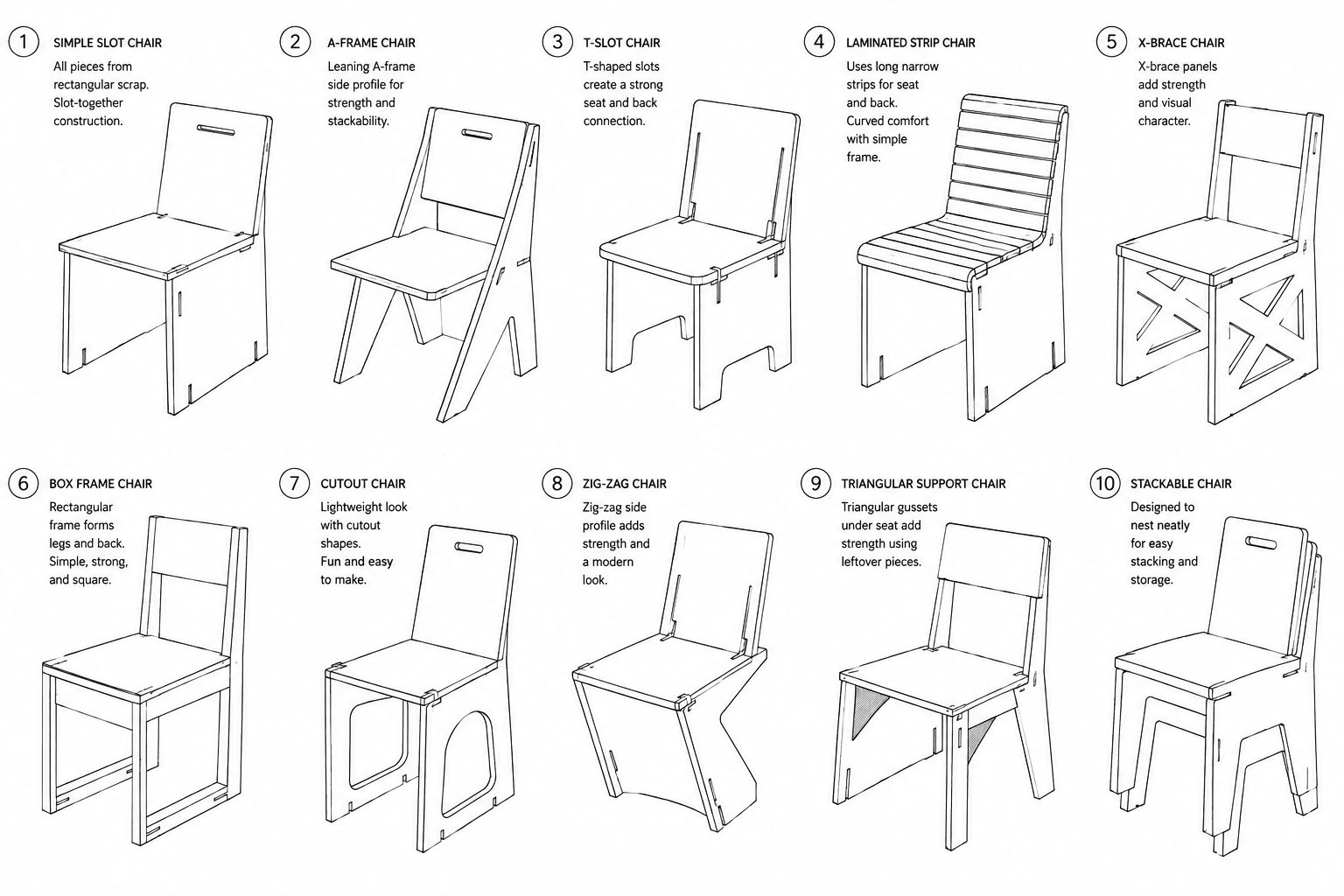
So the sentence is retracted, here, in the book's own culture, with the evidence printed beside the retraction. And I will replace it with the two things I now believe, at different confidence. First, from my notes, at high confidence: "I seriously doubt that within 10 years there will be any cognitively demanding information task for which the machine is not better than virtually every human." Second, from the tape of this project, at the confidence of a documented month: the persistent, holistic, iterative delivery of a winning physical object, the noticing that a number smells wrong, the sitting test, the veto, the taste, is not today the machine's solitary pursuit. I taught the centaur before I lived it. My own 2025 course script tells students that the most powerful approach lets the AI supply expansion, surprise, and sheer volume while humans supply selection and synthesis (self-citation, the Design Thinking scripts). I quote my own syllabus to establish the date. Believing a slide and cutting wood from an unchecked list are different orders of belief, and this chapter is about crossing between them.
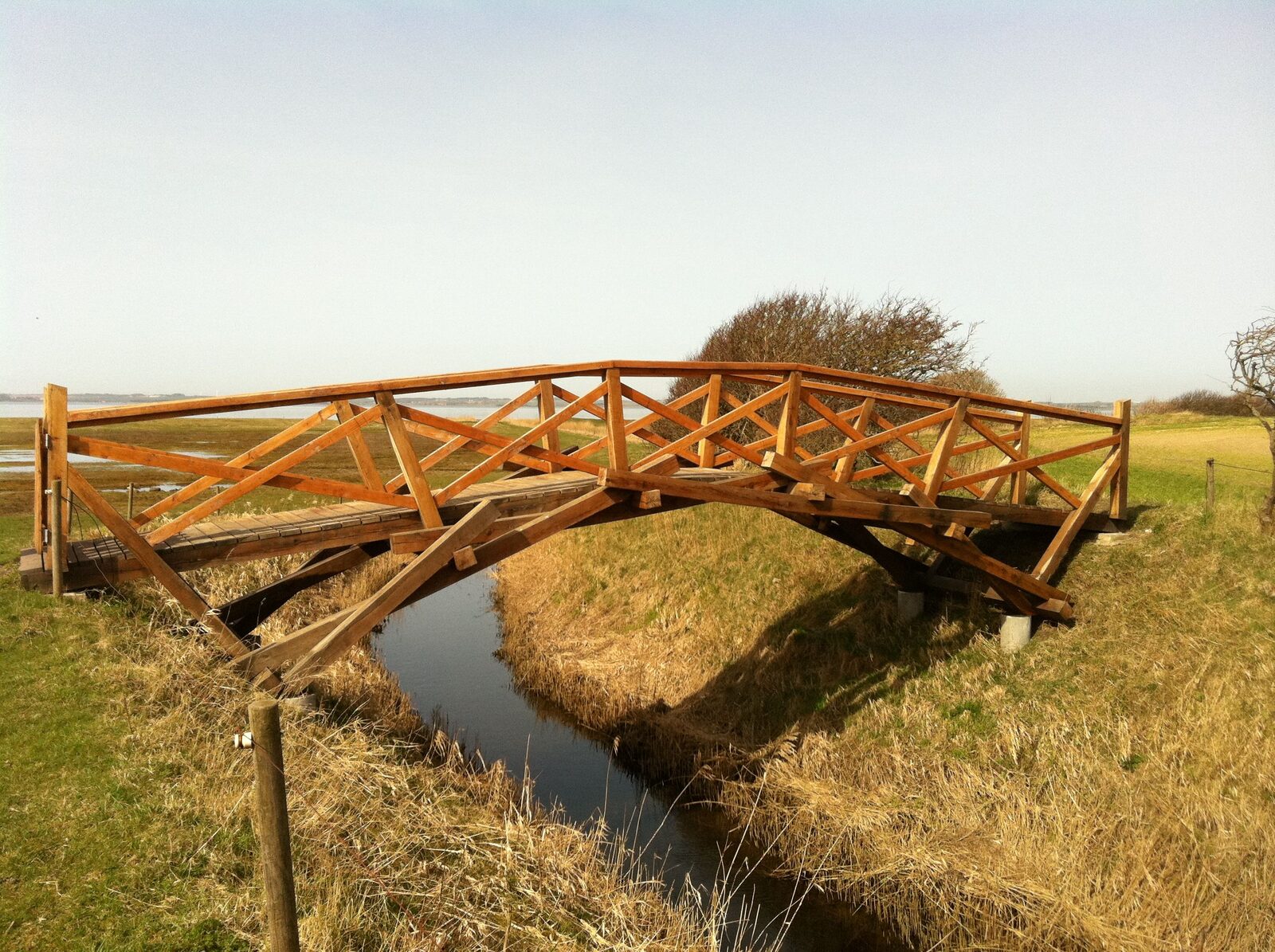
The outer marker for what one unaided designer can be is older. Leonardo drew a bridge that holds itself up, no fasteners, no collaborator, geometry as the entire structure; the design sits in the Codex Atlanticus, folios 69 AR and 71 V, written between 1478 and 1518. People still build the thing. Five centuries on, the information alone is enough to put a working bridge over a stream, which is what the photograph shows and the folio could not. The caveat that completes the comparison: Leonardo is not the typical designer, and the centaur's promise runs the other way. Its human half does not need to be Leonardo. It needs to know when a number smells wrong, and what Wendy's face looked like when the chair moved under her.
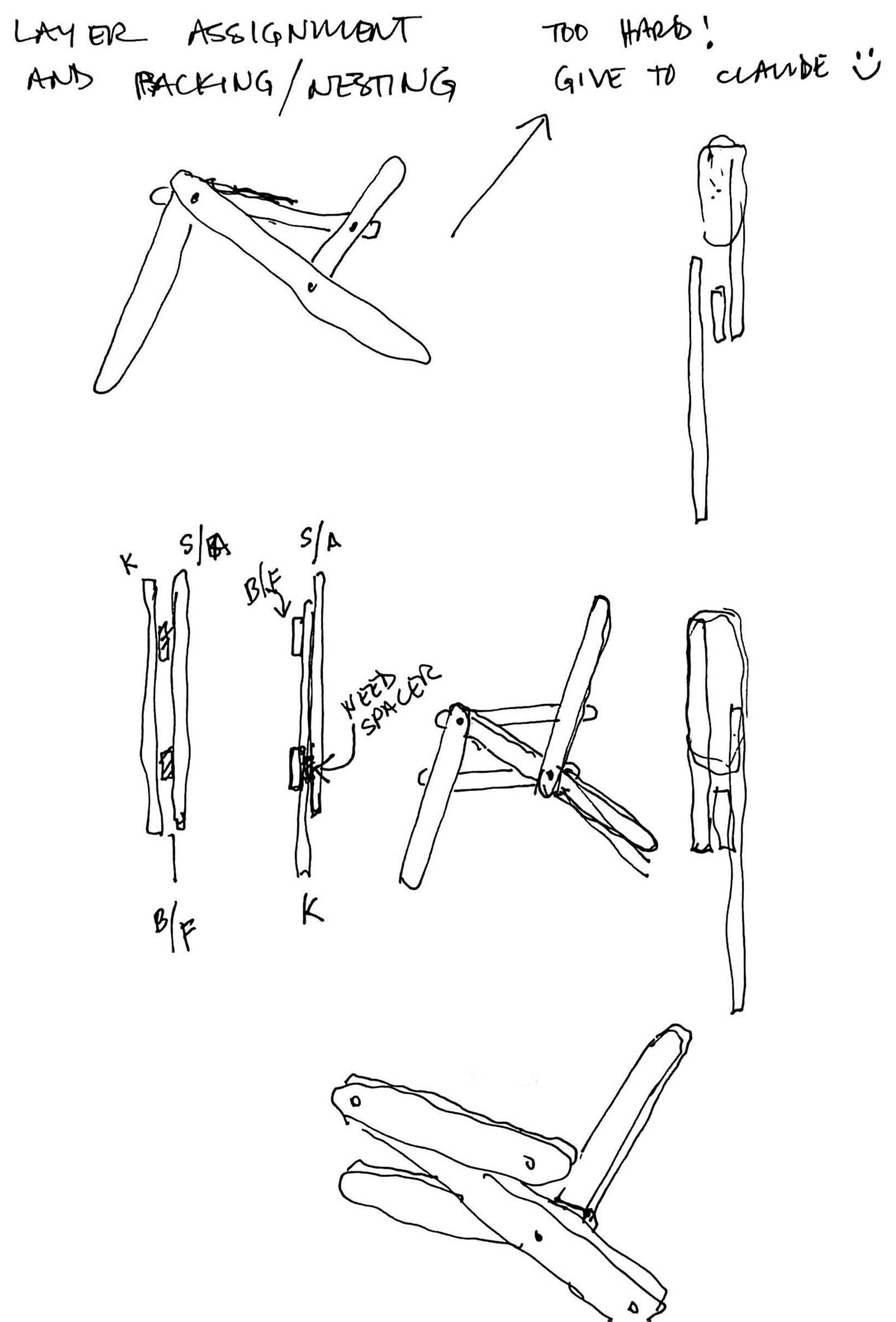
Too hard, give to Claude
The clearest single frame of the arrangement came late, on the fifth of September, over a question about the second chair, the one the chapter So Similar, Yet So Different is about. It folds flat to ship, and its arms were fouling the fold. The fix looked like a matter of which of the five sticks on each side goes in which of the three layers, and I sat down that morning to think it through. From the scratch pad, later the same day: "this morning tried to think through the arm interference question for the flat pack configuration. Very hard spatial visualization. Basically gave up after 10 minutes." The notebook page from that sitting has two tries at the stick order and, across the top in capitals, TOO HARD! GIVE TO CLAUDE, with a smiling face. So I gave it to the machine. My part was to state the problem so it could not be misread: five sticks, three layers, sticks that meet at a pin cannot share a layer, the arm must clear the back, the cap must swing free. The machine did the part I could not. Two hundred and forty-three assignments collapsed to six on the pin rule alone. The six forced a result the project had been treating as a design choice since the second of September, that the seat and the arm must share a layer and the back and the front must share another. The seat panel killed four of the six, and the two survivors both put the arm inboard of the back. Its conclusion was one sentence: "No three-layer ordering can fold with a recessed back panel." The interference was not a detail of my build. It was structural to the scheme, and no reordering could fix it. Then it enumerated four layers and found exactly two that work, at the cost of a spacer and thirty-six millimeters of width. I looked at the two and made the decision that was mine to make: "I do not think four layers is a worthy solution. It is inelegant. I think the answer is that the arm is removed entirely to ship." Four pins at first, six by the end of the day, and the chair ships flat. I wrote in the scratch pad that it was a "Convincing example of Centaur mode," and it is, for a reason I want to state exactly. I did not solve the combinatorics; I could not have. What I did was recognize a problem as one with combinatorics in it, tee it up so the machine could not misread it, and then judge the answer by a standard the machine does not carry, which is taste.
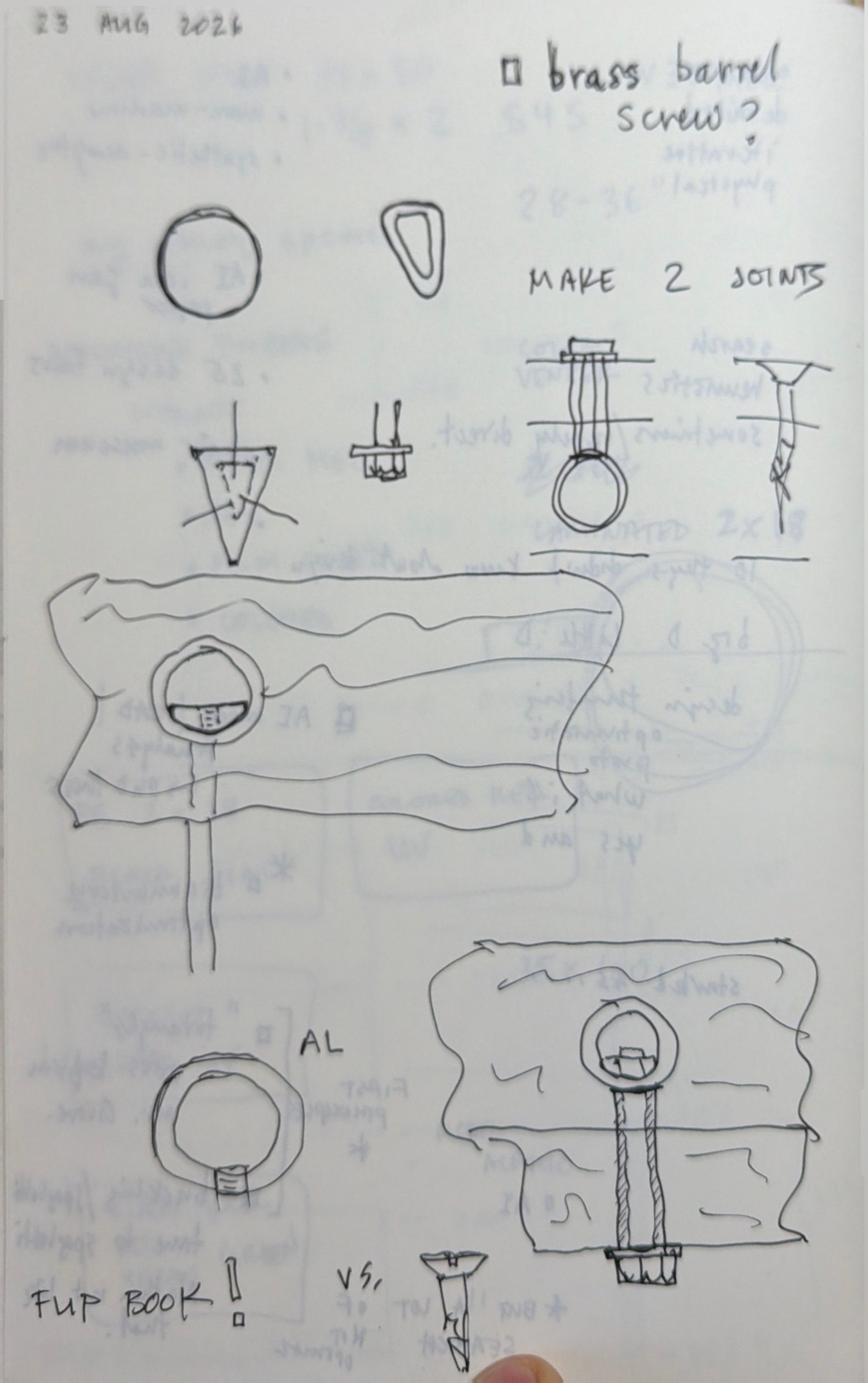
One late entry in the ledger points the other way, and I want it on the record because it is the only one of its kind. The tape of this project shows ideas flowing in one direction: the architecture came from me, and the machine drew, checked, computed, and remembered. Then, while we were restructuring this very part of the book, the machine proposed a feature for the physical object you are holding: a flipbook in the page corners, the twenty-six states of the chair animated by your thumb. My shop notebook's page for the twenty-third of August is a hardware page, brass barrel screws and joint sections, and at the bottom, in my hand, next to a checkbox, it says FLIP BOOK! It is the one page in the notebook where an idea crossed from the machine into the ink; every other page runs the other way. I did with it what I have always done with a colleague's good idea: I wrote it down so I would not lose it.
The machine has no stake in any of this. It does not sit in the chair. It does not pay for the wood. It will not be embarrassed at a design review. Every preference on the tape that survived into the object came from a person: my back, my scrap pile, my taste, Wendy's thirty seconds at breakfast. And the machine has no hours; every hour of mine was the same to it. My hours are another matter. They are the most lopsided fact on the whole tape, and they are the next chapter.
Quotations verbatim from the tape: the cut-list doctrine (15 Aug), the factor-of-eighteen catch (10 Aug, 06:51), the Doh line (2 Aug). Cost figures are what I actually paid (stated 22 Aug); the price-versus-cost paragraph is conjecture and marked. The Sol 5.6 experiment is from my notes, written within the hour; the plate is the exhibit. Queued: the centaur attribution chain (advanced chess; Mollick), the Codex Atlanticus folios against a facsimile, the Commons license variant for the Karby photograph, and the nineteen-minute run on the tape; which build the unchecked cut list belonged to is queued for a pin. The Nathan passage is the author's account, kept near verbatim, the agency spelling corrected to Wilhelmina; the crash is stated as family telling, with the option to pin date and place from public accounts at print. Son Nate named for brother Nathan: confirmed by the author; the text that began the book opens the chapter Why Every Designer Does a Chair. The chapter was rearranged to open on the Nathan movement, with the stopped-checking moment repositioned as the pivot; no text lost. The flipbook is the machine's proposal; notebook page 84 records my jot of it, verified against the scan.
A chapter of The Hundred-Year Chair, drafted and refined in public. The same text lives in the book; the interactive tools and the fully-sourced technical notes live here. home · the book · the technical notes · hundredyearchair.com