The Hundred-Year Chair · a chapter
The Verdict of the Builds
On the evening of the fifth of August my wife sat down in the newest chair, and the chair moved. I had built it that afternoon; I was pleased with it, the stave chair, the lightest and cleverest thing the project had made. Wendy sat, leaned forward the way everybody leans forward in a chair a hundred times a day, and the rear leg slid half an inch across the tile.
She said she was not sure it would hold her. In plain fact she was a little afraid to sit in it. I spent that evening telling her, and myself, that it was fine.
It was not fine. The person who settled that was not designing anything. Wendy weighs fifty-four kilograms, about half the load a dining chair is built to shrug off, so the chair was in no danger from her. What was in danger? The one thing no load case covers: whether a person at half the design load believes the chair. The report I typed that night kept her verdict and my own diagnosis in one breath:
"...interesting results with Wendy... the seat flexes obviously. The rear leg is sliding 1/2-1 inch. Interestingly it slides on carpet too. Why? Because if you lean forward two things happen: You put the front legs in serious bending, and you unload the rear legs so they easily slide."
The machine has never once leaned forward in a chair. No instrument in this project could have produced what she found, except a body that did not trust the object under it.
The next chapter takes the mechanism of the sliding apart. But, we can quickly get the main idea. The chair's legs rake to the front and back, so each foot pushes a bit sideways on the floor the whole time you sit. Lean forward and the weight comes off the back feet. The front legs take up the load and bend. The frame standing on those bending legs starts to move. A rear foot pressing on almost nothing has nothing left to hold it still, so it goes along for the ride. It slid on the tile. What surprised me enough to write down that night is that it slid on carpet too.
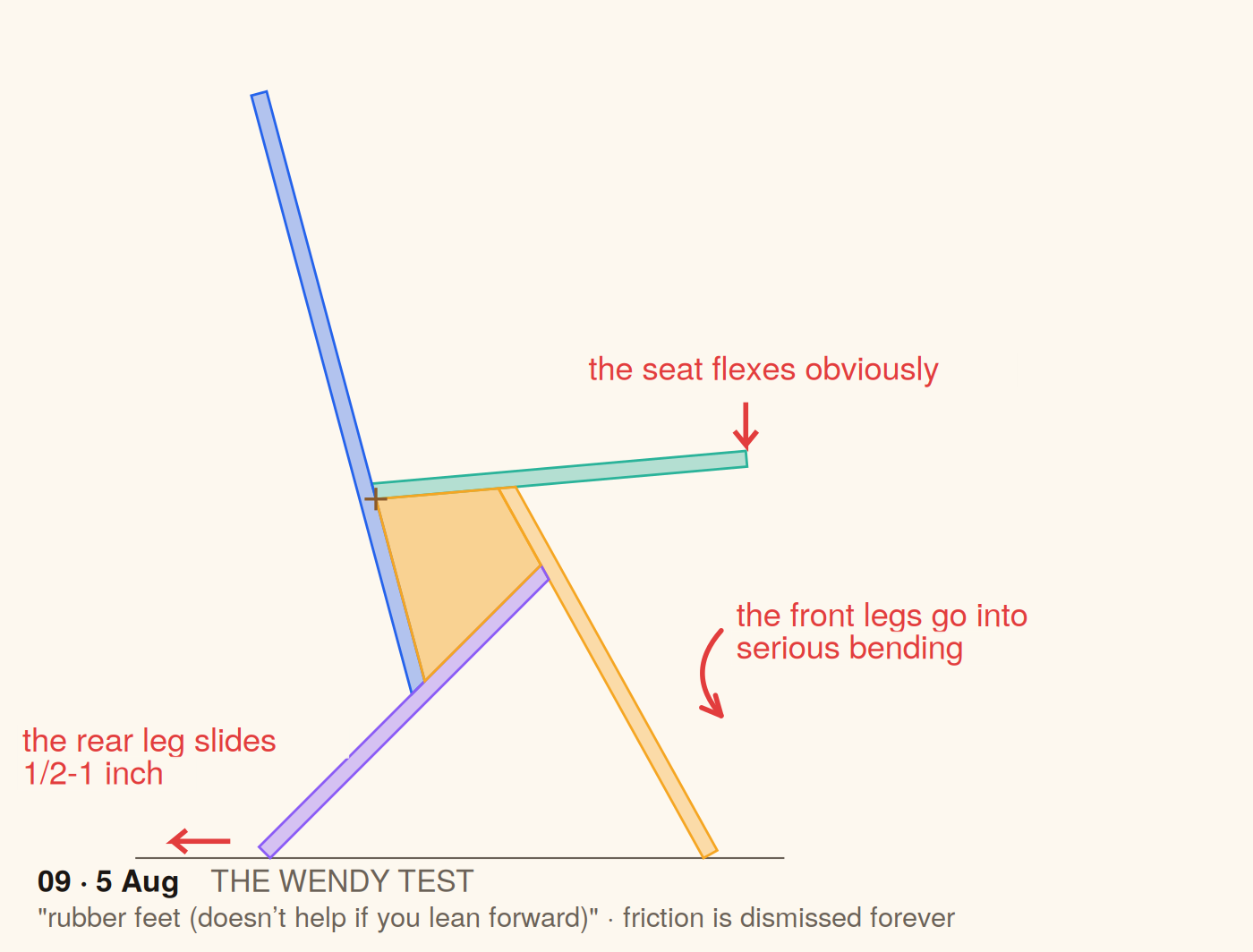
The slide has two cures; only one of them makes a chair. We can raise what the floor gives, or we can lower what the chair asks. Rubber feet raise what the floor gives; they would have worked on that tile, that day, with the pads new. A chair meant to be sat in for a hundred years does not get to choose its floors, or its housekeeping, or whether anyone replaces a worn pad in 2074. I had refused that strategy when the machine had suggested it as a possible fix: "relying on the rubber feet is not an heirloom strategy...feet come and go."
One word in that quotation is nowhere in the original design brief. The brief was about consuming scrap cheaply. Here, for the first time, the goal is an heirloom, a thing meant to outlast its maker, and from this evening on that is quietly the real target. Nobody wrote it down. It emerged from the Rietveld experience and a sliding chair.
The other cure for sliding lowers what the chair asks of the floor. Picture standing on ice with your feet spread and about to go, and now a rope tied between your ankles. The outward push has somewhere to go that is not the ice. In a chair, that rope becomes a stick between the feet, a tie; two raked legs and a tie make a triangle.
My considering a tie between legs did not feel like opening a textbook. It felt like hearing a voice, the voice of Peter Grove, my son Jamie's elementary-school science teacher, who taught for thirty years at Friends' Central outside Philadelphia. His classes launched hot-air balloons and waded in streams, and once a year the children hauled his car up a hill with a pulley system they rigged themselves. When the lessons turned to structures and popsicle-stick bridges, his whole doctrine was one word, delivered as a mantra: triangles. He died on the sixth of May 2026, eleven weeks before the founding message. He never saw the chair. The hundred-year chair contains two of his triangles.
For sources, citations, and the technical notes behind this chapter, see hundredyearchair.com.
A chapter of The Hundred-Year Chair, drafted and refined in public. The same text lives in the book; the interactive tools and the fully-sourced technical notes live here. home · the book · the technical notes · hundredyearchair.com