The Hundred-Year Chair · a chapter
Lovable, Legible, Maintainable
What must a chair be so that a chain of people who will never meet me keeps choosing to keep it? My answer is that a chair lasts by being lovable, legible, and maintainable. That is a claim about people, not about wood. Nothing in nature enforces it. It is the smallest set of properties that accounts for the survivors I have studied and predicts the failures I have watched. Test an old chair against the three. The ones that lasted have all three. The ones that died are missing one.
A chair lasts first because someone wants it enough to keep it. Desire funds repair. A joint cracks, and in that moment the chair is weighed, usually without anyone noticing they are weighing it, against the cost and bother of fixing it. If the chair is loved, the repair happens and the century continues. If it is not, the chair becomes firewood the first time it wobbles. No clever joinery saved it, because no one reached for the glue. The wobble did not kill it. The indifference did.
The chairs that are old and merely owned, rather than old and enshrined, make the case. Ming hardwood chairs of the sixteenth and seventeenth centuries survive because people have wanted them, without a break, for four hundred years, enough to trade them, repair them, and sit in them. That is a market, not sentiment. A good huanghuali armchair sells at auction for close to two million dollars, and then it goes back into a house rather than a vitrine.
Set against that, the clever chair no one loves past the novelty. I backed one on Kickstarter, a shape-shifting sheet-metal seat that raised close to three hundred thousand dollars from five hundred and thirty-nine admirers in 2017. It came home heavy, half-unglued, and unloved. The idea outran the object, and a concept does not fund its own repair.
Lovable is the one property I cannot engineer. I can compute a joint that ages by compression. I can put the irreplaceable geometry into a single member so a stranger can copy it. I cannot compute lovability, and I cannot promise it. Whether I have made a chair that people will love, and keep, and re-cane in 2080, is not a thing I get to declare. It is the one claim in this book that only time and other people can settle. This is the project's real risk. A chair that is perfectly legible and perfectly maintainable but merely fine will be maintained by no one.
Some of lovable I can influence without guaranteeing. The look, for one, which arrived by an irony: I did not choose it. Function handed it to me, and the result reads as a style I would never have picked on purpose. Color, grain, and the small human signals that make an object feel worth keeping are all real and all worth doing. None of them is the thing itself. Decoration on a chair no one wants to sit in is decoration on firewood.
One part of lovable does take numbers, and I nearly missed it. On the first of September I wrote a worry into my notes. The flat-panel chairs I admire, the Zig-Zag, the Panton, the Judd, all use flat panels, and I remembered Piet Hein Eek saying his scrap chair was not comfortable until they curved the back. My chair is flat panels. So is the whole family it comes from.
The complaint has a mechanism. A flat back reads more upright than it measures, because a flat panel gives the pelvis nowhere to go. Your sacrum meets the board before your lumbar does, the board pushes the base of your spine forward, and the recline you get is less than the rake you drew. The first time I sat in the K3 I reported the effect without knowing the cause. It felt surprisingly upright, given how laid back it actually is.
Eek has used both fixes, one in each of two chairs. His armchair carries the comfort in the frame: a level seat, a hard oak back, no cushion. His lounge chair carries it in the cushion, over a flat platform lower than any wooden lounge chair I have measured. The foam supplies the height, the tilt, and the lumbar.
The cushion is the part I had wrong. It is not a uniform offset. Under the sit bones the pressure is enormous, and the foam there crushes past two-thirds of its depth, so of fifty millimeters perhaps ten survive. Under the thighs, where the pressure is a tenth as high, nearly all of it survives. A flat cushion on a flat deck becomes a wedge the moment someone sits on it. That is how it supplies a tilt without anyone cutting one. I had been told that fifty-five percent of a cushion survives compression. That turned out to be an upholstery rule of thumb with no source behind it. What settled the question was that I had already sat on the thing and put the difference at under six millimeters by feel. The physics predicts exactly that, once the arithmetic is done right. The body was the better instrument, again.
Comfort will not make anyone love a chair. Its absence will guarantee they do not.
A chair lasts second because a stranger can read it. I call that property legible. The object has to explain itself: how it is made, and just as much, how it comes apart, readable from the chair without me standing beside it. A hundred years guarantees three things: I will not be in the room, the factory will be closed, and the server that once held the instructions will have gone dark. If understanding the chair needs any of those, the chair is already mortal. So the knowledge has to live in the object, or in something as durable and public as the object.
This is why the project publishes what I call the Pattern rather than a specification. The Pattern is a reference a stranger can read and reason from, not a rule a stranger must obey. It says what any version of the chair has to be, and leaves a builder free to make a conforming one out of whatever a century I cannot see puts on the bench.
Legibility is not only in the document. One member, the keel, carries every hard cut and every reference, so a stranger who lays a rule along it can recover the whole chair. The chair also carries its own description: a mark on the object, and a design history kept in public. The chapter The Pattern and the chapter Signing Work You Will Not Outlive take up those two in turn.
Legibility is the property I trust most. It comes almost purely from discipline. You make the geometry readable by concentrating it. You make the disassembly readable by refusing glue, so every connection announces how it opens. A chair you cannot take apart is a chair no one can repair, only patch.
A chair lasts third because keeping it up is within reach of ordinary hands and ordinary materials. I call that property maintainable, and the weight is on ordinary. It is not enough that a conservator with a climate-controlled studio could repair the chair. That is intensive care, and intensive care is reserved for objects a culture has already decided are precious. No working chair should have to earn that status to survive. Maintainable means the repair is a hardware-store errand and an afternoon, done by someone with no special training, out of materials that will still exist because they are common.
This year I fitted a run of drawers in my own house with prefabricated boxes and integrated runners. They are excellent. They arrive flat, go together in a minute, run smoothly, and self-align, and I would use them again tomorrow.
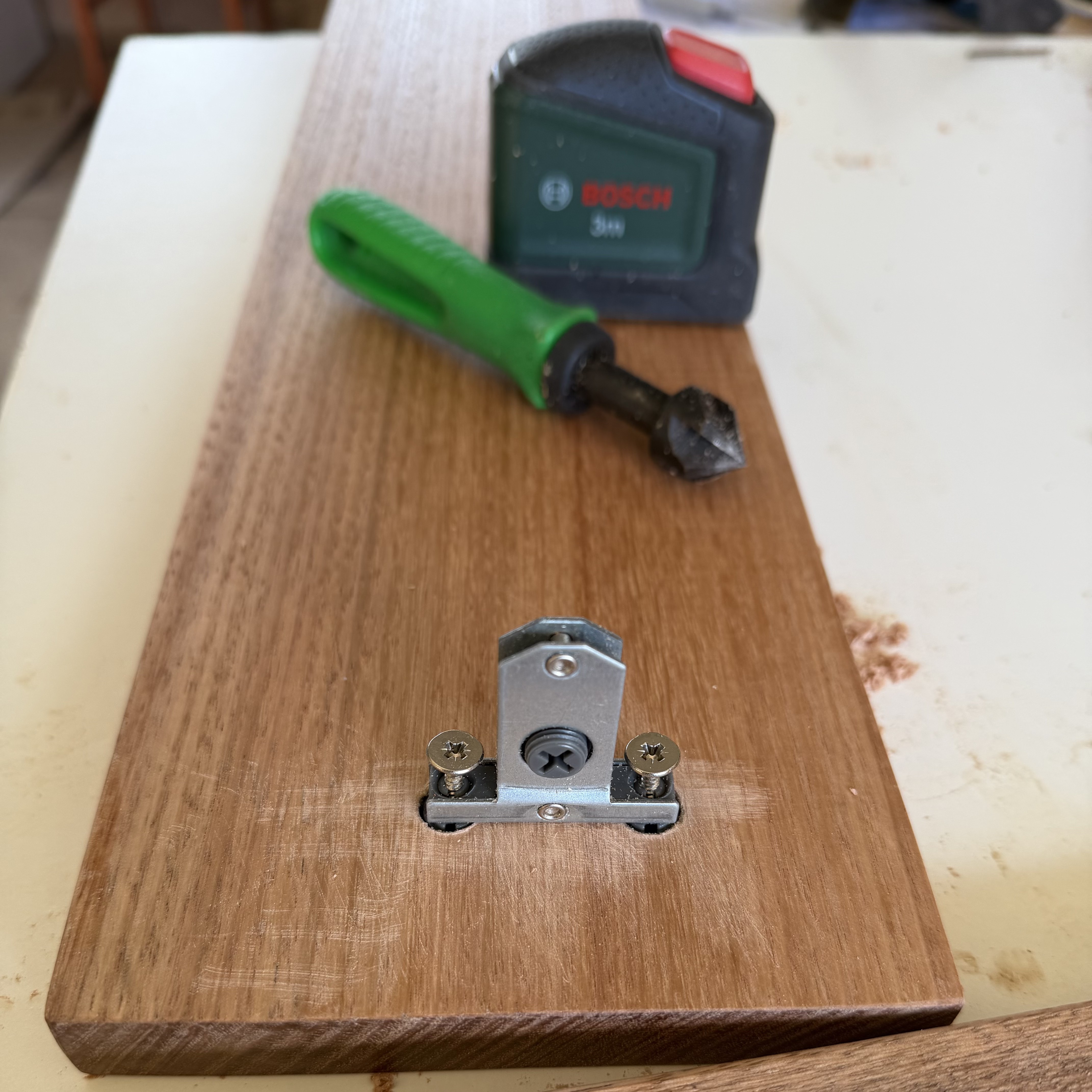
Then look at the part that holds the drawer front on. Two screws do not thread into the oak. They drive into a plastic insert in a bored hole and wedge it open against the walls of the hole. The grip is a plastic plug spread once into a socket. Back the screws out and the plug relaxes into a hole it has already crushed to its own shape. Do that a few times, or let the panel take up a winter's moisture, and the socket grips nothing. There is no larger screw to step up to. The hole was never a screw hole. The drawer will not fail because the oak rotted. It will fail because a plastic plug gave up, and the company that sized the hole has been gone for eighty years.
That is the distinction. It has nothing to do with quality. Those drawers are better made than any drawer I would cut by hand. Being well made brought maintainability along with it exactly never.
What fails in a chair is almost never the wood. Wood kept dry and indoors is effectively permanent at the scale of furniture. What fails is the joints. A bolted joint holds because something is stretched, and wood, given a year of seasons, un-stretches it. A chair that relies on that preload slowly loosens itself whatever you do. Compression ages best. So the chair holds by bearing and compression, which age gracefully. It treats its metal as a consumable rather than a permanent part. The arithmetic of how much a joint loses in a season is in the technical note; here the doctrine is enough.
The metal is made replaceable on purpose. The chair's threads never run in bare wood. They end in steel inserts, so tightening costs nothing and a stripped bolt is an errand rather than a funeral. The bolts are the commonest metric size of the century, on the same instinct that once made a builder choose the peg his village already whittled. The chair is built to survive the loss of any fastener it was born with, because over a hundred years it will certainly lose several.
The last move is to order the failures on purpose. You concentrate the irreplaceable in one dense, documented member, the keel, and make everything around it a rectangle a stranger can re-cut from any sheet. Then you decide what gives first: bolts before panels, panels before the keel, and the keel never.
My own chairs have one data point on the right side of this. The maple chair of the thirty-first of August was a week old when I rebuilt it. I restained the keel, remade the tie in twelve-millimeter stock, replaced the seat, and swapped every bracket. Nothing had to be drilled out or cut off to reach anything else. Taking the chair apart and putting it back was fastener work. It came off the scale afterward at 16.3 pounds against 17 before. One week is not a hundred years. But the first maintenance event in this chair's life was an afternoon. The old chairs say the same thing at the scale of centuries. The chapter How Long Is a Hundred Years? is where they say it.
Two of the three I can build. Lovable, the one that decides everything, I can only hope for. Miss any of the three and the century quietly closes.
Legible is delivered by The Pattern and by Signing Work You Will Not Outlive, the two ways the chair speaks for itself once I am gone. Maintainable is stated here, shown on a real chair in A Thousand-Year Chair, and evidenced by the survivors in How Long Is a Hundred Years?. Lovable has no chapter of its own: the look is in Aesthetics, Style, Memphis, the wanting in How Long Is a Hundred Years?, the money in Chaironomics, and the one part that submits to arithmetic in the comfort section above.
The next chapter is the Pattern itself: not this chair, but the thing that can make it again.
The comfort section rests on measured work and on my own build logs. The seat-pressure figures are Eun-ji Go and Sang-Heon Lee, "Effects on sitting pressure distribution during the application of different cushions and anterior height wedges," Journal of Physical Therapy Science 29:3 (2017), 390 to 393: peak pressure under the hip of about 305 millimeters of mercury on a firm surface against about 120 on a 50-millimeter foam cushion, in thirty-six adults aged 20 to 27. The foam-deflection arithmetic works from ASTM D3574's indentation force deflection. The flat-panel worry is my own note of 1 September 2026. The two Eek chairs were measured from photographs by local ratio, with the method and its error bars in the K3 build log. The K3 field report, that it feels surprisingly upright given how laid back it is, is my own, 2 September. The fifty-five percent figure was an upholstery rule of thumb with no source, corrected against the physics and my own reading of the chair.
The clever-chair example is the Ollie by RockPaperRobot: close to $290,000 from 539 backers in 2017, verified against the Kickstarter campaign, with the judgment of the object my own, as a backer. The huanghuali armchair market is treated as a dated survivor in the chapter How Long Is a Hundred Years?; the auction figure here is the order of magnitude, not a specific lot. The prefabricated drawer is my own build of 2026, and the photograph is mine.
The joint principle stated here (a bolted joint holds because something is stretched, and wood un-stretches it; compression ages best) is quantified in the technical note the retired Joints chapter became. The steel inserts, the metric-bolt choice, and the failure ordering are the chair's own design. The historical survivors that prove the maintainable case, iron and nail sickness, Thonet's screws in service, and the seven-century oak core, are given in the chapter How Long Is a Hundred Years?, not here. The maple rebuild of 6 September, and the weights 17 and 16.3 pounds on the same scale, are my own report of that day.
A chapter of The Hundred-Year Chair, drafted and refined in public. The same text lives in the book; the interactive tools and the fully-sourced technical notes live here. home · the book · the technical notes · hundredyearchair.com