The Hundred-Year Chair · a chapter
The Pattern
By the end of August the chair worked. You could sit in it and lean back hard. You could tip it back on two legs to reach across a table. It neither racked nor slid. For most furniture that is the end of the project.
It was not the end of this one. The chair I care about is not this chair. It is a chair in 2126, in a room I cannot picture, holding up a stranger I will never meet. A hundred years is not long for wood kept dry. That stranger may well be sitting in this very piece.
But a joint cracks, a panel splits, a child wants one of her own, and an object cannot repair itself or make another. On that day the chair in the room is not enough. What the stranger needs is the knowledge of how it was made, how it comes apart, and how to cut the part that failed.
That knowledge can live in more than one place. I have put it in three. A book comes first. It is sturdier than it looks. Words have crossed a thousand years on good paper that someone kept dry, and these are on that paper. The object comes second. Lay a straightedge along the chair and the geometry is there to be read. People come third, because every stranger who builds one holds a working copy.
Legibility, the middle of this book's three properties, means more than reading a text. The chair can be recovered from any of the three, and rebuilt from the object alone if the words are lost.
So the last question in the design was not what to write down. It was this: what has to survive, and in what form can a stranger still read it a century on?
None of that is worth doing if the goal is not worth wanting. Chair immortality is a faintly ridiculous thing to want, and I do not quite want it. Objects come and go, and most of them should. What I am unwilling to do is waste the part that was hard to make.
The Christmas I was eleven, my father, a combustion engineer, gave me a chemistry set. Not the toy kind. It was university-surplus glassware: a condenser, an Erlenmeyer flask, a stopper cutter, glass tubing. Handing an eleven-year-old a Bunsen burner troubled even him, so my heat came from a hot plate he had built from a clothes iron turned upside down on a wooden box. What it taught me, before I had words for it, was that a serious instrument can be made from salvage.
You do not throw out a thing that still has use in it. Durability is that instinct pointed at objects. A chair someone paid for, that cost the earth something to build, should earn its keep by lasting. The pattern is the same instinct pointed at knowledge. I have worked out how to make a chair that lasts. I can let the method die with me, or I can write it down and give it away.
There is vanity in the wish, a fear of being erased, which I take up later where it belongs. Under the vanity is a plainer thing. Keeping the method to myself would waste it.
So the pattern is small. The temptation is to write down everything I know, and I know a good deal: a cut list, a bill of materials, a finish, a torque I would prefer. Every number I pin is a number the stranger cannot change. Their boards and tools and century will not match mine. The whole of the pattern is two congruent triangles that share a keel.
The numbers that fix this particular chair are not the inheritance. They are the dimensions of one chair. What a stranger inherits is the arrangement: two congruent triangles that share a keel. Keep that arrangement and change every number to suit your body and your stock, and you have made something I would recognize. Put my numbers on a different arrangement, and you have made a different chair that happens to use my measurements.
If you want to hold this chair's proportion in your head, hold it as a triangle of roughly 40, 60, and 80 degrees. Those three round angles add to a straight line and can be drawn at any size. The exact sides in millimeters are how you build this one accurately.
Biology has a pair of words for this. An organism's DNA is what it inherits: a small set of instructions, copied exactly, carrying nothing about the world the organism will grow into. Its body is what those instructions become in a particular place, with particular food and weather.
The chair has the same two layers. Its DNA is the two triangles and the shared keel. Its body is everything else: the species of wood, the thickness of a panel, the finish, the color, the shape of a bracket, the exact angles and millimeters of one build.
Almost every failure of longevity I have studied comes from confusing the two. A maker writes down the body and calls it the design. Ikea publishes a part number. A part number is a body. It works until the factory that makes that part closes. Then the object cannot be maintained, not because it was badly made but because the wrong layer was recorded.
Wood is not protein and a chair does not breed, so I will not lean on the borrowed words past that one distinction.
Everything I have just called the body has already moved. On the thirty-first of August I built two chairs. The first was white oak with eighteen-millimeter plywood. It weighed 23.3 pounds, too heavy for a dining chair. The second had a hard maple keel of a different section and a twelve-millimeter plywood seat, twelve being what was on the rack. It weighed 17. The lighter one is better. The DNA does not know the difference between them.
That day's notes changed five things and left the pattern alone. A thinner seat cannot hold a threaded insert, so the threads moved out of the plywood and into the keel and the brackets. Each panel now carries its own thickness, which the configurator has to take as an input. The fasteners wanted to sit twenty millimeters in from a panel's end, so the notch in the keel went deeper to leave room. The brackets, printed one-off for the prototype, settled into a single eighty-degree part, used twice at the back and twice at the front.
In the middle of those notes is the sentence that drew the line I had been circling for weeks. I wrote it while thinking about a hole:
I'm inclined to not move the apex...set it for 18mm nominal seat thickness, and let seat come down by 18-t, where t is the actual seat thickness. that way the keel is a standard part independent of the seat material.
One member has to stay put when the material changes. The rest absorbs the change instead. The apex holds its place, and a thinner seat simply sits lower by the difference. So a shop can cut the keel, the part that is expensive to cut accurately, without knowing yet what anyone will bolt to it.
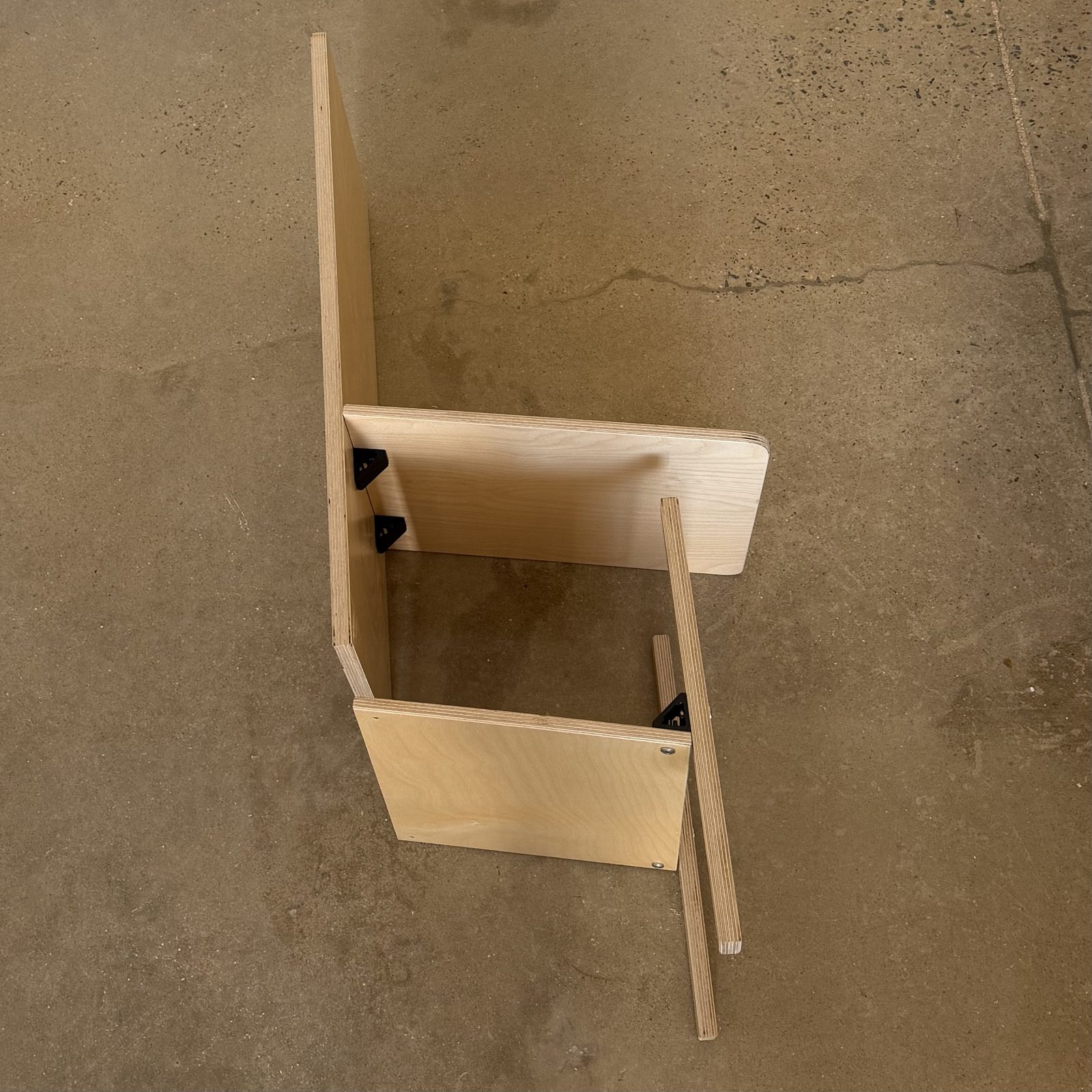
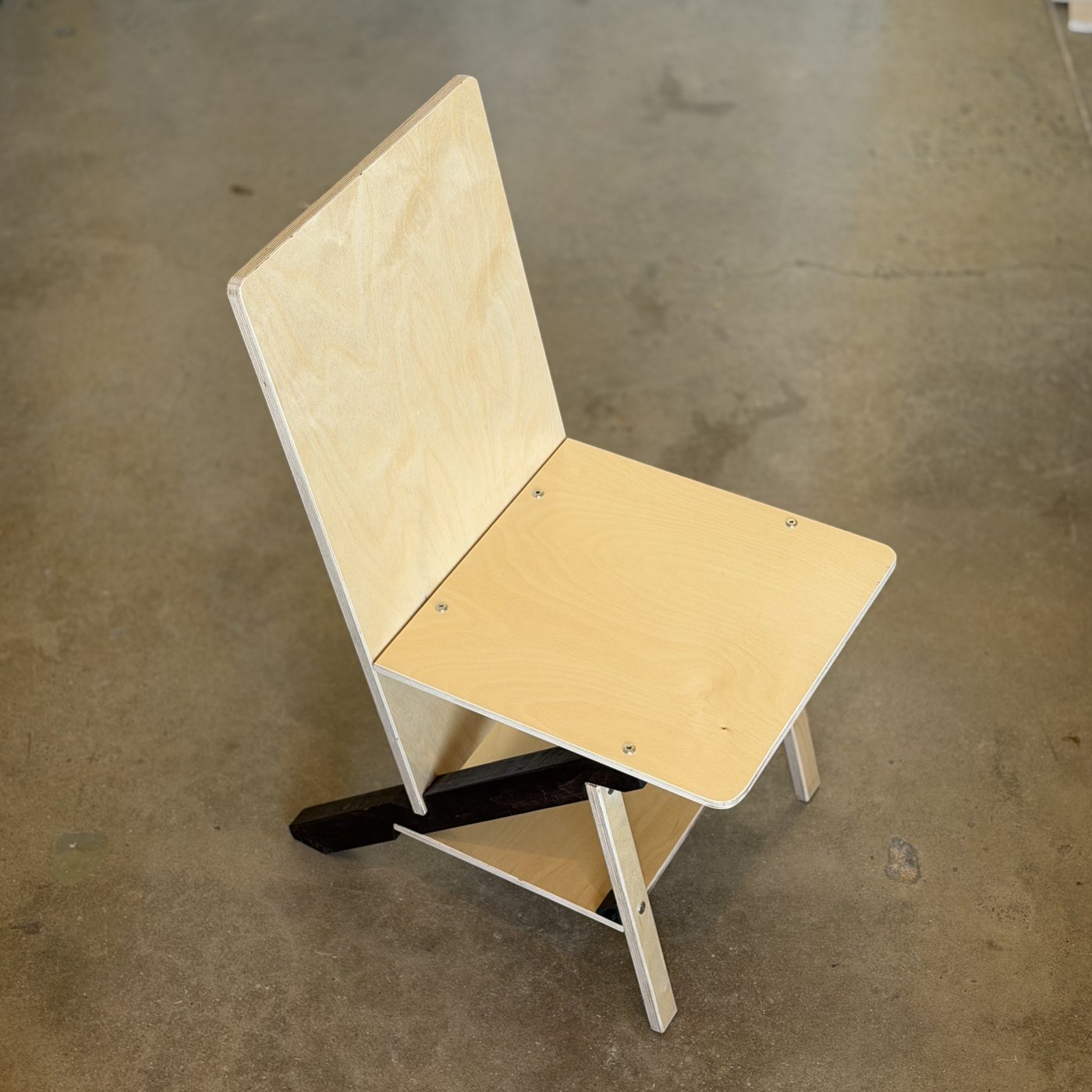
Six days later I rebuilt the maple chair into what I now call the production build. The maple keel is stained black. The tie went to twelve-millimeter stock, the seat was replaced, and the brackets became the extruded aluminum section with square nuts captured inside. It went together fast, and I did not have to think while doing it. It weighs 16.3 pounds against 17 before.
That evening I cut a pair of keels in cherry and built a chair that had not existed that morning. Every part was made to the drawing and then assembled. Nothing was fitted. No hole was reamed to meet another hole. No shoulder was pared back because the drawing and the wood disagreed. It went together in about five minutes, the first time that has happened in this project.
Until then I had cut close, offered the part up, found the half millimeter, and taken it out with a block plane. The chair came right because I was standing there to make it come right. That habit hid a question I could not answer while I was the one answering it: is the chair correct, or am I correcting it?
When someone else builds this chair, next year or in 2126, I will not be at the bench to take out the half millimeter. They will have only the drawings. Either the drawings are right on their own, so a stranger who follows them gets a working chair, or they only look like a chair and will not build into one. Cherry 1 is the first evidence they are the first kind.
A specification treats every line as equally binding. That claims more certainty than anyone has. There are three kinds of statement in the pattern, and they differ in how sure of them I am.
Some of it is fixed: the two triangles and the shared keel. Change any of that and you have a different chair, not a version of this one.
Some of it is recommended, and I mark my confidence. The posture is here: a seat about 440 millimeters high with 5 degrees of tilt, a back 15 degrees off vertical, a hundred degrees between them, and the 40, 60, 80 triangle those angles imply. I have checked the posture against the literature and against a good many bodies, and I will argue for it. A weaker claim, that a scribed frame goes together faster than a measured one, I believe and have not put a stopwatch to. I say so beside it.
The rest is flexible: species, thickness, finish, color, fasteners, the shape of the bracket, how the ends are cut. Every one of those has already changed at least once. Changing it again is using the pattern, not breaking it.
The habit of ranking the parts of a pattern by how sure of them you are I owe to Christopher Alexander. His A Pattern Language marks each pattern with the confidence that it names a real invariant.
This is why I keep calling it a pattern and not a standard. A standard is a set of orders, and orders last exactly as long as the body that enforces them. The institutions that would enforce a chair standard, the brands and factories and servers, are the very things I am betting will not be here in a century. A pattern needs no enforcer. It needs a reader, and readers keep being born.
For the same reason the pattern is published in full, free for anyone to build, sell, or improve without asking me. That is not generosity. It is the only way I know to store the thing safely. A drawing in my drawer has one copy and one custodian. A pattern people are building from has as many copies as it has builders, and each copy is a backup that keeps itself current. Rietveld put a chair in a Dutch magazine in 1934, and I built it from that sheet ninety-two years later. The experiment has already run.
Giving it away is a choice, not a limit of the law. Copyright does not reach the shape of a useful object, only the drawings and any ornament you could lift off and still have a chair. Under copyright the two triangles are already free to copy. A patent is a different matter. A mechanism that is new, useful, and non-obvious can be owned for about twenty years. I hold one myself, on the working part of an ice cream scoop. I could probably patent something in this chair. I have chosen not to.
A patent's whole effect would be to limit who may make the chair, and longevity wants the opposite. The more people who can build it, the more of them exist, and copies are what survive a century, not any one piece. Holding the design close would buy me twenty years of control at the cost of the chair's best chance of lasting.
Thonet is the case in point. His privilege on bending wood ran about a decade, and the tens of millions of copies came after it lapsed, when anyone could make them. What is finally at stake was never who owns the shape. It is whose description of the chair a stranger builds from: a question about a name and a record.
The appendix at the back of this book gives a full recipe: sections, thicknesses, a cut list, a fastener schedule. On the day you read it, it will probably disagree with the configurator on the website. The keel section may differ, and the panel thicknesses almost certainly will. That is not an erratum. The appendix is a body, frozen on the day the book went to press. That is what paper is for, and what paper is bad at. The website carries a body that still moves. The pattern beneath both has not changed since August.
To tell whether some chair a century from now is one of these chairs, do not measure it against the appendix. Lay a rule on it and ask whether it is two congruent triangles sharing a keel. The object answers that question with no website, no company, and no author to consult.
A week after I thought the book was finished, I built a second chair from the same scrap pile. It stands on the same two triangles and the same keel, with the apex moved from the seat to the arm. That single move makes a dining chair into a lounge chair. The two share no part, no species, and no dimension, only the triangles and the keel. They are plainly the same family, which I call Keel, after the member every version has.
I did not build it to prove anything. It became the best evidence I have that the pattern holds while the chair changes completely.
The pattern is what a stranger inherits. Writing it down does not, by itself, keep a chair alive. Someone has to want to build it, and be able to afford to. What a chair costs to make, and who ends up paying, is the next chapter.
The two triangles, the four numbers, and the rounding are established in the chapter First Principles: Two Triangles and in the appendix; this chapter does not re-derive them. The five phenotype changes and the quoted note on the apex are from my scratch pad of 31 August 2026. The chair weights, 23.3 and 17 pounds on 31 August and 16.3 after the production rebuild, are my own scale readings of 31 August and 6 September. Cherry 1, assembled the evening of 6 September, is my report of 7 September: every part made to the drawings and then assembled, no fitting, about five minutes. The chemistry set is my own account, first told in the retired chapter Messing Around: a Christmas gift the year I was eleven, university-surplus glassware and a hot plate built from an upended clothes iron. The confidence ranking is after Christopher Alexander, Sara Ishikawa, and Murray Silverstein, A Pattern Language (Oxford University Press, 1977), which marks each pattern with how sure its authors are that it names a true invariant. American copyright does not reach the utilitarian form of a useful article: 17 U.S.C. 101, and Star Athletica, L.L.C. v. Varsity Brands, Inc., 580 U.S. 405 (2017). A utility patent is the separate regime: it can protect a new, useful, and non-obvious functional design for a limited term, roughly twenty years from filing under 35 U.S.C., and the author holds one on the working geometry of the Belle-V ice cream scoop (US 9,173,527 B2). The choice not to seek patent protection for the chair is the author's own. The scoop's patents are treated in the chapter Aesthetics, Style, Memphis. Thonet's bentwood privilege and the later scale of copying are given in full in the sources to the chapter Chaironomics. Rietveld's 1934 crate chair and the ninety-two-year interval are established in the chapter The Search.
A chapter of The Hundred-Year Chair, drafted and refined in public. The same text lives in the book; the interactive tools and the fully-sourced technical notes live here. home · the book · the technical notes · hundredyearchair.com