The Hundred-Year Chair · a chapter
Coda: The Keel of Theseus
There is an old puzzle about a ship. A vessel is repaired at sea over many years, one rotten board swapped for a sound one, then another, and another, until not a single original plank remains. Is it still the same ship? Philosophers have argued the ship of Theseus for two thousand years and mostly treated it as a paradox. Boatbuilders never did.
In a working yard a hull is replanked strake by strake across a century, and no one on the dock imagines a new ship has quietly appeared in the old one's place. The vessel stays the vessel so long as one thing runs on beneath all the changing wood: the keel. It is the first timber laid, the backbone the whole hull is scribed to, the datum every later part is fitted against. Replace every plank twice over and the ship your grandchildren sail still runs on the keel it was born with. That keel still carries, in its own long line, every dimension the next set of planks will have to meet. A ship of Theseus with a persistent keel is not a riddle. It is maintenance.
That is the whole book in one image, and I did not plan it. I set out to build a chair a stranger could keep rebuilding. It took me a long while to see that I had been describing a keel the entire time.
The atom that is the information
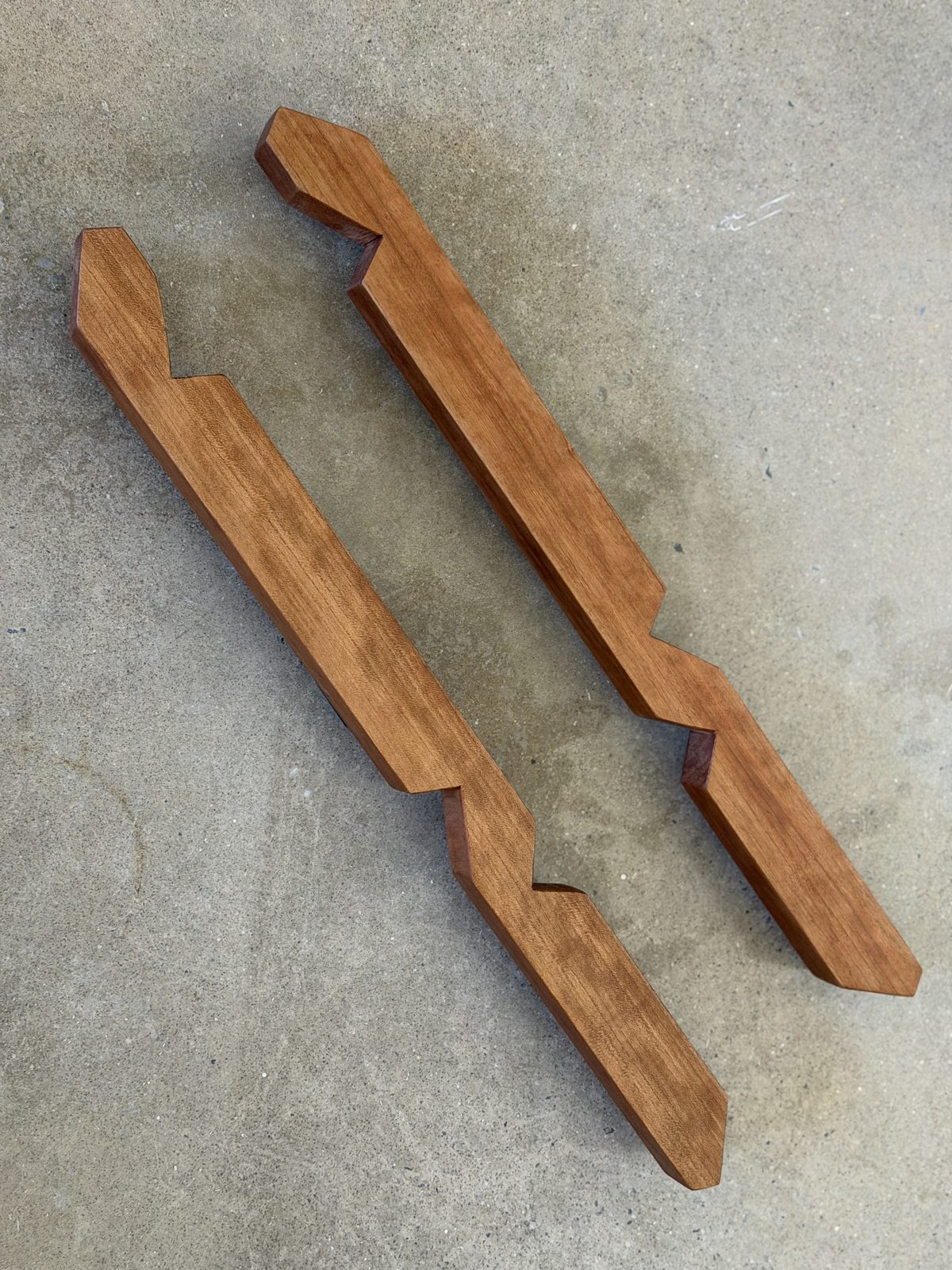
The chair carries all of its geometry in a single hardwood member. Every panel lands on a fish mouth cut into that one stick, so the keel is structure, datum, and drawing at once. The panels are plywood, and plywood has no hundred-year record. That looked at first like a disqualification and is the opposite. Divide the chair into a durable datum and replaceable skins, and the puzzle dissolves the way it always dissolved on the water. Replace the panels twice in a century and the chair your great-grandchildren sit in still holds the original keel. The keel still holds, cut into its own faces, every measurement needed to make the next set of panels. There are two known ways to make a wooden thing last: keep the original atoms, as an ancient temple does, or keep the information and let the atoms be consumables, as a shrine rebuilt every twenty years does. The keel is both in one part. It is the atom that is the information.
The forward version got its first test in the shop. It was mundane. The maple chair was one week old when I stained its keel, replaced its tie and its seat, swapped all four of its brackets and put it back together in an afternoon. Nobody thought a new chair had appeared. It is the same chair, lighter by seven tenths of a pound. The keel it was born with still carries every station the next set of panels will have to meet.
For a while I thought that was the answer. But a keel is only wood, and wood burns and floods and rots like any other. If the argument depended on this particular stick surviving forever, I would have smuggled the old fragility back into the keel and called it a solution.
So the keel is not quite the point either. What actually persists is not the stick but the idea the stick holds: the posture the body demands, the two triangles that cannot rack, the practice of striking every station from one end so that error never accumulates. That idea is what I have called the chair's genotype. It is the thing truly laid first. A stranger with that idea and a fresh length of oak can lay a new keel, and from it scribe a new chair, without me, without a factory, without a drawing on some server that stopped answering decades ago. Identity does not even require the first keel to outlast the century. It requires only that the idea be legible enough to read off the object, and the object lovable enough that someone bothers to lay another.
I did not expect to test that claim inside the covers of this book, and I did not expect to be the stranger. But that is what the chapter before this one records: the idea laid down a second keel, in a second body, a week after I thought the book was done, and the identity held. The popsicle chair shares not one part, not one dimension, not one joint with the keel chair. It shares three words, two congruent triangles sharing a keel, and anyone who has read this far can pick the two out of a room as siblings. That is the ship of Theseus run the other way. The puzzle asks whether a ship stays itself when every plank is replaced around its keel. The second chair asks whether an idea stays itself when everything is replaced, keel included. The answer on the shop floor was yes. What persisted was not even the longest-lived part. It was the thing the part was for.
The second chair also taught me, by hand, what the word I had chosen for this coda actually means. Take its keel out and the other four members close into a loop that lies flat on the bench, a parallelogram with one degree of freedom, a hinge and not a chair. Fit the keel and both triangles close at once. On the water the keel is laid first. On my bench it is pinned last, and the chair is flat until it is in. The keel is the only member that belongs to both triangles, which is to say it is where the idea lives in the wood. And the idea does not care what the wood is. In the thousand-year edition the durable part is a bronze bracket with the numbers cast into its face. In the popsicle chair cut from white oak and pegged with oak, which I have already caught myself sketching, there would be no metal in it at all and the numbers would ride in the proportions. Either way the atoms are the century's business and the information is the chair's.
What lasts is a practice, not a part
I wanted a chair that strangers could keep rebuilding after its maker, its manufacturer, its website and its original materials were all gone. What survives all of that is not much. It is enough.
The panels wear out. The pegs are meant to be driven out and renewed. The keel is the longest-lived part and not an immortal one, and I go before any of them. So the thing built to last is not a part at all. It is a practice: the habit of rebuilding the chair around something laid first and never argued with.
That is why the three properties are the whole engineering of it. Lovable, so that someone in a hundred years wants to keep the chair alive, because desire is what funds the next repair. Legible, so that a stranger can read the idea straight off the wood and know where the lines go. Maintainable, so that acting on what they read is within reach of ordinary hands and ordinary stock. Get those three and the chair does not survive, exactly. It persists, which is the better word. Survival is a single object running down toward its failure. Persistence is renewable, a thing remade faster than it can decay.
This is not only a law of chairs
I did not expect a chair to teach me anything about buildings. The argument would not stay in its lane. Stewart Brand wrote a book called How Buildings Learn about why some buildings thrive across centuries and others are torn down young, and his answer is the keel's answer in a larger coat. The buildings that last, he argues, are not the grand, finished, perfectly resolved ones, the showpieces that admit no change. They are the ordinary, adaptable buildings that can be modified without a fight, knocked through and re-fitted and repurposed by each generation into whatever it needs, a warehouse become a studio become a home. A building persists by being kept up and changed, not by being frozen, and its fast-changing layers, the fittings and the walls, have to be free to move without disturbing its slow ones, the structure and the site. Brand is not shy about specifics, either. He calls brick a superlative material, eight thousand years of fired clay, near enough to fireproof, cheap to keep up with a little repointing across a lifetime. Tally what actually survives and the survivors are disproportionately masonry. He does not mean brick is the one right answer. He means it is a very good one, held with high confidence, which is about the most any maker can truthfully hand the future. That is the keel and the panels again, at the scale of a city block. The same law runs through institutions, which outlive their founders only when they are built to be revised rather than merely obeyed. What lasts, everywhere I have looked since, is never the thing. It is the practice of keeping and adapting the thing. It does not surprise me that Brand also helped found the Long Now Foundation, whose ten-thousand-year clock I leaned on a few chapters ago. He has spent a lifetime on this one question, at every scale from a wall to a civilization. The chair turns out to be the same question, small enough to hold in one hand.
Did I solve the scrap problem?
This chair began as an answer to a plain industrial problem: the offcuts that come off our saws at MakerStock, something like a twentieth of a large volume, the sub-foot pieces nobody can bring themselves to throw away, accumulating faster than any give-it-away program can move them. So a coda owes an accounting, and the first draft of this one, written in the last week of August, gave it straight: I did not solve it. I may have done the opposite. The keel chair needs a panel four hundred millimeters wide, which is not scrap. If it works we sell more material to build it, and more material means more offcuts, and I will have designed a rather elegant machine for producing exactly the scrap I set out to consume. That is the kind of joke the physical world likes to play on anyone who thinks he has closed a loop.
I left that paragraph standing for four days, and then the second chair arrived and made me revise the verdict without touching the joke. The verdict now reads: not with the first chair. The popsicle chair is built from the bin. Its widest piece is a hundred and forty-three millimeters, every stick in it is a strip we would otherwise have tucked into a customer's order or thrown away, and the first line of its cost ledger, in my own hand, is "Material $0." On the day I finished it I wrote, "This chair will eat our scrap," and I believe that sentence as far as it goes. It does not go all the way. The scrap problem, as an industrial problem, is a flow, so many offcuts a week for as long as the saws run, and no object solves a flow. The pile will outproduce any chair the moment the chair stops selling, and a chair that sells well enough to matter starts wanting material of its own. What the second chair did was smaller and, I think, better. It turned the offcut from a disposal problem into a raw material with a design waiting for it. And it kept the promise the founding message made, "beautiful mosaics made of otherwise scrap material," which the first chair could not. I did not solve the scrap problem. I found the chair that wants the scrap. Those are different achievements, and I spent a month confusing them.
There is a room in our Old Forge warehouse that answers this for me. The employees call it, not unkindly, Karl's Land of Misfit Products, after the island where the unwanted toys wash up in the Christmas special. It holds the residual inventory of everything I have designed and launched over the years: leftover Xootrs, odd Belle-V pieces, unsold Xpults. It is the remainder of a working life spent bringing objects into the world and learning that the world wanted slightly fewer of them than I made. It is a humbling place to stand. And I have no illusion that either chair is exempt. Somewhere on those shelves there is very likely a future stack of chairs, or of keels, or of ten-stick kits, waiting on a demand that came in under forecast. A hundred-year chair is no proof against a slow quarter.
But that room is also where the point of the whole book comes clear, by contrast. The Land of Misfit Products is a graveyard of things that could not find a second life, overstock with nowhere to go, next year's scrap in waiting. The keel is the one thing on my bench designed for the opposite fate. It is not built to sit on a shelf hoping to be wanted once. It is built to be wanted again and again, laid down and rebuilt around, its members recut from whatever stock the century has lying about. In the second chair that stock is the warehouse's own waste. I have come to suspect that the scrap problem cannot be solved by making more objects. The second chair does not contradict that so much as show the one exception the rule allows: an object whose raw material is the leftover of making everything else. What I may have done, if I am lucky, is make two bodies of one idea whose highest use is always just to go on being themselves, and so the rare things that never quite arrive in the Land of Misfit Products, because no one is ever finished with them.
The chair I could not make lovable
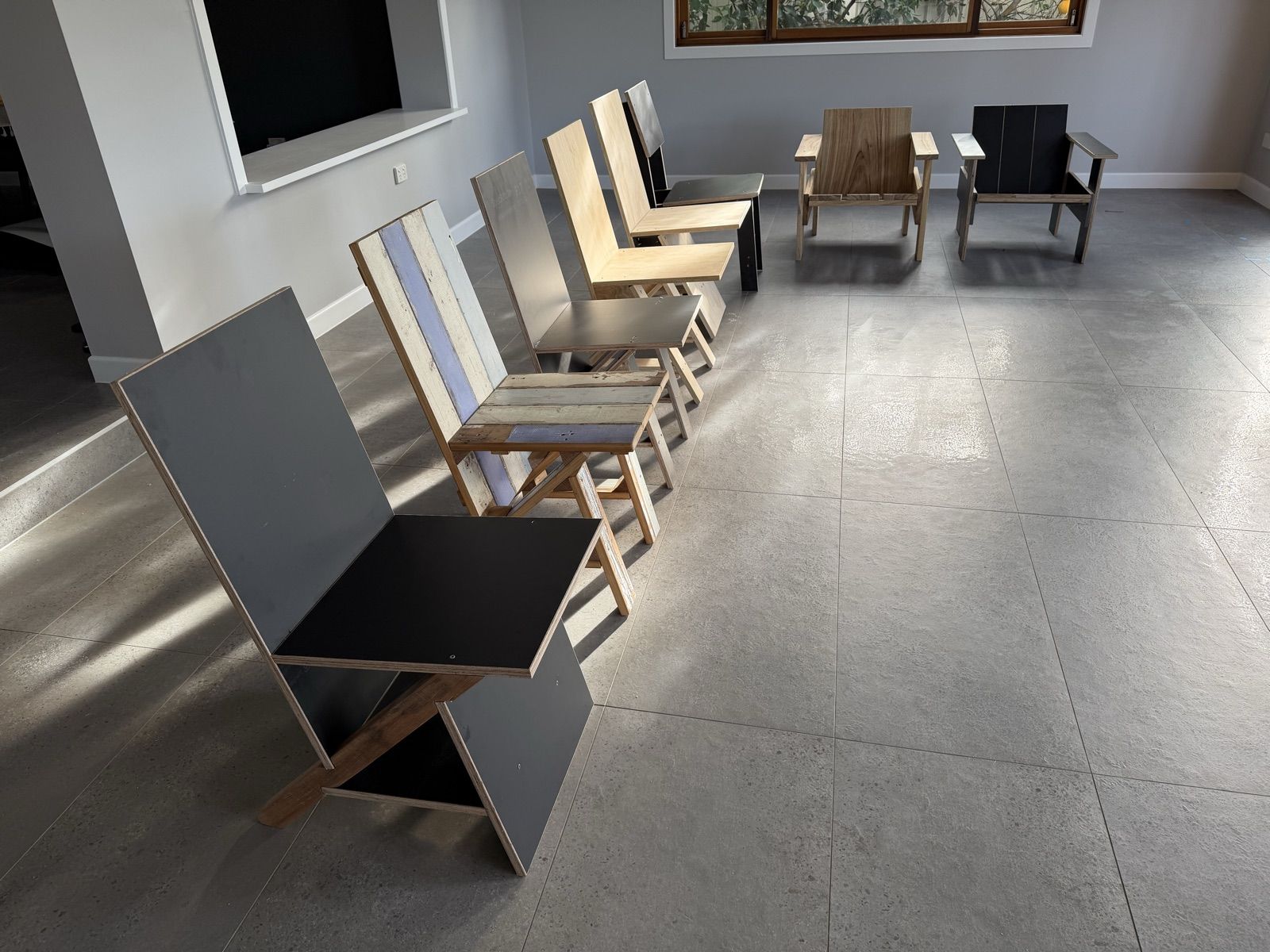
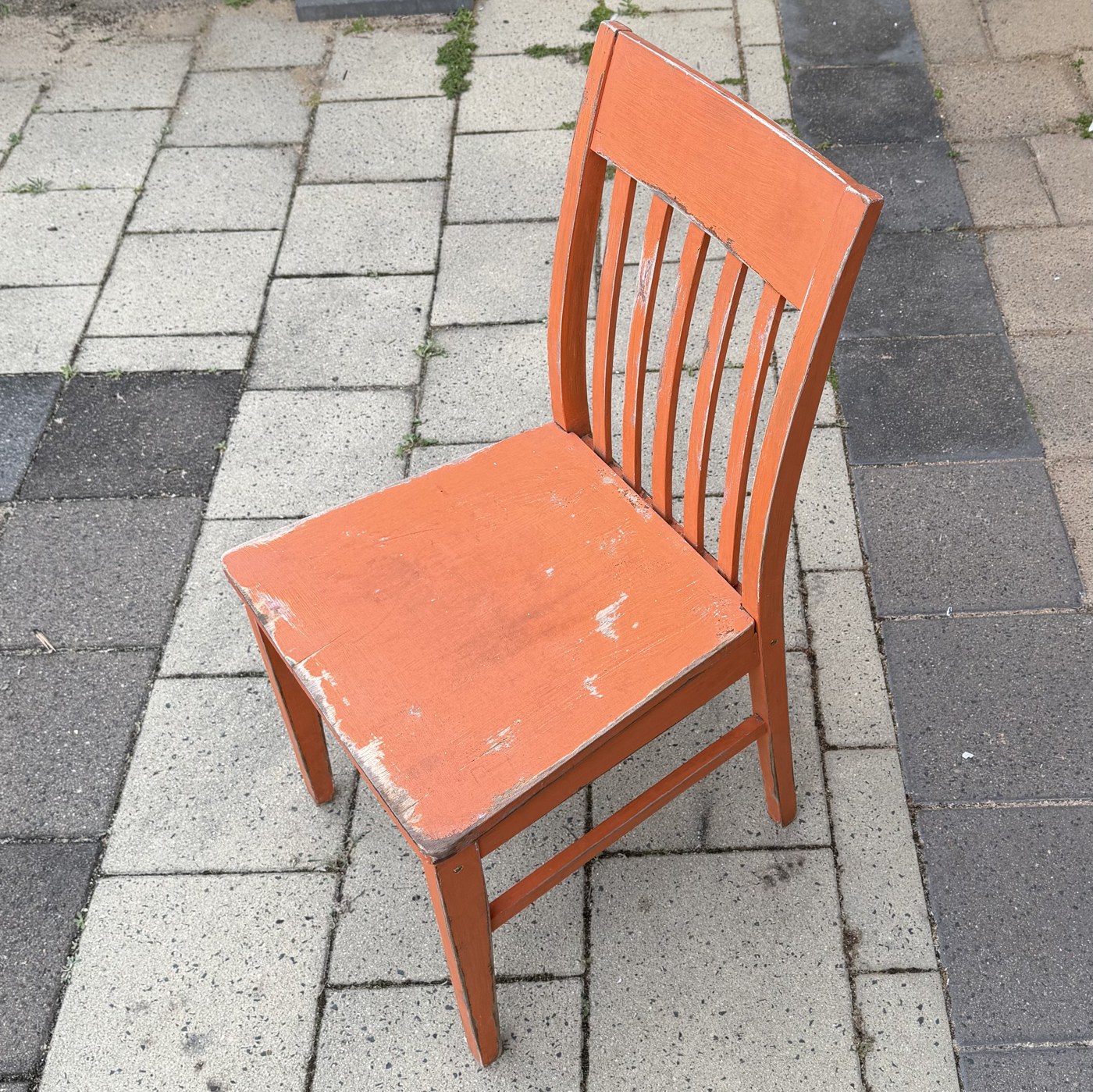
I tested this whole argument, without meaning to, on a chair that is not mine. While I was finishing these chapters I found an orange library chair set out on a verge fifty meters from my door, and because I cannot walk past a good object left for dead any more than my father could, I carried it home. The chapter How Long Is a Hundred Years? left it on the bench with a prediction attached: legible, maintainable, and probably not lovable enough to earn a place in the house.
I cleaned it up and went looking for its history. The orange is the last coat and not the first: where it has chipped along the top rail there is something paler underneath, blue- gray in the deepest chips. Under the seat there is a stamp reading MADE IN AUSTRALIA. The joints are machined pocket slots. The fasteners are Phillips heads with a few socket heads among them, which puts a floor under the build somewhere in the late 1930s. The Phillips drive patent issued in 1936, and by 1940 most of the American screw industry was licensed to make it. When it reached Australian furniture shops I could not establish, so post-war is my reading of the odds rather than a proof. I went through newspaper furniture advertisements from 1956 and found the vibe without finding the chair. The design is vernacular enough that a search like that was never going to converge on a year.
I took the top rail of the back down to bare wood to read the grain. An LLM proposed silky ash. No Australian timber is sold under that name. There is silver ash, and there is silky oak, and the name looks like a splice of the two. Silky oak is known for a bold ray fleck across the quartered face and this wood has none. It is a fine, even, dense-pored hardwood I cannot put a name to.
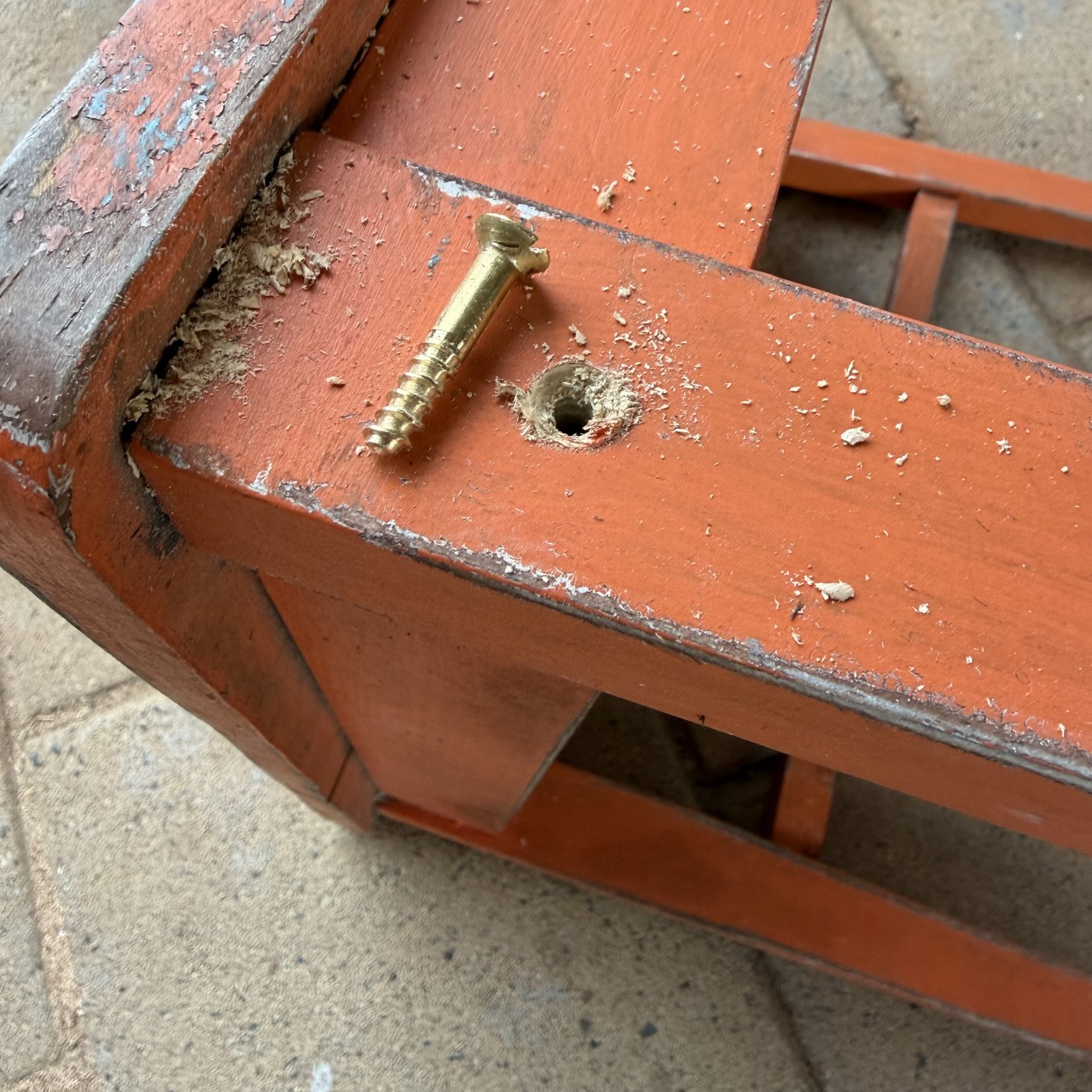
Otherwise the chair was sound. One screw on the underside had stripped out the wood around it, so a larger stainless one went in its place. The seat-to-back joint had a little wobble, so I added a brass wood screw through the back leg and into the joint on each side. One of the brass screws snapped off, as brass will, and I nudged another in beside the broken tip and left the tip in the wood.
Then came the verdict, and it was not the one I predicted. The chair did not clear the bar for the house. It cleared a lower one. It went out to the shop and displaced a green one-piece injection molded deck chair, a monobloc by another name. I count that an upgrade. It has already been a step stool once, holding me up while I went after a ceiling outlet that had stopped working. It has a job.
I catch myself planning things for it. Paint it white and Pollock it. Lay down a neutral ground and put my ambigram on the seat back. A chair you find on the street sets a low bar, and every year past the verge is clear profit. It lives to see another one.
The prediction was right about the house and wrong about the outcome. I had been measuring against the wrong bar. Adoption into the parlor is one route to a second century, and the orange chair took the other one, the route most surviving furniture has actually taken, which is to make itself useful to somebody who already has it.
That is the humility under all of this. I can lay a keel a stranger can read. I can make a chair a stranger can fix. I cannot make a stranger care, and neither can you, and the century turns on exactly that ungovernable thing. What the orange chair added is that caring is not the only mechanism, and the others are no more mine to arrange. The K itself might end its days on a shelf in the Land of Misfit Products beside the leftover Xootrs, wanted once and then not. All I can do is make it as worth keeping as I know how, lay the idea down where it can be read, and leave the rest to whoever finds it worth laying down again.
Now that the orange chair is written down here, I may have a hard time taking it to the dump.
What the century carries
I will not be there to lay the next keel. That was the condition from the first page: the design cannot depend on me being in the room, or it is already mortal. If the chair works as I hope it does, then a stranger I never met, holding a chair I never touched, made of wood I never saw, will set a fresh keel on the bench, strike one line from one end, and know exactly what to do next. Whether the two triangles meet at the seat or at the arm, whether the joints are bronze or oak pegs or whatever the century keeps in a jar, whether the keel is quarter-sawn white oak meant to last outright or a strip from a bin meant to be replaced, the chair under their hands will be mine and theirs and no one's in particular, the same way the ship on the water is still, against all the arithmetic of replaced boards, the ship.
That is the only kind of hundred years I know how to build toward. I would rather build toward it in the open, and hand a stranger a keel and an idea and a reason to bother, than promise a single plank that lasts and be wrong about the plank. A chair is a small thing to ask a century of, and I have spent a book asking. But the century was never going to be carried by the wood, and it was never going to be carried by me. It was going to be carried by whoever, long after both of us are gone, still thinks the chair is worth laying down again.
For sources, citations, and the technical notes behind this chapter, see hundredyearchair.com.
A chapter of The Hundred-Year Chair, drafted and refined in public. The same text lives in the book; the interactive tools and the fully-sourced technical notes live here. home · the book · the technical notes · hundredyearchair.com