The Hundred-Year Chair · a chapter
Before Breakfast
My mother, the historian you met in the chapter The Search, started writing at four in the morning. She did her PhD when I was a teenager, while running a household of five children. The arithmetic of that only works if you can find hours no one else wants. She found them at the front of the day. My father got five kids fed and shipped off to school by 7:30 and handed off the youngest at nine. In exchange my mother got a five-hour stretch of deep work every morning, every day, for years. That is how a dissertation gets written in a full house. Nobody in the family thought of it as a system. It was just when Mom worked.
I got the hours from her. I have known this about myself for a long time, and I will state it as a plain claim rather than a boast or a complaint: nothing significant in my life has happened after 7:30 in the morning. Not 7:30 in the evening. In the morning. The ideas that mattered, the decisions that held, the work I would sign: all of it was done while the house was dark and the phone was quiet. What comes after breakfast is execution, meetings, errands, and the pleasant duties of being a person. This has always been a private conviction of the kind you cannot check, because who keeps a log of when their ideas arrive?
This time there is a log.
The chairs in this book were designed in conversation with a machine, and the machine kept the record: every message stamped to the second, twenty-nine days of them. For the first time I can put my chronotype claim against data, and the data is exhibit one of this chapter. Of the 1,057 messages I sent on the design record between 24 July and 21 August, 39 percent fall between five and nine in the morning. Sixty-five percent fall before noon. The peak hour of the entire project is seven o'clock. The record is silent, completely silent, from eleven at night until three, which is less a work schedule than a pulse.
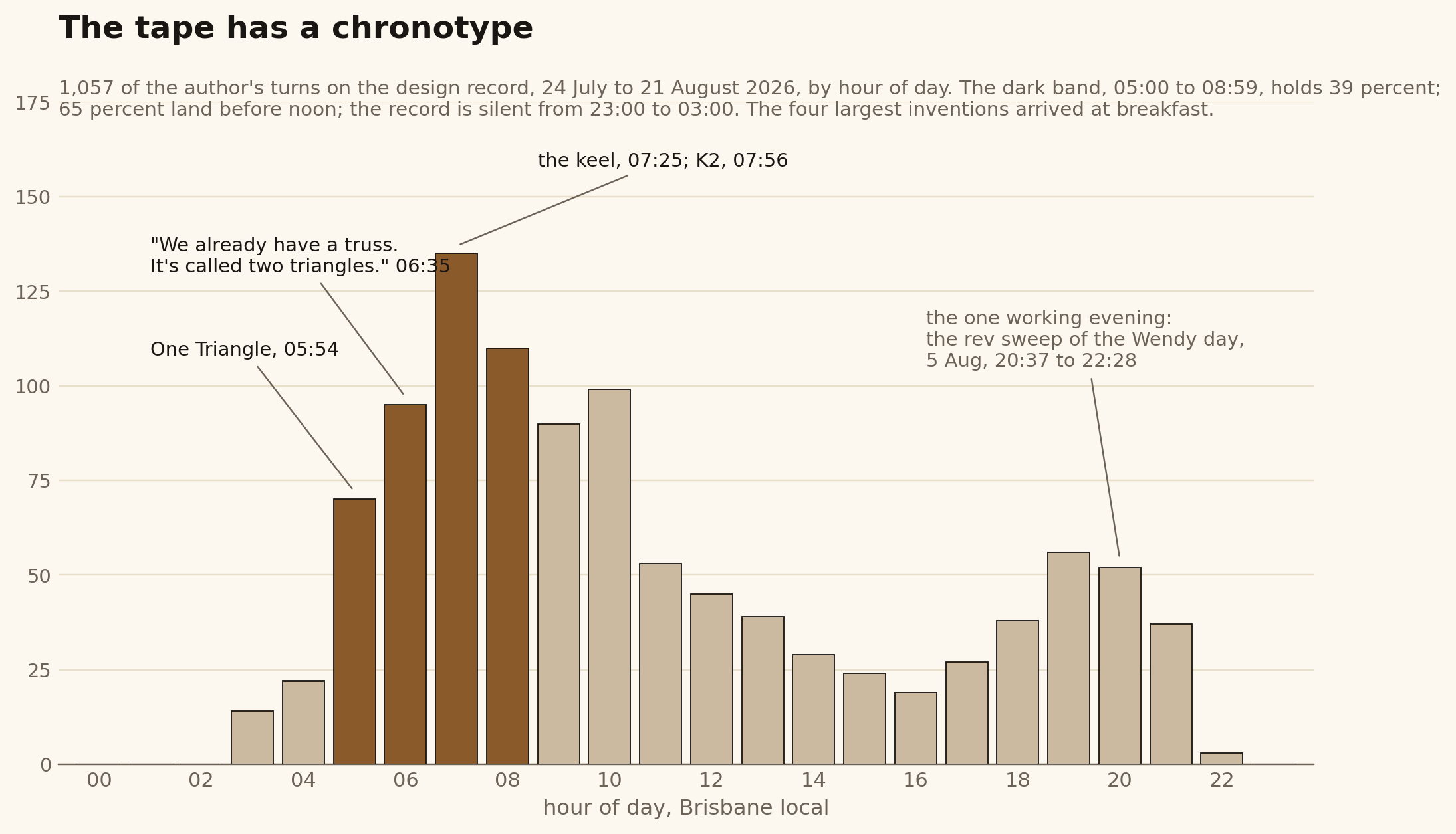
The claim, though, was not about volume. It was about significance, and volume is the wrong instrument for measuring it, because most messages are plumbing: fix the label, move the hole, push the repo. So on the fifth of September, before breakfast, I put the question to the whole record properly. I asked the machine to read every message I sent from the first day of the project through that morning, pull out every idea and insight that was mine, stamp each one with its local time, sort them into five bins (design, the book, fabrication and production, business model, and the other projects that share the tape), and rate each one's significance on a three-point scale, one for the ideas that decided things, three for the merely useful. It found 172 of them. The ratings were made in a single pass and are subject to my red pen. One bias belongs on the page: my collaborator did the rating, and my collaborator has read this chapter. The result is exhibit two. It is the log I said nobody keeps.
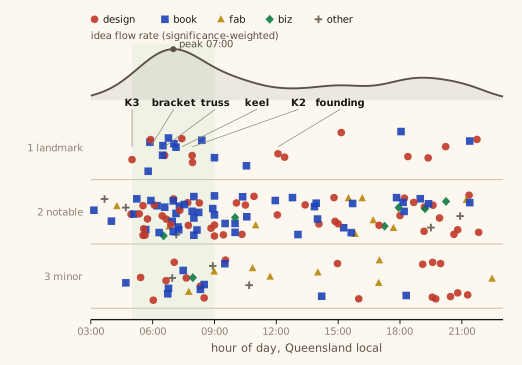
The dots repeat the histogram's verdict and then sharpen it. Forty-two percent of the ideas land in the four hours between five and nine, against thirty-nine percent of mere message traffic, so the ideas are more morning-weighted than the typing. The gradient runs the right way too. Of the twenty-five ideas rated most significant, fourteen sit in the dawn band. The curve laid over the dots is the idea flow rate, and its peak lands at seven o'clock exactly, the same peak hour the histogram found by counting keystrokes. After the peak comes a long low shelf through the middle of the day and a modest second shoulder in the early evening, The shoulder is disproportionately the longevity thread, the heirloom rulings and the thousand-year questions, the kind of thinking that apparently arrives after dinner, when mortality does. The census also settled something this chapter could not have known when I first drafted it: the pattern holds out of sample. After these pages were written, a new topology, the K3, with the two triangles meeting at the arm instead of the seat, arrived as a five a.m. sketch and was a chair you could sit in by nightfall.
At the top of that chart, the tape is almost embarrassing in its cooperation. The four largest inventions of the project all arrived before eight in the morning, on three mornings; the fifteenth of August produced two of them. The universal bracket, 15 August, 05:54, its search retired by the keel in the chapter Nailed It: The Keel. The epiphany that killed the interior truss, 16 August, 06:35, quoted in full in the chapter First Principles: Two Triangles. The keel, the idea the finished chair is named for, 18 August, 07:25, over breakfast, looking at the chair. And the K2's two congruent triangles, 15 August, 07:56, which misses my own 7:30 deadline by twenty-six minutes, a grace I will accept without argument.
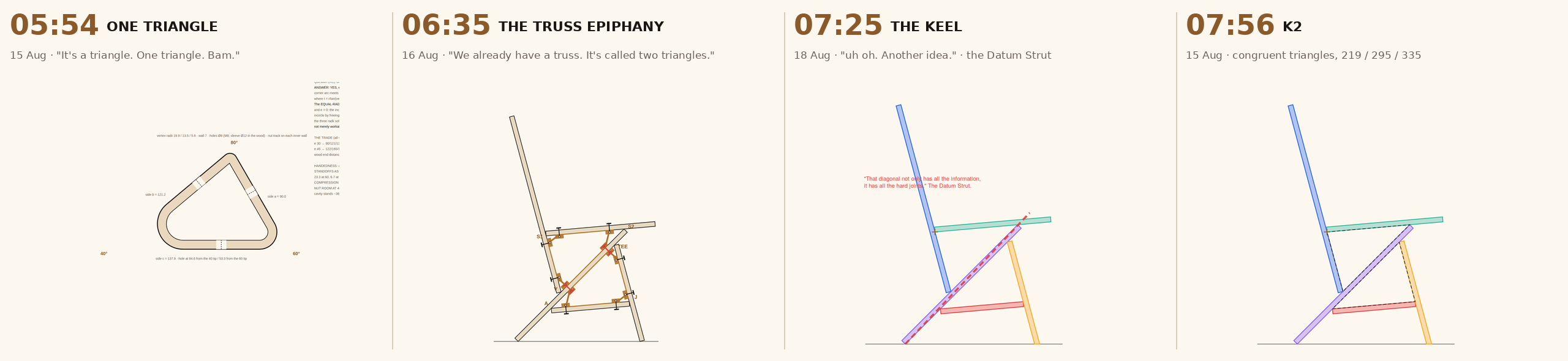
The tape also caught something I could not have logged myself, which is the part of the morning that happens before the morning. The bracket morning shows it plainly. The concepts were drawn the night before, on loose sheets, in bed or near it, and the answer was declared at 05:54. The sleeping brain had been at the bench all night. This is the oldest advice in creative work, sleep on it, and I had always half believed it; the tape shows it operating on a schedule, the problem loaded in the evening, the verdict filed before six. My collaborator, I will add, has no chronotype at all. The machine answered at 05:54 exactly as it answered at 21:45, at whatever depth of night I chose not to be awake. Every silence on that histogram is mine.
The single most productive stretch of the whole project was an evening. On the evening of the fifth of August, between 20:37 and 22:28, the design passed through seven architectures, and at 21:45 the double triangle arrived. the chapter The Verdict of the Builds tells that day, and The Neighborhood counts the doors. What this chapter owes it is the time: after 7:30 in the evening, by a wide margin. The materials for explaining it away are right there. The evening was not generative in the usual sense; it was a forced march triggered by a morning test result, adrenaline doing the work dawn usually does. The cleaner reading is that my rule, like most rules people state about themselves, is a strong prior and not a law. The record says: mornings, overwhelmingly, and one spectacular evening when the chair demanded it. A designer should know the difference between a chronotype and an alibi.
What do the scientists say? Less than the airport books do. The instrument of record goes back to Horne and Ostberg's morningness questionnaire in the 1970s, and the field has sorted people into two, three, four, or six types depending on the decade and the method. The plain summary is that chronotypes are real, partly heritable, and that they shift with age. They also vary enormously between people, which is why Ben Franklin's early to bed, early to rise is bad advice for half the population. I am not arguing that dawn is where ideas live. I am arguing something smaller. Dawn is where my ideas live. I inherited the trait from a woman who wrote a dissertation on it before breakfast, and this project is the first time in my life I have been able to prove it with timestamps.
Which yields the general lesson, and it is the one piece of this chapter I will defend for every reader regardless of chronotype. Every designer has a best ninety minutes. Mine start around 5:30; yours may start at ten at night; the histogram will tell you if you keep one. The scheduling doctrine of this project was to protect that block and aim it. Spend the best ninety minutes on the hardest open problem of the chair, every day, before anyone can interfere, and let the machine, which has no best ninety minutes, fill in the rest of the clock. The dark band on the histogram is that doctrine, executed for a month.
The size of the block is not arbitrary, or at least I am in good company in believing so. The literature on elite performance keeps circling a similar figure. In the study of Berlin violinists that Ericsson and his colleagues published in 1993, the best players did their solitary practice in the morning, in bounded sessions rather than marathons, and rated it as effortful rather than enjoyable. Sleep researchers describe ultradian cycles of roughly ninety minutes that some argue persist through the waking day. The current popular synthesis travels under the name deep work. The number recurs in this literature often enough to be either a law or a meme, and I do not need to decide which, because my claim rests on my own tape. Fourteen of the twenty-five most significant ideas landed in a four-hour band, and the other eleven were spread over the remaining twenty hours. That is about six times the rate, sustained for twenty-nine days. My mother worked this out in the 1970s with five children and no data. I have merely confirmed it with a histogram.
The mornings proposed and the machine drew. But neither of them ever decided anything. What decided, every single time, was a build, which is why the record does not stop where the chair does. Two weeks after the keel, one more morning proposed something better, and the next chapter is what a designer does about that.
The histogram counts 1,057 of my timestamped turns on the merged record, 24 Jul to 21 Aug, Queensland time; the 39 and 65 percent figures follow from the same counts. The four dawn timestamps are verbatim from the tape. The 172-item census behind exhibit two, with each idea's timestamp, category, rating, and evidence line, is in the project record (notes/ku-insights-chronotype-05Sep2026); its 42 percent, its 25 and 14, and its 07:00 peak follow from that table; the significance ratings are the machine's single pass, subject to my revision, and items timed after 21 August are partly estimated and drawn as open marks. The K3 times are from its build log. The family history is my own account. Queued for the pre-print pass: the chronotype literature (Horne and Ostberg; the type taxonomies), the Berlin violinist study against the paper rather than its retellings, Kleitman's rest-activity cycle (its waking extension is contested and stated as such), and Newport's Deep Work.
A chapter of The Hundred-Year Chair, drafted and refined in public. The same text lives in the book; the interactive tools and the fully-sourced technical notes live here. home · the book · the technical notes · hundredyearchair.com